
Trump Shocked by Iranian Retaliation
The U.S. President admitted to being taken by surprise by Iran’s retaliatory strikes, as the country targeted even its neighboring nations.
“Nobody, including the greatest experts, could have expected them to attack. Those countries are not close allies, but they aren’t enemies either. They have lived next to each other for many years,” President Donald Trump told reporters at the White House on March 16.

The U.S. President made these remarks when asked if he was surprised and had not been forewarned about the risk of Iran attacking neighboring countries when the conflict broke out.
He admitted he “was shocked” that Iran reacted so aggressively. “The United Arab Emirates (UAE) is like Iran’s bank. Qatar is a neighbor and once had a fairly stable relationship. Then there is Saudi Arabia, Kuwait, and Bahrain. No expert said this scenario would happen,” he said.
Rebuffed by allies, Trump now says U.S. doesn’t need help defending the Strait of Hormuz
However, a U.S. official and two sources familiar with intelligence data revealed to Reuters that President Trump had long been warned about the scenario of Iran launching retaliatory strikes across the Gulf. They said many pre-war intelligence assessments included this scenario on the “list of probable occurrences.”
According to the two sources, Mr. Trump was also briefed on the risk of Iran blockading the Strait of Hormuz after the U.S. and Israel launched their airstrike campaign.
On the same day, CNN cited sources familiar with the matter revealing that American, European, and Asian diplomats are increasingly frustrated because the Trump administration has not made efforts toward dialogue to find a way out of the conflict.

They contend that Washington is not fully utilizing traditional diplomatic channels, including international mobilization efforts to clear the Strait of Hormuz. No U.S. official has yet emerged in a leadership role to guide the dialogue aimed at restoring the strategic maritime route.
Secretary of State Marco Rubio is reportedly involved in related activities, primarily in his role as acting U.S. National Security Advisor. Nevertheless, the dialogues between the U.S. and its partners have not yet been effective. “The U.S. could achieve more positive results if it intensified diplomatic engagement,” a European diplomat observed.
After the U.S. and Israel launched their offensive campaign on February 28, Iran retaliated by launching missiles and drones (UAVs) into Israeli territory, U.S. bases in the Middle East, and critical energy infrastructure in several Gulf countries.
Rebuffed by allies, Trump now says U.S. doesn’t need help defending the Strait of Hormuz
The Strait of Hormuz, through which 20% of the world’s oil and liquefied natural gas is transported, remains almost completely blockaded, causing energy prices to climb and sparking concerns about inflation.
Many experts have long warned that Iran is prepared to attack regional nations—particularly those that allow the U.S. to deploy bases on their territory—if conflict breaks out. Tehran has also repeatedly declared that any Middle Eastern nation with ties to Washington is a potential target.
——————————
‘Not our war’: U.S. allies balk at Trump’s Strait of Hormuz demands
Many European governments expressed reservations Monday about providing military support to reopen the crucial waterway.
LONDON — President Donald Trump has berated and threatened America’s NATO allies. Now he wants these same countries to help unblock the Strait of Hormuz — and their response has not exactly been enthusiastic.

“This is not our war, we have not started it,” German Defense Minister Boris Pistorius told reporters Monday.
That appeared to sum up the mood among U.S. allies, with leaders from Berlin to London expressing reservations about Trump’s demands and indicating they had no immediate plans to provide military support to reopen the crucial waterway.
Rebuffed by allies, Trump now says U.S. doesn’t need help defending the Strait of Hormuz
SAVE America Act is ‘No. 1 priority,’ Trump tells Republicans
Iran effectively closed the trade route in response to the American-Israeli assault launched last month. This sent global oil prices surging and threatened an international economic shock, something economists had warned about before the war began.
Trump called upon “countries of the world that receive oil through the Hormuz Strait” to “take care of that passage,” as he put it in a post Sunday on Truth Social. In an interview with the Financial Times the same day, he went further, warning that NATO would have a “very bad future” if its members did not help free up the strait.

It was “a bit rich” for Trump to be asking help from countries he had previously insulted, former Estonian President Toomas Hendrik Ilves told NBC News in a telephone interview Monday.
Earlier, Estonian Foreign Minister Margus Tsahkna called on Trump to provide more information. Europe needed to understand Trump’s “strategic goals. What will be the plan?” he asked.
Though often wary of risking the president’s ire, many European governments have been reluctant to be pulled into the war with Tehran.
Some, such as the leftist government of Spain, outright refused the Hormuz demand.
“Spain will never accept any stopgap measures” to keep the strait open, Defense Minister Margarita Robles said, “because the objective must be for the war to end, and for it to end now.”
Even in Italy, whose Prime Minister Georgia Meloni has previously cast herself as something of a Trump whisperer, the government declined to get involved.
Rebuffed by allies, Trump now says U.S. doesn’t need help defending the Strait of Hormuz

Foreign Minister Antonio Tajani told reporters that “diplomacy needs to prevail.”
In Britain, Prime Minister Keir Starmer has been criticized by Trump for not taking part in the initial attack on Iran.
Starmer told a news conference Monday he was “working with all of our allies, including our European partners,” to “restore the freedom of navigation” as quickly as possible.
“Ultimately, we have to reopen the Strait of Hormuz to ensure stability on the market,” he said. “That is not a simple task.”

But Starmer made it clear that he would not be drawn into “the wider war,” and that any Hormuz mission should be a broader effort — including the U.S. and Gulf states — rather than something for NATO.
Meanwhile, Japan and Australia said they had no plans to send ships to aid Trump’s request.
There are other proposals on the table, such as top European diplomat Kaja Kallas on Monday floating a similar deal to the one in 2022 that ensured Ukraine could export grain amid Russia’s invasion.
But the proposal to expand the mandate of a European Union naval force currently in the Red Sea to include the Strait of Hormuz was rejected by member states. “For the time being, there was no appetite in changing the mandate of the operation,” Kallas said.
Rebuffed by allies, Trump now says U.S. doesn’t need help defending the Strait of Hormuz
SAVE America Act is ‘No. 1 priority,’ Trump tells Republicans
The wrangle over the strait marks the latest point of tension between the Trump administration and Washington’s historic friends across the Atlantic.
Last year, the president refused to rule out using military force to seize Denmark’s semi-autonomous island of Greenland. He then claimed incorrectly that NATO allies had not fought on the front lines in Afghanistan — which caused dismay and anger across the continent.
“It’s a bit rich — after you’ve been threatening Denmark and insulting the memory of around 1,000 NATO troops who fought in Afghanistan — to say, ‘Oh, you all have to come and help us now,” said Ilves, who was Estonian president between 2006 and 2016. “If countries send troops and something happens to them, is he going to make fun of them again?” he added.
“It’s a political nonstarter from the get-go,” he said. “I’m not sure what he expected.”
Ultimately, much European skepticism over Trump’s Hormuz demand seemed to stem from their wariness of the war itself.
“The European answer must be: The way to end the problem is to end the war, not to join it,” said Sven Biscop, a director at the Egmont Institute, a Belgian think tank. He said the main thing was “not be intimidated by threats on NATO” by Trump.

Asked for comment on the European reaction, the White House directed NBC News to comments made by press secretary Karoline Leavitt, who told reporters that these countries should help out because they “are benefiting greatly from the United States military taking out the threat of Iran.”
She added that “the president is absolutely right to call on these countries to do more to help the United States to reopen the Strait of Hormuz so that we can stop this terrorist regime from restricting the free flow of energy.”
Despite several ships being bombed as they attempt to cross the strait, Iran denies it has closed the narrow neck of water entirely. After the U.S. and Israel launched the war, it said it would attack vessels from those countries or their allies.
“From our perspective the Strait of Hormuz is open, and only closed to enemies,” Iranian Foreign Minister Abbas Araghchi wrote on Telegram.
Rebuffed by allies, Trump now says U.S. doesn’t need help defending the Strait of Hormuz
————————-

Trump said he spoke to a former president about bombing Iran. Four denials suggest otherwise.
Trump said twice Monday that he spoke to one of his predecessors about the Iran war and that the former president said he wished he had taken the action Trump did.
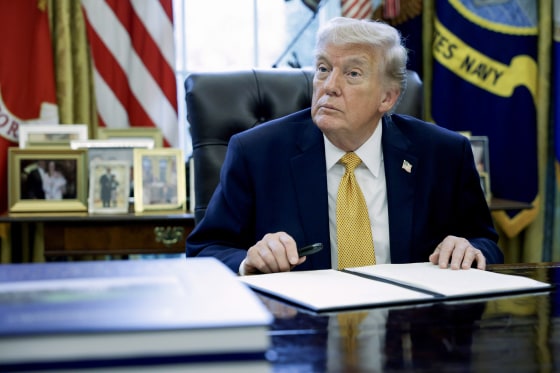
President Donald Trump indicated he didn’t speak to George W. Bush but suggested he talked with a Democratic president.Alex Wong / Getty Images
WASHINGTON — President Donald Trump told reporters Monday that one of his predecessors told him he wished he had been the one to bomb Iran.
It appears he did not speak to any of the four former presidents.
An aide for George W. Bush told NBC News that “they haven’t been in touch,” while an aide to Bill Clinton told NBC News that whoever Trump was referring to was not Clinton.
An Obama aide said “no recent conversations” have taken place between Barack Obama and Trump, and a source familiar with the matter said the former president Trump was referring to was not Joe Biden.
The White House did not immediately respond to a request for comment on the denials Monday night.
Rebuffed by allies, Trump now says U.S. doesn’t need help defending the Strait of Hormuz
Earlier in the day, Trump claimed twice to have spoken to a former president about Iran.
“I’ve spoken to a certain president — who I like, actually. A past president, former president, he said: ‘I wish I did it. I wish I did.’ But they didn’t do it. I’m doing it. Yeah?” Trump said at a lunch for Kennedy Center board members.

Later in the day, Trump repeated the claim in the Oval Office, saying: “I spoke to one of the former presidents who I actually like.”
“I actually speak to some,” Trump said. “And he said, ‘I wish I did what you did.’”
Asked by a reporter to elaborate on which president he was speaking to, Trump did not specify. He said it wasn’t Bush and then said “I don’t want to say” when he was asked it was Clinton.
“I don’t want to say because a member of a party, a member of a party, they have Trump derangement syndrome, but it’s somebody that happens to like me, and I like that person, who’s a smart person, but that person said, ‘I wish I did it.’ OK, but I don’t want to get into who. I don’t want to get him into trouble,” Trump said.
“You know, it’s interesting. And maybe he’d be proud,” Trump said about the former president. “And I could even ask him that: ‘Would you like me to reveal your name?’”
———————————
Trump Criticizes Allies for Refusing Assistance in the Strait of Hormuz
Mr. Trump expressed anger toward allies, claiming they were unenthusiastic when the U.S. requested the deployment of warships to the Strait of Hormuz.
“Many countries have informed us that they will participate. Some countries are very enthusiastic, but some are not. There are countries that the U.S. has helped for many years, protecting them from external dangers, yet they are not very enthusiastic about this. The level of enthusiasm is very important to us,” U.S. President Donald Trump said at the White House on March 16.
Mr. Trump referred to the U.S. request for allies to send warships to escort oil tankers through the Strait of Hormuz. The U.S. President did not specify which countries had agreed, saying only that the U.S. administration would provide a list of these nations at another time.

“In truth, there are some countries that are very enthusiastic. They are preparing to participate, and have even begun their journey. You know, it takes a little time to get there,” he added.
Mr. Trump has attempted to persuade countries to assist in ensuring that oil tankers can pass through the Strait of Hormuz, but so far, many U.S. allies have either failed to make commitments or have flatly rejected the request.
“There are countries where the U.S. has deployed up to 45,000 troops to protect them from danger, and we have done very well. Yet when we asked, ‘Do you have any minesweepers?’, they replied, ‘We will not participate, sir,'” the U.S. President stated.

The American leader described the escort operations in the Strait of Hormuz as a “very minor matter,” despite some tankers having been hit, adding that he already knew allies would not stand with Washington when the country needed support. “I have long criticized the U.S. protecting other nations, because I knew that even if we always protect them, they would not be there if one day we needed help,” he said.
The conflict in the Middle East has entered its third week and shows no signs of ending. The Strait of Hormuz, which transports 20% of the world’s oil and liquefied natural gas, remains almost completely blockaded, causing energy prices to soar and raising concerns about inflation.
The conflict has caused economic losses for U.S. allies, who were not consulted prior to the airstrike campaign against Iran and have endured many harsh criticisms and threatening remarks from President Trump since his return to power.
Rebuffed by allies, Trump now says U.S. doesn’t need help defending the Strait of Hormuz
Japan, Germany, Spain, and Italy stated that, for the time being, they have no plans to send ships to help reopen the strait.
A spokesperson for German Chancellor Friedrich Merz stated that the Middle East conflict originated from U.S.-Israeli attacks on Iran, emphasizing that this activity “is not related to NATO” and is “not NATO’s war.”
“The possibility of NATO participating in this war was never considered before the conflict and is not currently being taken into account,” the spokesperson added.
———————————
America’s Lonely Stance in the Strait of Hormuz
Allies once snubbed and isolated by Mr. Trump have rejected calls for support in Hormuz, pushing the U.S. into a solitary position in its efforts to reopen the strategic strait.
President Donald Trump has repeatedly asserted that the war with Iran is progressing well. However, his call for allies and other nations to assist in resolving the crisis in the Strait of Hormuz is the latest evidence causing public doubt regarding this claim.

“It would be great if other countries joined us in patrolling the region,” he told reporters on Air Force One on March 15. “We always stand by NATO. We are supporting them in Ukraine. It doesn’t affect us, but we help them anyway. Now, let’s see which countries do not support us in this very small effort to keep this strait open.”
Later, at a White House meeting on March 16, the President spoke out in strong criticism of long-standing allies whom he believes have not helped the U.S. with enough enthusiasm.
“There are countries that we have supported for many years. We have protected them from terrible external threats, yet they are not very eager,” Mr. Trump said. “The level of enthusiasm is very important to me.”
The President stated he had received “some positive feedback” after contacting various countries, but he did not name any allies who had committed to sending warships to the Strait of Hormuz to counter Iran.
In reality, many U.S. allies have bluntly declared they have no intention of sending warships to escort oil tankers through the Strait of Hormuz as proposed by President Trump.
Japanese Prime Minister Sanae Takaichi said on March 16 that Tokyo has no plans to deploy naval vessels to escort ships in the Middle East. According to her, Japan is considering what it can do “independently and within the framework of the law.”
Rebuffed by allies, Trump now says U.S. doesn’t need help defending the Strait of Hormuz
A spokesperson for German Chancellor Friedrich Merz noted that the conflict in the Middle East stems from U.S.-Israeli attacks on Iran and is “unrelated to NATO,” as well as “not NATO’s war.”
The United Kingdom, considered a top close ally that has stood by the U.S. in many overseas campaigns, has so far shown caution. British media reported on March 15 that Prime Minister Keir Starmer, in a phone call with President Trump, said he was “not ready” to agree to the request to send warships.
Experts analyze that the hesitation of allies to participate in the plan to clear the Strait of Hormuz proposed by the U.S. President is a consequence of Mr. Trump frequently displaying a cold, and at times isolating, attitude toward them.

Even until recently, President Trump continued to dismiss contributions from allies.
On March 3, after Spain refused to allow the U.S. to use its airbases to conduct airstrikes against Iran, Mr. Trump asserted that he did not need support from that nation.
“I told him we don’t want it; Spain has absolutely nothing we need,” Mr. Trump stated. “They have great people, but not the leadership.”
On March 7, when Britain considered sending an aircraft carrier to the region, Mr. Trump asserted that such support was completely unnecessary because victory was already within reach.
“It’s okay, Prime Minister Starmer, we don’t need them anymore,” the President wrote on social media. “But we will remember this. America doesn’t need people who only join the fight when we’ve already won!”
By March 9, Mr. Trump said the effort to protect the Strait of Hormuz was “my honor,” while asserting that the oil supply passing through this strategic waterway primarily benefits other countries, such as China.
On March 13, the President told Fox News radio host Brian Kilmeade that “we don’t need help in fighting UAVs,” in response to an offer from Ukraine to send forces to help the U.S. and Israel counter Iranian drones (UAVs) based on their actual combat experience.
According to experts, when making these statements, President Trump seemingly did not foresee that he would one day need help from his allies.
As the hostilities with Iran entered their second week and the shipping route through the Strait of Hormuz remained paralyzed, Mr. Trump displayed a completely different stance. On March 16, he said he was “not happy” with British Prime Minister Starmer for failing to immediately commit support for U.S. forces in Hormuz.
“I said, ‘You don’t need to meet with your team. You’re the Prime Minister, you can make the decision yourself. Why do you have to meet with subordinates to see whether or not to send a few minesweepers or warships to support us?'” the President told reporters.
Mr. Trump spent much of his two terms creating tension with allies who could have supported the U.S. And this is believed to have increased during his second term.
Two months ago, the President still left open the possibility of military action to take control of the island of Greenland, belonging to Denmark, a NATO ally. He even attempted to pressure Denmark into handing over the island.
President Trump also did not hesitate to speak about annexing Canada as the 51st state of the U.S., which enraged leaders in Ottawa. He simultaneously targeted a range of allies with tariff policies, at times appearing tougher on them than on adversaries.
He frequently made controversial remarks at international meetings and behaved as though he were trying to pressure allies rather than find common ground with them. Following such statements by Mr. Trump, an increasing number of European leaders have publicly said that perhaps their best direction is to decouple from the United States.
At the end of January, the U.S. President continued to make “particularly sensitive” comments about NATO, the military alliance toward which Mr. Trump has repeatedly expressed skepticism and criticized as being “too dependent on the U.S.,” threatening to cut budget contributions to the bloc.
“We never needed them. We really never asked them for anything,” Mr. Trump said. “You know, they will justify it by saying they sent troops to Afghanistan or did this or that. They did, but they just stood in the back, a bit far from the front lines.”
According to Aaron Blake, a veteran analyst from CNN, even in a normal context, such comments would have deeply wounded allies, especially since many of them suffered significant casualties in Afghanistan. NATO coalition soldiers actually fought on the front lines in Afghanistan, and more than 1,000 were killed.

Placed in the current context, Mr. Trump is clearly suffering the consequences of his forceful statements targeted at allies, Blake evaluated.
“President Trump repeatedly said he did not need America’s long-time allies, only to pivot less than two months later and request support in a war of his own making. He did not respect the sacrifices of the allies and then turned around to ask them to continue sacrificing once more,” the CNN writer noted.
“At the very least, this shows that Mr. Trump did not imagine he would fall into this situation,” Blake added.
Echoing this view, Dan Sabbagh, a defense and security analyst for The Guardian, assessed that “the White House seems to have not fully anticipated what could happen” after launching the attack campaign against Iran alongside Israel.
According to Blake, despite potential unhappiness with President Trump’s previous statements, many U.S. ally nations may still feel the need to assist in some way, because the blockage in the Strait of Hormuz holds the potential to cause long-term damage to the global economy.
“But Mr. Trump’s abrupt shift seems to further reinforce the observation that the U.S. President is facing a problem far beyond what he once imagined,” Blake concluded.


:max_bytes(150000):strip_icc():focal(711x351:713x353)/meghan-markle-duchess-of-sussex-prince-harry-2025-Invictus-Games-Vancouver-021025-23480ec9918341968be0de8c087893a0.jpg?fit=1500,1000&ssl=1 "Royal Family make brutal Harry and Meghan decision as Sussexes left completely isolated")





:max_bytes(150000):strip_icc():focal(753x271:755x273):format(webp)/cole-the-deaf-dog-112125-1a-ad248101bd174108a795d88d6afd93d8.jpg?fit=750,500&ssl=1 "Elementary School Throws Deaf Therapy Dog a Surprise Birthday Party as Students Learn Sign Language to Sing ‘Happy Birthday’")



:max_bytes(150000):strip_icc():focal(777x260:779x262)/kylie-jenner-062624-1e26d12a5df849e3b13c4a6b192b1bb0.jpg?fit=1500,1000&ssl=1 "Kylie Jenner Asks Plane to Turn Around Minutes Before Takeoff Due to Anxiety")






:max_bytes(150000):strip_icc():focal(608x271:610x273)/CHER-poses-with-Dolly-Parton-for-a-portrait-in-1978-in-Los-Angeles-082625-6ed6da39310343ba97c5b376375a3cdc.jpg?fit=1500,1000&ssl=1 "Dolly Parton’s niece Danielle Parton opens up about cancer battle, new estate role")


