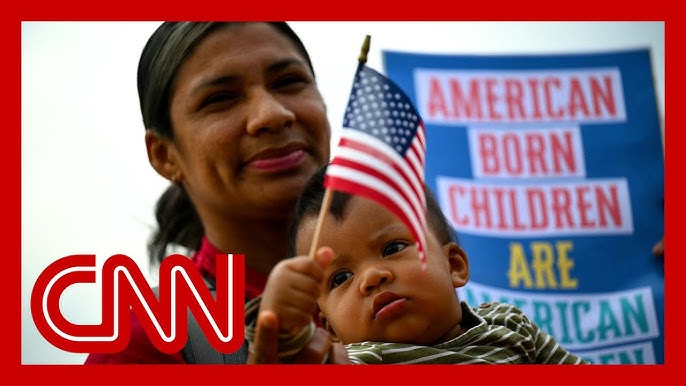

The Supreme Court agreed Friday to decide if President Donald Trump’s attempt to end birthright citizenship with an executive order is constitutional, offering the justices an opportunity to revisit what has widely been considered settled law since the 19th Century.
By granting the appeal, the court is directly taking on the merits of a controversy that it largely avoided earlier this year, when it sided with Trump on technical grounds dealing with how the challenges to the policy were handled by lower courts.
Cecillia Wang, national legal director for the American Civil Liberties Union said the organization looks forward to the Supreme Court “putting this issue to rest once and for all.”
“The federal courts have unanimously held that President Trump’s executive order is contrary to the Constitution, a Supreme Court decision from 1898, and a law enacted by Congress,” she added.
Though the legal theories advanced by the Trump administration’s appeal have long been considered fringe even by many conservatives, the case will nevertheless draw considerable public focus to the Supreme Court term that began this fall. It is yet another test of the court’s willingness to embrace a boundary-pushing legal argument from the White House.
A ruling for Trump would upend a longstanding tenet of constitutional and American immigration law and may have significant practical implications for US citizens who may face new hurdles documenting newborns.
The court will hear arguments next year and will likely hand down a decision by the end of June.
Steve Vladeck, CNN Supreme Court analyst and professor at Georgetown University Law Center, said that the Trump administration was simply “wrong” in its effort to “narrow birthright citizenship by executive order.”
“Whether because it violates the relevant statutes; the Fourteenth Amendment itself; or the Supreme Court’s authoritative 1898 interpretation of that constitutional provision, the bottom line is the same,” he said.
Two decades after the 14th Amendment was ratified in 1868, the Supreme Court ruled in US v. Wong Kim Ark that people born in the United States – in that case, the son of Chinese immigrants – are entitled to US citizenship, with a few narrow exceptions. But the Trump administration argued in its appeal that the precedent has long been misunderstood.
Despite the understanding of the citizenship clause enshrined in the 1898 opinion, the Trump administration told the Supreme Court in its appeals that notion was “mistaken” and that the view had “destructive consequences.” Trump has made ending birthright citizenship a key part of his immigration agenda.
“The citizenship clause of the Fourteenth Amendment was adopted to grant citizenship to newly freed slaves and their children – not to the children of temporary visitors or illegal aliens,” Solicitor General D. John Sauer, the administration’s top appellate attorney, told the Supreme Court in the appeal.
While the Supreme Court handed down an important decision in June that touched on Trump’s birthright citizenship order, that case was focused on a more procedural question of how much power lower courts had to stop a policy implemented by a president. A 6-3 majority of the court essentially limited – but did not completely eliminate – the power of courts to block such policies.
After the Supreme Court’s decision, Trump’s birthright policy was quickly blocked again by courts using other methods and has never gone into effect.
Lower courts, made up of both conservative and liberal judges, have all sided against the administration’s order.
“Their case amounts to little more than a jumble of historical misstatements, inapposite citations, newly manufactured doctrines, and – more than anything else – policy preferences,” the American Civil Liberties Union and other groups representing the individual plaintiffs, told the Supreme Court this year.
The court agreed to hear arguments in a case from a judge in New Hampshire that barred enforcement of Trump’s order against any babies who would be impacted by the policy in a class-action lawsuit brought by the ACLU.
But it did not take up a separate case that came from the San Francisco-based 9th US Circuit Court of Appeals. That upheld a Seattle judge’s ruling blocking Trump’s policy nationwide in a case brought by a group of Democratic-led states.
The difference likely has to do with who was suing: The 9th Circuit case involved a question of whether states had standing to sue over the policy.
Signed by Trump on January 20, the executive order, titled, “PROTECTING THE MEANING AND VALUE OF AMERICAN CITIZENSHIP,” said that the federal government will not “issue documents recognizing United States citizenship” to any children born on American soil to parents who were in the country unlawfully or were in the states lawfully but temporarily.
Trump asks Supreme Court to decide whether he can end birthright citizenship

The Trump administration asked the Supreme Court on Friday to review the constitutionality of President Donald Trump’s executive order seeking to end birthright citizenship, pushing the issue before the justices for the second time this year.
Despite more than a century of understanding that the 14th Amendment confers citizenship on people born in the United States, the Trump administration told the Supreme Court in an appeal that notion was “mistaken” and that the view became “pervasive, with destructive consequences.”
“The lower court’s decisions invalidated a policy of prime importance to the president and his administration in a manner that undermines our border security,” wrote Solicitor General D. John Sauer, the administration’s top appellate attorney. “Those decisions confer, without lawful justification, the privilege of American citizenship on hundreds of thousands of unqualified people.”
CNN reviewed a copy of the appeal, which has not yet been docketed at the high court.
While the Supreme Court handed down an important decision in June that dealt with birthright citizenship, that case was technically focused on a more procedural question of how much power lower courts had to stop a policy implemented by a president. A 6-3 majority of the court essentially limited – but did not completely rule out – the power of courts to block those policies.
That decision sent states and individuals who were challenging Trump’s birthright order scrambling to file new cases to shut down the birthright policy through other means, including class-action lawsuits. The Supreme Court implicitly allowed those other types of nationwide blocks to continue.
A series of new rulings have continued to keep Trump’s policy on hold, and the administration is now asking the justices to take up those cases to settle the issue once and for all.
The administration has long expressed confidence that the high court would approve Trump’s policy. But it’s not entirely clear whether four justices will ultimately vote in favor of hearing the cases, as is required.
At issue are two of several lower-court rulings that have held up implementation of Trump’s policy since the high court’s more procedural ruling this summer. In July, a San Francisco-based federal appeals court upheld a Seattle judge’s ruling that blocked Trump’s policy nationwide in a case brought by a group of Democratic-led states.
A separate decision issued earlier that month by a judge in New Hampshire barred enforcement of Trump’s order against any babies who would be impacted by the policy in a class-action lawsuit brought by the American Civil Liberties Union.
The administration filed its appeal in both of those cases on Friday.
“The government has a compelling interest in ensuring that American citizenship – the privilege that allows us to choose our political leaders – is granted only to those who are lawfully entitled to it,” the administration wrote in those appeals.
The administration has in recent weeks appealed the ruling from New Hampshire to a Boston-based federal appeals court, but the intermediate court has not yet had a chance to weigh in on the matter.
“This executive order is illegal, full stop, and no amount of maneuvering from the administration is going to change that,” said Cody Wofsy, an ACLU attorney who argued the New Hampshire case. “We will continue to ensure that no baby’s citizenship is ever stripped away by this cruel and senseless order.”
A Justice Department spokesperson did not immediately respond to a request for comment.
Signed by Trump on January 20, the executive order, titled “PROTECTING THE MEANING AND VALUE OF AMERICAN CITIZENSHIP,” said that the federal government will not “issue documents recognizing United States citizenship” to any children born on American soil to parents who were in the country unlawfully or were in the states lawfully but temporarily.
Three decades after the 14th Amendment was ratified in 1868, the Supreme Court ruled in US v. Wong Kim Ark that people born in the United States – in that case, the son of Chinese immigrants – are entitled to US citizenship, with a few narrow exceptions. But the administration argued in its appeal that the precedent has long been misunderstood.
The Wong Kim Ark decision recognized citizenship for people born in the United States who enjoyed “permanent domicil and residence” in the country, US Solicitor General Sauer argued.
“That limit,” Sauer wrote, “was central to the analysis.”
But those arguments have had no purchase in lower courts thus far.
The 9th Circuit said in a 2-1 ruling in July that Trump’s order contradicts the citizenship clause of the Constitution, Wong Kim Ark and decades of executive branch practice.
“The district court correctly concluded that the Executive Order’s proposed interpretation, denying citizenship to many persons born in the United States, is unconstitutional. We fully agree,” appeals court Judge Ronald Gould wrote for the majority.








:max_bytes(150000):strip_icc():focal(753x271:755x273):format(webp)/cole-the-deaf-dog-112125-1a-ad248101bd174108a795d88d6afd93d8.jpg?fit=750,500&ssl=1 "Elementary School Throws Deaf Therapy Dog a Surprise Birthday Party as Students Learn Sign Language to Sing ‘Happy Birthday’")







:max_bytes(150000):strip_icc():focal(608x271:610x273)/CHER-poses-with-Dolly-Parton-for-a-portrait-in-1978-in-Los-Angeles-082625-6ed6da39310343ba97c5b376375a3cdc.jpg?fit=1500,1000&ssl=1 "Dolly Parton’s niece Danielle Parton opens up about cancer battle, new estate role")


