
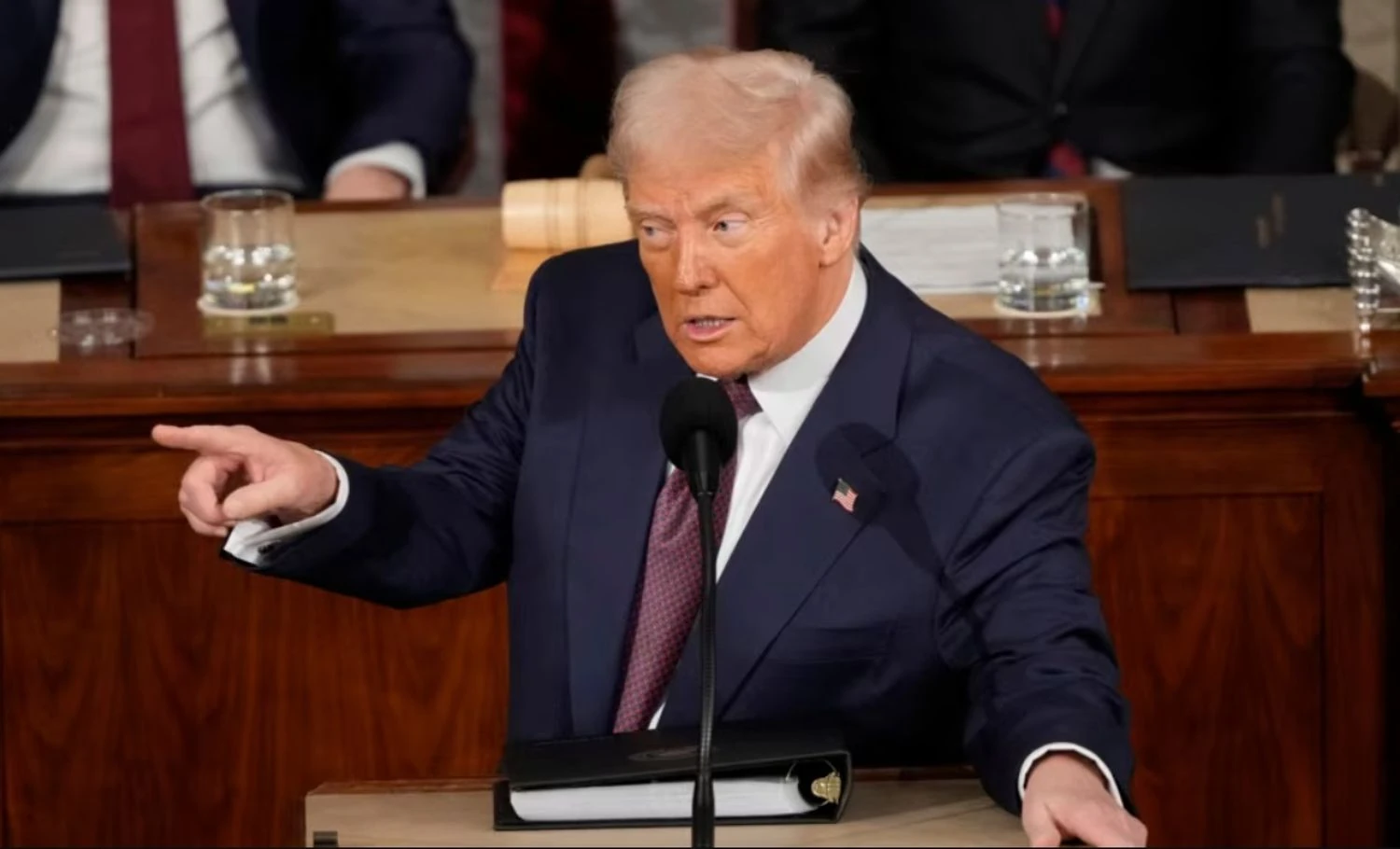
President Donald Trump’s approval rating among voters with a high school education or less has fallen to an all-time low, according to new polling, raising fresh questions about whether the president is losing ground with one of his most reliable political constituencies.
The latest figures from Echelon Insights show Trump is now firmly underwater with this group—marking a dramatic reversal from the early months of his second term, when he enjoyed strong positive ratings among less-educated voters.
For a demographic that has consistently anchored Republican electoral success in recent years, the shift signals a potentially significant crack in the coalition that returned Trump to the White House.
White House spokesman Davis Ingle told Newsweek in emailed comments that Trump had delivered “historic progress” at home and abroad, adding that “no other President in history has accomplished more for the American people,” while highlighting efforts to “create jobs, cool inflation, increase housing affordability, and more.”
The administration added that the president’s agenda is still “taking effect,” with further results expected in the months ahead.
Key Points
- According to the latest Echelon Insights poll, Trump’s overall approval stands at 38 percent, with 61 percent disapproving (net minus 23).
- Among voters with a high school education or less, approval is 41 percent, disapproval 57 percent (net minus 16), which is the lowest it has been with this demographic in this polling series.
- In July 2025, his net approval with this group was minus 7.
- At the start of his second term, he held a net plus-18 approval rating with less-educated voters.
- That equates to a 34-point swing since January 2025 among this key demographic.
Donald Trump Approval Rating Trend
The president has seen a 34-point drop among voters with a high school education or less since January 2025
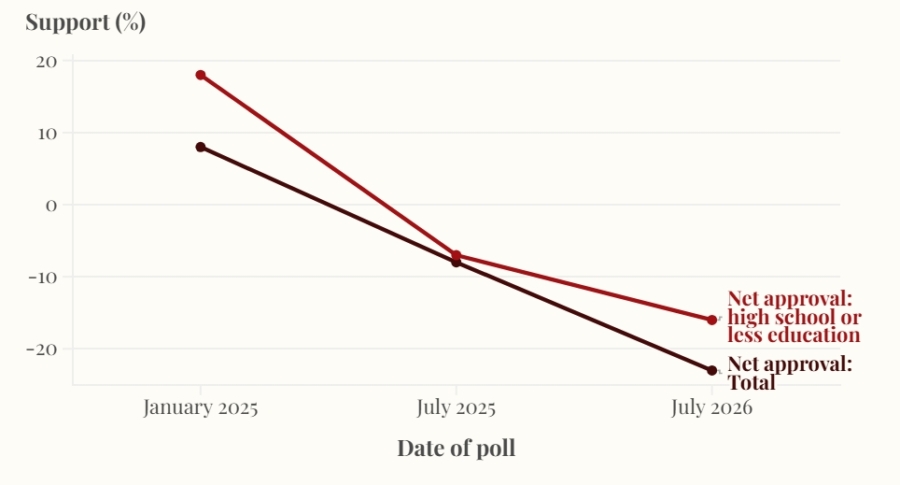
Source: Echelon Insights • Data taken from the tracker survey conducted during the month specified.
Clear Base Weakness
The latest Echelon Insights July 2026 Omnibus Survey provides the most up-to-date snapshot:
- Sample size: 1,004 likely voters
- Field dates: July 9–13, 2026
- Margin of error: plus or minus 3.6 percentage points
Results:
- Overall voters: 38 percent approve, 61 percent disapprove (net minus 23)
- High school or less education: 41 percent approve, 57 percent disapprove (net minus 16)
While Trump remains slightly stronger with this group than nationally, he is now clearly underwater—a notable shift for a demographic that has historically leaned in his favor.
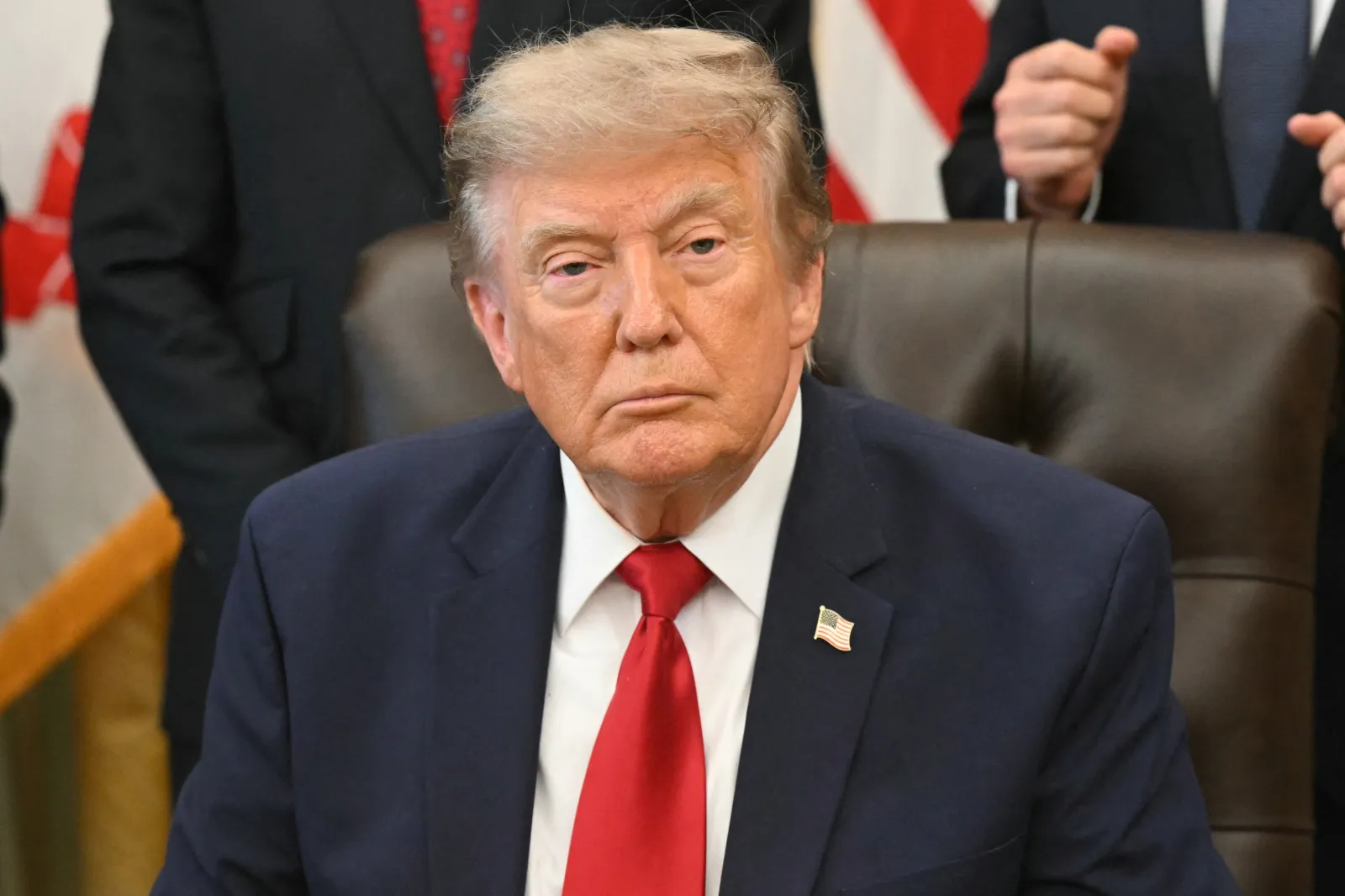
President Donald Trump at the Oval Office of the White House in Washington, DC, on July 13, 2026. | SAUL LOEB / AFP via Getty Images
One-Year Trend
A comparison with the July 2025 Omnibus shows deterioration across the board:
Sample size: 1,084 registered voters
Field dates: July 10–14, 2025
Margin of error: plus or minus 3.6 percentage points
Results:
Overall voters: 45 percent approve, 53 percent disapprove (net minus 8)
High school or less education: 46 percent approve, 53 percent disapprove (net minus 7)
That means:
- Trump’s overall net approval worsened by 15 points (from minus 8 to minus 23)
- Among less-educated voters, his net rating dropped 9 points (from minus 7 to minus 16)
Both figures show decline, but the crucial point is that his base has not been insulated from it.
From Strength to Deficit
At the outset of his second term, Trump’s standing among less educated voters was substantially stronger, according to the January 2025 Voter Omnibus:
- Sample size: 1,024 likely voters
- Field dates: January 22–24, 2025
- Margin of error: plus or minus 3.5 percentage points
Results:
Overall voters: 51 percent approve, 43 percent disapprove (net plus 8)
High school or less education: 56 percent approve, 38 percent disapprove (net plus 18)
Comparing those figures to July 2026:
- Overall approval has shifted from net plus 8 to net minus 23 (a 31-point drop)
- Among less-educated voters, from net plus 18 to net minus 16 (a 34-point drop)
That decline is sharper among this demographic than the electorate overall—an important signal about how opinion is evolving.
A Core Trump Advantage Under Strain
Trump’s political success has been closely tied to strong performance among voters without college degrees.
Exit poll data from the 2024 election showed non-college voters favored Trump by a clear margin, making them a decisive bloc in key swing states.
More broadly, this “diploma divide” has shaped American politics for nearly a decade, with non-college voters leaning Republican while college graduates generally trend Democratic.
In that context, the latest polling is striking—not because Trump has lost this group outright, but because the margin of support has narrowed significantly and moved into negative territory.
Broader Evidence of Slippage
The Echelon findings align with other polling analysis showing declining support among voters without college degrees, particularly outside the Republican base.
An analysis of AP-NORC polling found that approval among independents without a college education dropped sharply during Trump’s second term—falling from around half before taking office to about one-quarter by early 2026.
That shift suggests the erosion is not confined to one dataset, but part of a wider pattern affecting a group that was once central to Trump’s appeal.
Why This Could Matter for 2026
The electoral significance of less-educated voters cannot be overstated.
They make up a substantial share of the electorate and are particularly influential in battleground regions such as the Midwest and parts of the South. Even modest shifts in support can translate into large changes in electoral outcomes.
Midterm elections amplify these effects. Turnout is typically lower and more variable, meaning shifts in enthusiasm among core groups can have an outsized impact.

Trump ‘Deeply Saddened’ by U.S. Military Casualties in the Middle East
U.S. President Donald Trump said on July 19 that he was “deeply saddened” by the casualties suffered by American troops in the conflict with Iran, as the death toll among service members rose to 17.
“We are deeply saddened, but you know, those great people, those great patriots… are fighting so that Iran cannot have nuclear weapons,” the U.S. President told reporters upon his return to Washington after attending the World Cup final.
One American soldier was killed in northern Iraq on July 18, while two others succumbed to injuries from Iranian missile attacks in Jordan a day earlier, according to a confirmation by the U.S. Military’s Central Command (CENTCOM).
Trump also praised American military prowess, shortly after CENTCOM announced a ninth consecutive night of strikes against Iran.
“Iran has taken a very, very heavy hit. They have lost almost everything militarily. They have very little left,” the U.S. President said.
The current flare-up in conflict is also posing widespread risks to American citizens in the Middle East. The U.S. Embassy in Bahrain has just warned citizens currently in the Gulf nation to exercise caution, noting that Iran could target “unspecified locations” in central Manama, Bahrain’s capital.
“We urge all Americans to remain vigilant, follow local authority instructions, and review the latest guidance from the U.S. Embassy,” the embassy in Bahrain stated in a post on X, without providing further details.
Earlier on July 18, the U.S. Department of State issued a global travel advisory for its citizens, citing escalating tensions in the Middle East and the potential for further security risks.
Trump administration launches largest-ever effort to denaturalize U.S. citizens accused of fraud or other crimes
The Trump administration on Monday announced it is seeking to revoke the citizenship of 17 U.S. citizens accused of immigration fraud, expanding its unprecedented denaturalization campaign.
CBS News exclusively reported about the plans before they were unveiled by the Justice Department.
Officials said the move represents the largest-ever effort by the U.S. government to use its denaturalization powers, which were rarely invoked before President Trump returned to the White House last year with promises to launch a historic deportation blitz. Between 1990 and 2017, the Justice Department filed an average of just 11 legal complaints per year seeking to denaturalize American citizens, historical figures indicate.
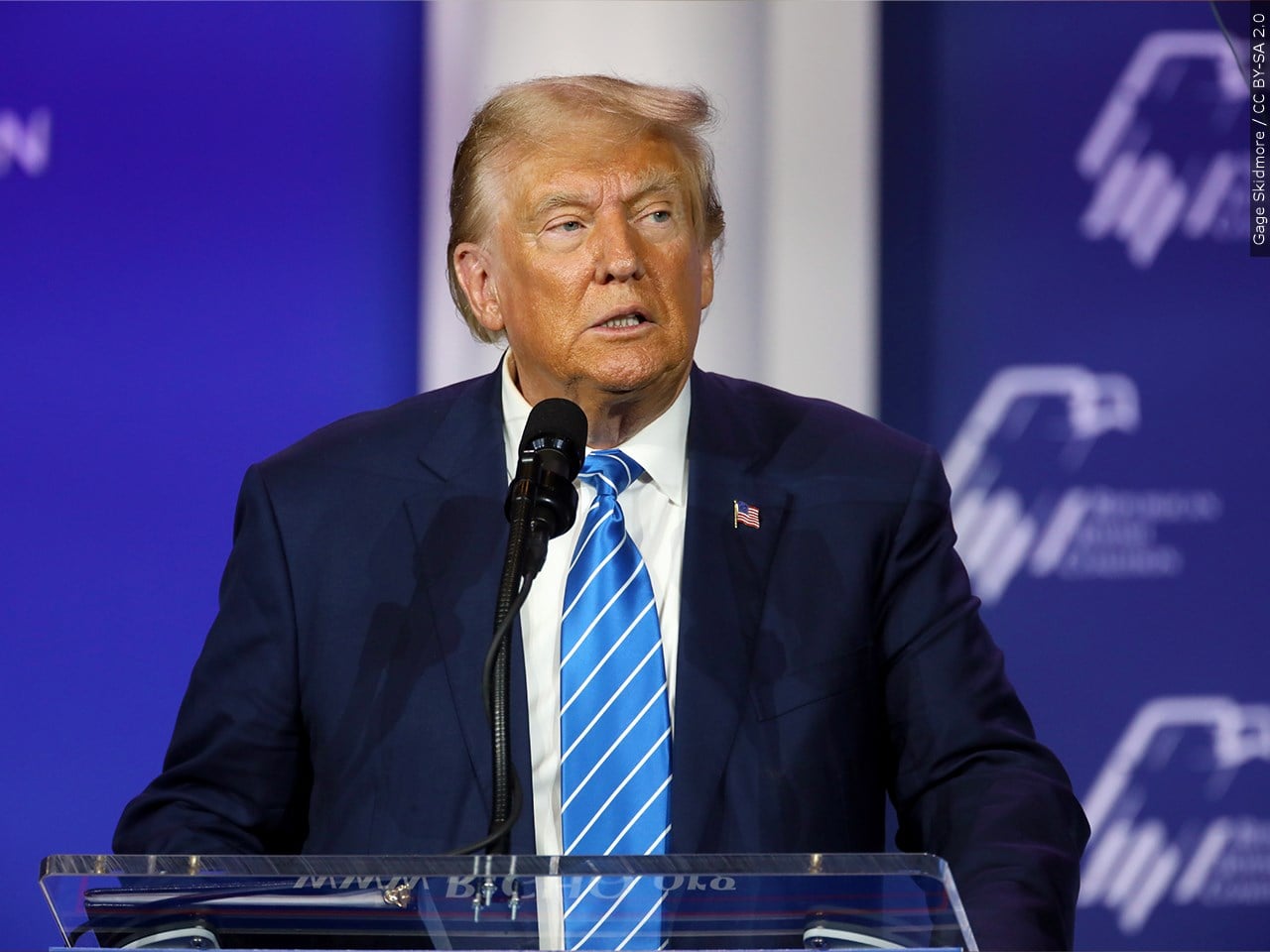
Federal law has long allowed the government to try to denaturalize foreign-born U.S. citizens who officials believe committed fraud to obtain their citizenship, such as by concealing information, like criminal conduct, on their immigration applications. But the process has been historically lengthy, complex and seldom exercised, requiring officials to persuade judges to strip naturalized citizens of their citizenship in civil or criminal proceedings in federal court.
The Trump administration has sought to vastly escalate denaturalization efforts as part of its larger crackdown on illegal and legal immigration. In 2025, the Justice Department broadened the categories of naturalized citizens who should be prioritized for denaturalization. Last month, officials announced a dozen denaturalization cases, at the time the largest such effort in years.
Some of the 17 citizens targeted in the latest denaturalization campaign were convicted of violent or serious crimes, including sex offenses against children. Others were convicted of fraud crimes or accused of committing immigration fraud.
In federal court complaints filed across the country in recent days, Justice Department officials argued that the individuals concealed their criminal activity when they applied for U.S. citizenship or were otherwise ineligible to be naturalized, including because they lacked a “good moral character,” one of the requirements in the naturalization process.
Those targeted in the latest round of denaturalization cases include a Haitian immigrant who allegedly sexually abused his daughter; a man from the former Yugoslavia convicted of sexually abusing a child under the age of 15; an immigrant from Mexico convicted of receiving sexually explicit images of minors; a former Catholic priest born in Colombia accused of child sex abuse; and a Filipino-born man who pleaded guilty to a child sex crime.
The group also includes an Indian immigrant accused of filing fraudulent H-1B visa petitions; the daughter of a Colombian drug trafficker accused of money laundering; a man born in Jamaica convicted of wire fraud; and a Cuban-born woman accused of defrauding a tribal casino. Other naturalized citizens were accused of using false identities.
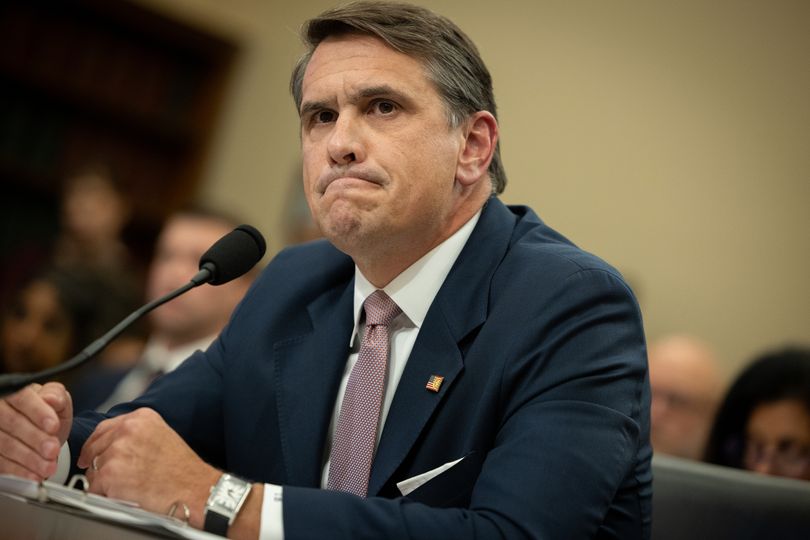
Acting Attorney General Todd Blanche said the Justice Department would have “zero tolerance” for abuse of the naturalization process.
“Criminal aliens are lying about their past crimes, including drug dealers, sexual predators, and fraudsters,” Blanche said.
Homeland Security Secretary Markwayne Mullin said the Trump administration would “continue to use every lawful avenue to denaturalize and remove aliens.”
“American citizenship is a privilege, and it must be earned honestly. If you come here, break our laws, and lie in your immigration proceedings, you forfeit that privilege,” Mullin said.
The denaturalization process allows the targeted citizens to challenge the government’s filings to try to retain their citizenship. If U.S. citizens are denaturalized, they return to their prior immigration status, typically as permanent U.S. residents, and lose all the legal benefits of American citizenship, including protection from deportation.





:max_bytes(150000):strip_icc():focal(539x0:541x2)/Stray-Dog-Gets-Unicorn-sisu2-49aa7f345b004fb3bfa19c84c025a1c7.jpg?fit=1080,1080&ssl=1 "Stray Dog Who Kept Trying to Steal Unicorn Toy from Shop Gets Rescue and the Toy")




:max_bytes(150000):strip_icc():focal(753x271:755x273):format(webp)/cole-the-deaf-dog-112125-1a-ad248101bd174108a795d88d6afd93d8.jpg?fit=750,500&ssl=1 "Elementary School Throws Deaf Therapy Dog a Surprise Birthday Party as Students Learn Sign Language to Sing ‘Happy Birthday’")






:max_bytes(150000):strip_icc():focal(979x540:981x542)/joey-king-steven-piet-1-d4547f00bc1543c6a4212832662b4efd.jpg?fit=1500,1127&ssl=1 "Who Is Joey King’s Husband? All About Steven Piet")






:max_bytes(150000):strip_icc():focal(749x0:751x2)/Mel-Gibson-Fanexpo-Chicago-083126-f90ea0e0e7904853b5fd33a8b889840f.jpg?ssl=1 "Mel Gibson Apologizes for ‘Spontaneous Thoughtless Idiocy’ After Using Mock Sign Language at Toronto Fan Event")


