
The apparent discolouration on Donald Trump’s hand was first widely noticed one year ago.

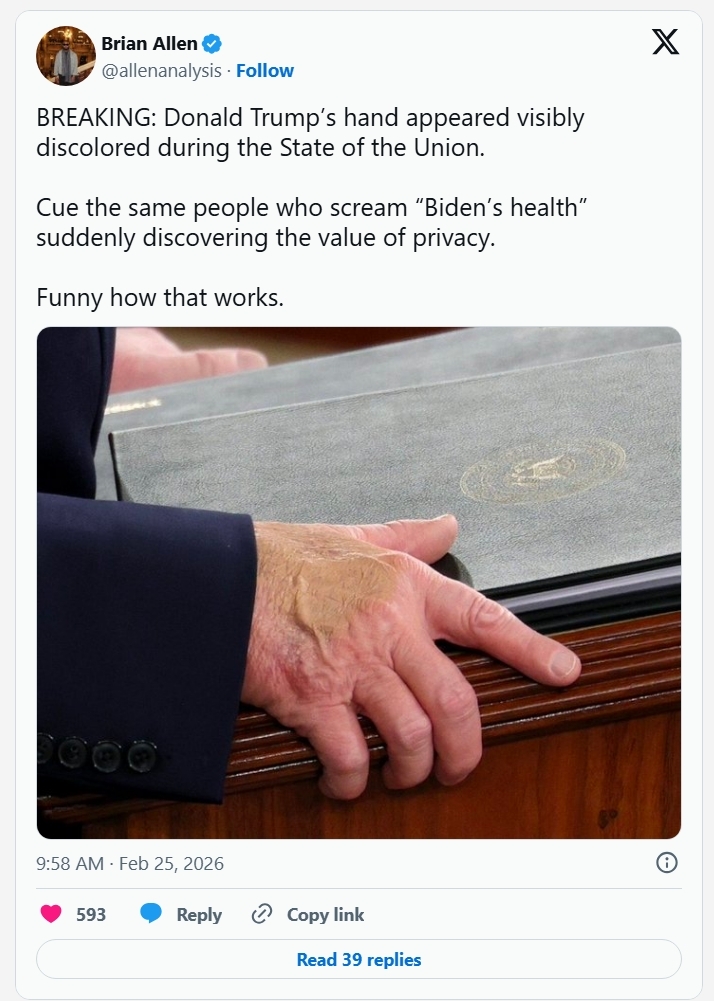
Health fears erupted once again for Donald Trump after many viewers of yesterday’s State of the Union noticed a discolouration on his hand. The 79-year-old US President appeared to have the mark partially covered with make-up as he delivered the high-profile speech.
The White House has previously played down concerns, saying the bruising is linked to frequent handshaking and his use of aspirin, a blood-thinning medication. The marks first attracted widespread attention last year after similar discolouration was repeatedly seen during public appearances. Officials have also confirmed the President was diagnosed in July with chronic venous insufficiency, a condition affecting blood flow from the legs back to the heart. Mr Trump has previously been seen with swollen ankles, though no shots of that part of his body were visible during the televised address. Speaking to The Wall Street Journal in January, Mr Trump said aspirin was used to thin his blood.

A White House spokesperson has also said the President meets large numbers of Americans each day and frequently shakes hands with the public.
Images of the President’s hand quickly circulated on social media, with users on X sharing close-ups taken during the televised address.
Some commenters mocked the situation, with one post joking that critics who had previously questioned Joe Biden’s health were now “discovering the value of privacy”.
Mr Trump has repeatedly dismissed concerns about his health and has previously said he has “aced” cognitive tests.
Previously, White House Press Secretary Karoline Leavitt said the President “meets more Americans and shakes their hands on a daily basis than any other President in history”.
She added his commitment to the public was “unwavering” and demonstrated “every single day”.
During a recent White House remembrance ceremony for “Angel Families”, relatives of people killed by undocumented migrants, the President delivered a lengthy address.
The speech drew criticism from some commentators, who described it as “rambling” and said he moved between unrelated topics.
This included shifting from comments about New York’s mayor to a major snowstorm before speaking to a woman in the audience about her eyesight.
Mr Trump was also recently pictured during an appearance connected to Josh Pate’s College Football Show, a US sports programme focused on American college football.
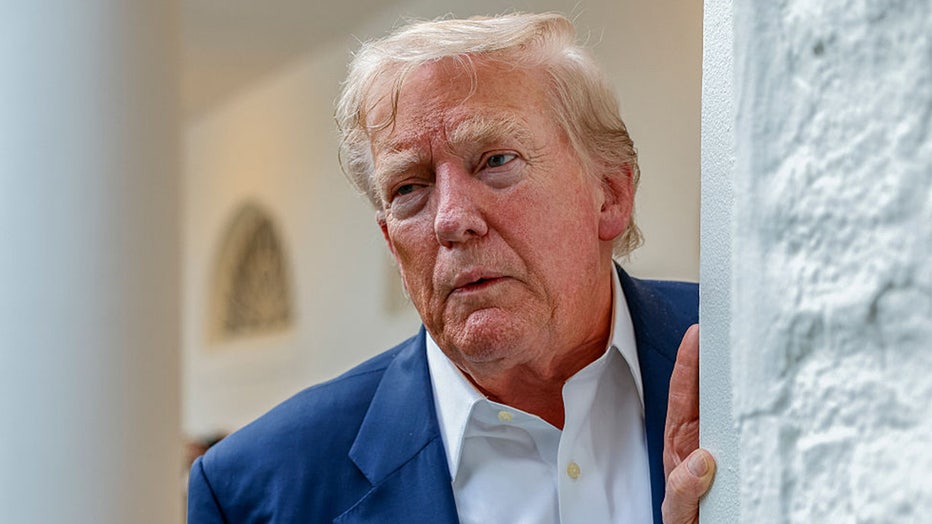
Images shared online showed his ankles exposed while seated, prompting some social media users to raise concerns about swelling.
According to the White House and medical assessments, Trump has swollen ankles due to chronic venous insufficiency (CVI), a common age-related, non-life-threatening circulatory condition.
This condition occurs when leg veins fail to effectively pump blood back to the heart, causing it to pool in the lower limbs.
Mr Trump also drew attention after appearing to cover his hand with a single glove during a recent public appearance, prompting renewed speculation online.
However, he later said the bruising was caused by a high dose of aspirin taken on medical advice to thin his blood.
In January, Dr Jonathan Reiner – a former cardiac doctor to Vice President Dick Cheney and now a CNN medical analyst – suggested the President appeared to fall asleep at his desk in a circulated image.
:max_bytes(150000):strip_icc():focal(749x0:751x2)/donald-trump-hand-bruise-1-082625-f31ada4ef7c3486da2352c2b94078644.jpg)
He said the behaviour could indicate excessive daytime sleepiness and recommended it should be medically evaluated.
The White House has consistently said medical tests found no evidence of serious illness.
Donald Trump Health Fears: Psychologist Warns President’s ‘Deteriorating Brain’ Risks World War
A disputed assessment of Donald Trump’s health has surfaced at a moment of rising tension over potential US action against Iran.

A psychologist’s claim that President Donald Trump may be suffering from what he called a ‘deteriorating brain disorder‘ has prompted a firm rebuttal from the White House, amid heightened US–Iran tensions and renewed scrutiny of the president’s foreign‑policy decision‑making.
The comments were made by Dr John Gartner during an appearance on The Daily Beast podcast, where he argued that Trump’s conduct and recent public statements should raise concerns about his cognitive fitness as the administration considers its next steps on Iran following last year’s strikes on Iranian nuclear facilities.
Psychologist’s Claims Add To Donald Trump Health Fears
Gartner, described by The Daily Beast as a former Johns Hopkins professor, told host Joanna Coles that Trump’s behaviour should be viewed through both political and medical lenses. He alleged that the president exhibits signs of cognitive decline and claimed this had implications for national security. ‘It’s such a terrible combination, because we have a constitutional crisis of sorts… But we have someone with a brain disorder, OK? A deteriorating brain disorder, so they have no internal controls or judgment,’ Gartner said.
He expanded on those claims by arguing that Trump’s decision‑making appeared unconstrained, saying: ‘Donald Trump’s id is now sort of in control of the world, because he has no frontal lobes. He has no advisors. We have no Constitution. We have no checks and balances.’ Gartner also characterised Trump as ‘hypomanic’ and ‘a narcissist’, according to the podcast summary published by the outlet.
As an example of what he called an ‘arbitrary, confused and paranoid’ approach to major decisions, Gartner pointed to remarks Trump made Thursday during the first meeting of his newly formed ‘Board of Peace’. At that event, the president referred to last summer’s US strikes on Iran’s nuclear facilities and told attendees: ‘So now we may have to take it a step further, or maybe not. Maybe we’re going to make a deal. You’re going to be finding out over the next, probably, 10 days.’
Gartner later interpreted the president’s phrasing on the podcast, saying: ‘We might go to war, we might not, we’ll let you know… You’ll find out. If we can’t make a deal and we feel like it’s wrong, we’re going to bomb.’
White House Rejects Donald Trump Health Fears
In response, the White House dismissed the psychologist’s comments and defended Trump’s condition. In a statement attributed to spokesperson Davis Ingle, the administration said: ‘President Trump is the sharpest, most accessible, and energetic president in American history.’ Ingle also criticised The Daily Beast and described Gartner as ‘a disgraced doctor’.
The exchange unfolded as Axios reported that the US had moved closer to a potential conflict with Iran, citing a dual‑track strategy combining diplomatic outreach with expanded military readiness. The outlet said Trump advisers Jared Kushner and Steve Witkoff met Iran’s foreign minister, Abbas Araghchi, for three hours in Geneva on Tuesday. Both sides reportedly said the discussions ‘made progress’, though US officials remained sceptical about bridging longstanding disagreements.
Vice President JD Vance told Fox News, according to Axios, that while diplomacy had shown some positive signs, Trump had set ‘certain boundaries’ that Iran had yet to address. Vance suggested talks may have ‘reached their natural end’.
Axios also reported significant US military deployments to the region, including two aircraft carriers, multiple warships, hundreds of fighter jets and additional air‑defense systems. The outlet said more than 150 military cargo flights had delivered weapons and ammunition, and that a further 50 fighter jets — including F‑35s, F‑22s and F‑16s — had been sent in the previous day.
One Trump adviser quoted by Axios said the president was growing increasingly frustrated. ‘I believe there is a 90% chance we see kinetic action in the next few weeks,’ the adviser reportedly said.

Half of Americans say Donald Trump is too old to be president; 36% say he is not
A new YouGov poll on Donald Trump’s health and age finds that about half of Americans believe the 79-year-old is too old to be president, while 36% say he isn’t. The poll also found that about half of Americans think Trump is suffering cognitive decline and about three-quarters think there should be a maximum age limit for the presidency.
Half (49%) of Americans say Trump is too old to be president. Fewer (36%) say he is not too old to be president. Democrats are much more likely than Republicans to say Trump is too old to be president (82% vs. 18%).
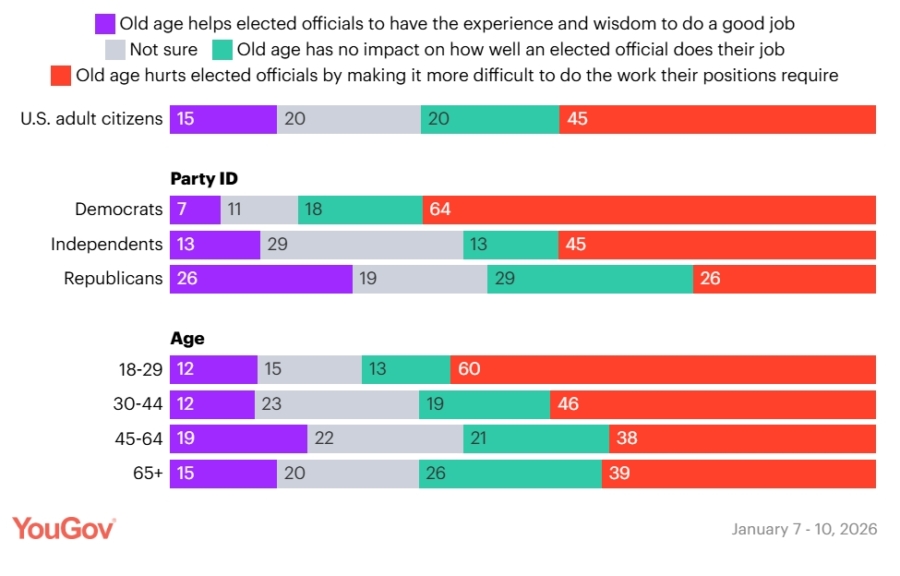
Adults under 30 are more likely than older Americans to say Trump is too old to be president (60% vs. 46%).
Half of Americans say Trump is too old to be President
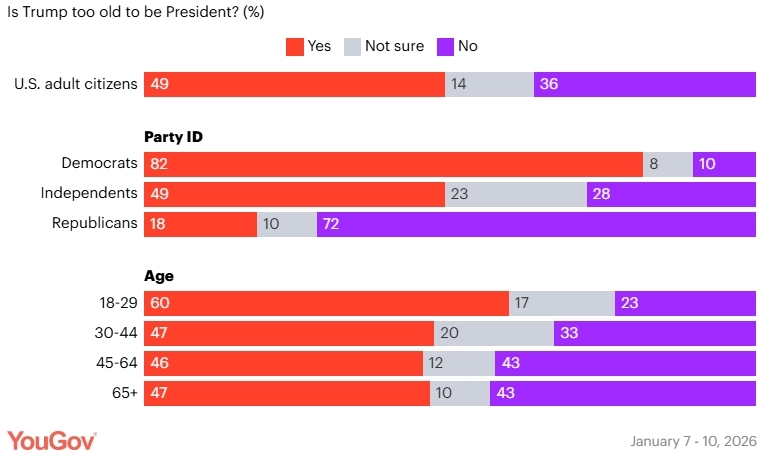
In December 2025, 44% of Americans said Trump was too old to be president and 44% said he was not. In September 2025, 49% said he was too old and 39% said he was not.
In December 2025, fewer Republicans said Trump was too old to be president (9% then vs. 18% now).
48% of Americans think Trump has not provided enough information about his physical health; 31% think he has.
About one-quarter (27%) of Americans think Trump’s current overall health is poor, more than say it is very good (14%) or excellent (8%).
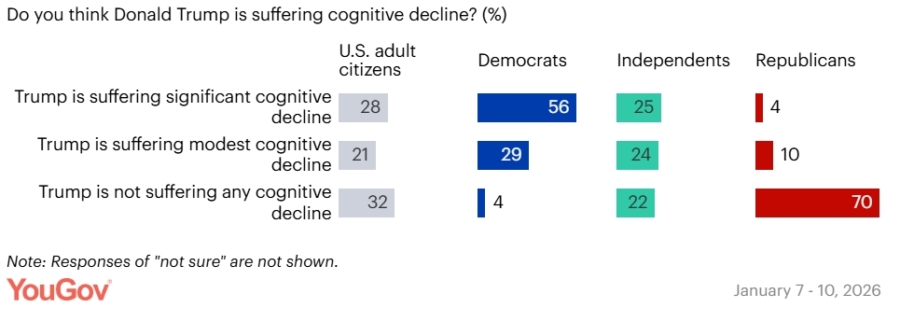
About half (49%) of Americans believe Trump is suffering some level of cognitive decline, including 28% who believe he’s suffering significant cognitive decline. The vast majority (85%) of Democrats and 14% of Republicans believe Trump is suffering cognitive decline.
About half of Americans believe Trump is suffering some level of cognitive decline
Most Americans (58%) believe Trump is suffering significant (25%) or modest (33%) physical decline. Democrats are far more likely than Republicans to say they believe Trump is suffering some level of physical decline (87% vs. 34%).
The majority of Americans believe Trump is suffering physical decline
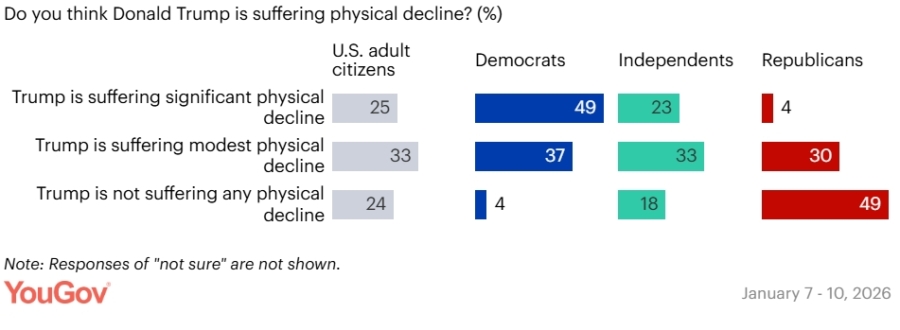
In September 2025, similar shares of Americans believed Trump was suffering modest or significant cognitive (49%) and physical (59%) decline.
36% of Americans believe Trump’s health and age are severely limiting his ability to fulfill his duties as president. Half (50%) say these factors have little effect (25%) or no effect (25%) on his ability to do his job. Democrats are much more likely than Republicans to believe Trump’s age and health are severely limiting his ability to do his job (68% vs. 8%).
Most Americans think Trump’s health and age are affecting his ability to do his job, including 36% who say these factors severely limit his ability
How much of an effect do you think Donald Trump’s health and age are having on his ability to fulfill his duties as president?
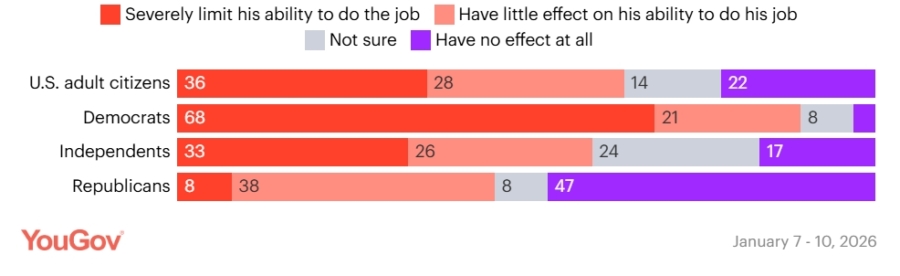
Far more Americans think Joe Biden’s health and age severely limited his ability to fulfill his duties as president when he was in office than say so about Trump now (66% vs. 36%). Biden was 78 years old when he was sworn in and 82 when he left the White House. 48% of Democrats and 88% of Republicans say Biden’s ability to lead the country was severely limited by his health and age.
44% of Americans — including 81% of Democrats and 11% of Republicans — believe there has been a cover-up of the current state of Trump’s health.
44% of Americans think there has been a cover-up of the current state of Donald Trump’s health
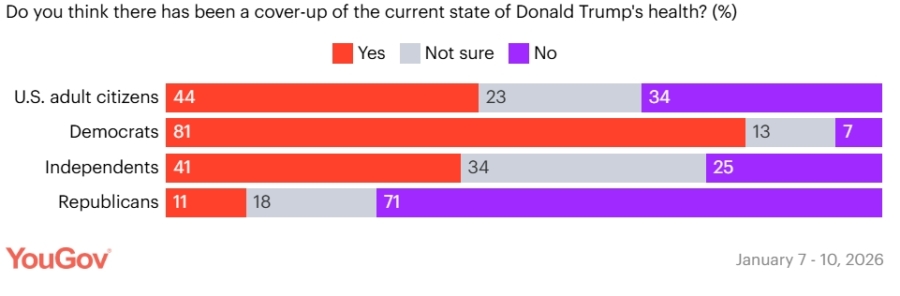
Far more Americans believe that there was a cover-up of the state of Joe Biden’s health when he was president than say so about Trump’s health now (66% vs. 44%). 44% of Democrats and 90% of Republicans think there was a cover-up of the state of Biden’s health.
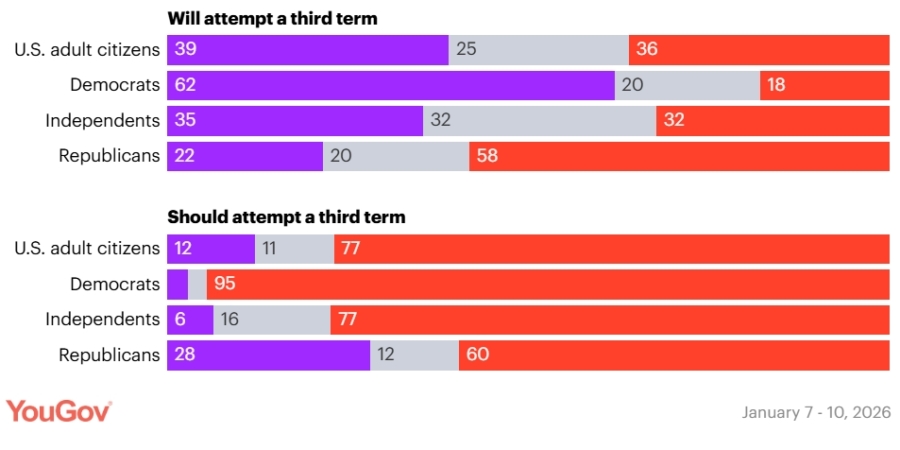
39% of Americans — including 62% of Democrats and 22% of Republicans — think Trump will attempt to serve a third term as president. Far fewer Americans (12%) say they think he should attempt to serve a third term. Majorities of Democrats (95%) and Republicans (60%) think he should not attempt to serve a third term.
39% of Americans think Donald Trump will attempt to serve a third term; only 12% think he should attempt it
Do you think that Donald Trump [will / should] attempt to serve a third term as president? (%)
Majority of Americans Say Trump Is ‘More Erratic Due to Age’
A majority of Americans believe that President Trump, 79, is becoming increasingly erratic as he ages, according to a Reuters/Ipsos survey.
Reuters/Ipsos, one of the world’s leading reputable polling sources, released results on February 24 from a poll of 4,638 adults across the United States, showing that 61% of respondents perceive Mr. Trump as “becoming erratic with age.”
This rate is 89% among Democratic voters, 30% among Republican voters, and 64% among independent voters. The survey was conducted over six days, ending February 23, with an estimated margin of error of 2 percentage points.

Reuters/Ipsos released the survey just before Mr. Trump, 79, delivered the State of the Union address before Congress, amidst several pressures he is currently facing.
The White House rejected the survey results, calling them one of the “fabricated and desperate stories.” Spokesperson Davis Ingle stated that Mr. Trump stands in contrast to his predecessor Joe Biden due to his “sharpness, unmatched energy, and a level of public accessibility on a historic scale.”
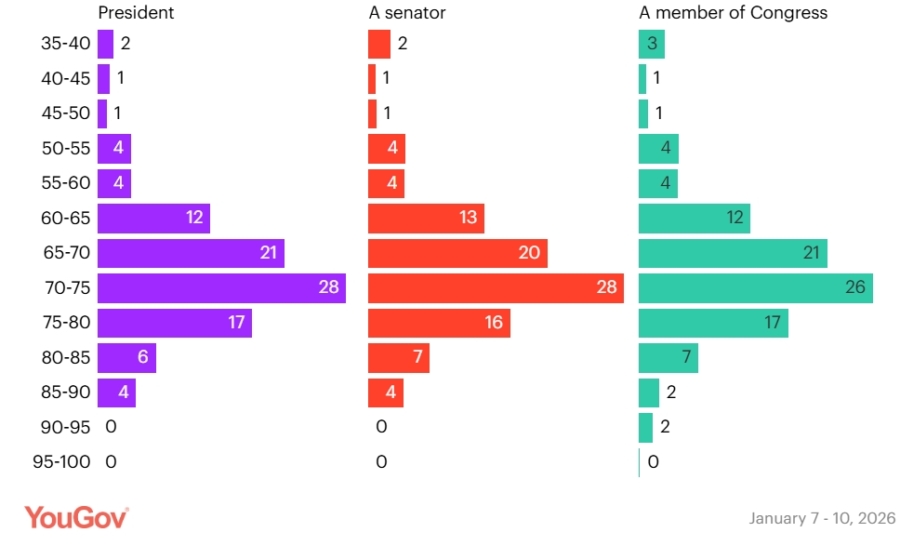
The survey results further noted that a majority of Americans view the country’s political leadership as generally “too old,” with approximately 79% saying elected officials in Washington are too old to represent the majority of Americans. The average age in the U.S. Senate is about 64, while in the House of Representatives, it is 58.
Democratic voters tend to want younger politicians, with 58% stating that the top Democratic leader in the Senate, Chuck Schumer, 75, is too old to continue working.
Mr. Trump returned to the White House in January 2025 at age 78, becoming the oldest president in U.S. history to take office.
His predecessor, Joe Biden, was judged by many to have declined in mental clarity due to advanced age during his time in office. Mr. Biden ended his term at age 82, older than any president in U.S. history.
81% of Republican voters still view Mr. Trump as “mentally sharp,” unchanged from a 2023 survey. Meanwhile, the percentage of Democratic voters who believe the president is capable of handling challenges fell to 19%, down from a previous level of 29%.
Among independent voters, 36% believe Mr. Trump remains mentally sharp, a decrease from 53% in 2023.

President Trump: ‘America is Back’
In his first State of the Union address of his second term, Mr. Trump praised economic achievements and announced new policies on the cost of living amid declining approval ratings.
U.S. President Donald Trump opened his speech by declaring that America is “back,” bigger, fairer, and stronger than ever before. “This is the golden age of America,” he said.

America is Back
Mr. Trump also strongly attacked the term of his predecessor, Joe Biden, claiming that he took over “a nation in crisis.”
Nevertheless, the U.S. President emphasized that the current administration has created an “unprecedented” transformation, while calling it a “historic turning point” for America.
“This is the golden age of America,” he said.
President Donald Trump affirmed that his administration has “completely ended” illegal border crossings into the United States over the past nine months.
“After four years where millions and millions of illegal aliens poured across our borders, completely unchecked and unvetted, America now has the strongest and most secure border in history, far surpassing any previous period. In the past nine months, not one illegal alien has been allowed into the United States,” he declared.
The U.S. leader also stated that the amount of fentanyl smuggled across the border has dropped by a record 56% within just one year.
Looking back at the one-year journey of his administration, Mr. Trump believed he had taken over “a country in crisis.” According to him, at that time the economy was stagnant, inflation was at record highs, the border was “wide open,” recruitment for the military and law enforcement was declining, while crime rose and the world was plunged into conflict and instability.
“But tonight, after only one year, I can say with integrity and pride that we have created an unprecedented transformation and an epochal turnaround,” the U.S. President emphasized, describing the changes under his tenure as a historic turning point for America.
In his speech, Mr. Trump also once again revived the controversial theme regarding the possibility of running for a third term when mentioning efforts to lower prescription drug prices.
“In my first term, second term, it should have been my third term, but strange things happened,” he said, alluding to the 2020 election.
Mr. Trump has long maintained that he was the actual winner of the election that put Democratic candidate Joe Biden in the White House, despite evidence and judicial rulings rejecting allegations of fraud.
In October, he declared he would not seek a third term, after months of hinting at the possibility despite the U.S. Constitution setting clear limits. The 22nd Amendment to the U.S. Constitution limits a president to only two terms.

“Iran is Building Missiles That Can Hit the United States”
President Donald Trump accused Iran of pursuing a long-range missile development program capable of reaching U.S. territory—a type of technology currently possessed by only a very few nations.
“They have developed missiles that can threaten Europe and our bases overseas. And they are working to build missiles that can reach the United States,” Mr. Trump said, implying a new advancement in Tehran’s deterrent capabilities.
Nevertheless, the U.S. leader affirmed that he still prioritizes resolving tensions with Iran through diplomatic channels. He simultaneously emphasized an impassable “red line”: Tehran must not be allowed to possess nuclear weapons.
“That cannot happen,” the U.S. President declared, reaffirming Washington’s hardline stance toward Iran’s nuclear ambitions.
Also related to issues in the Middle East, Mr. Trump praised the administration’s efforts in bringing home all hostages held in the Gaza Strip since the October 7, 2023 attack by Hamas against Israel.
“Under the ceasefire agreement that I negotiated, every single hostage, whether living or deceased, has been brought home. No one thought that could happen,” he said.
Last month, the body of the last hostage confirmed dead, Ran Gvili, was also returned to Israel. Following this statement, many Democratic lawmakers stood up to applaud, including Senators Elizabeth Warren, Jon Ossoff, and Chris Coons.
Earlier, Mr. Trump invited U.S. Special Envoy Steve Witkoff and son-in-law Jared Kushner to stand in the chamber, recognizing their pivotal roles in the hostage rescue negotiation process. The U.S. President has also hosted many released hostages at the White House, including American-Israeli citizen Edan Alexander.
Additionally, Mr. Trump offered praise to U.S. Secretary of State Marco Rubio, particularly for mediating the ceasefire agreement to end the war between Israel and Hamas in Gaza.
“Marco, you’ve done a great job. A fantastic Secretary of State. I believe he will go down as the best ever,” Mr. Trump praised.
In the chamber, the cheers and applause for Secretary Rubio were said to be the loudest and longest throughout the State of the Union address.

Issues with Mexico and Venezuela
Only about five minutes into the speech, Mr. Trump mentioned the U.S.-Mexico border issue, asserting that Mexico and the U.S. will “always allow people to enter legally.”
“We are never going back to the way it was. We are not. Today, our border is secure,” he said. Mr. Trump also stated that the U.S. has received more than 80 million barrels of oil from Venezuela—a sharp increase from the 50 million barrels he previously announced at an event in Rome last week.
“We have received over 80 million barrels of oil from our new friend and partner, Venezuela,” he declared. The U.S. President also emphasized that Washington intends to control Venezuela’s oil sales and revenue for an indefinite period, after U.S. forces captured President Nicolás Maduro in a raid in the capital, Caracas, on January 3.
Furthermore, Mr. Trump said he wants U.S. oil and gas corporations to invest up to $100 billion to restore the Venezuelan energy industry to its historic peak. Under this proposal, profits would be divided among the people of Venezuela, the U.S., and the participating extraction companies—a plan he described as a win-win and a strategic reconstruction.
“America is Winning”
The U.S. President praised the momentum of the financial markets since his re-election in late 2024. According to him, stock indices have set historic peaks three consecutive times within just one year after the election.
“The stock market has set three all-time record highs since the election. Think about that, just in one year helping to increase the value of pension funds, 401K accounts, and retirement savings for millions and millions of Americans. Everything is going up,” he emphasized.
In the U.S., a 401K is a popular form of employer-sponsored retirement savings account for workers, closely tied to capital market performance. Therefore, stock market growth is often seen as a direct measure of the wealth and long-term welfare of the middle class.
Mr. Trump also declared that his administration has completely ended Diversity, Equity, and Inclusion (DEI) programs nationwide.
Speaking before a joint session of Congress in the State of the Union, he affirmed: “We have ended DEI in America. Our country is winning again.”
Since returning to the White House, the Trump administration has implemented a series of moves to dismantle and reverse DEI policies in federal agencies, the military, as well as in public universities.
Supreme Court Ruling
“Just four days ago, the Supreme Court issued a very unfortunate ruling,” President Donald Trump spoke, referring to the decision to reject the legal basis for a series of import tariffs he enacted.
Present in the chamber at that time were four Supreme Court justices: Amy Coney Barrett, Elena Kagan, John Roberts, and Brett Kavanaugh. Except for Mr. Kavanaugh, the other three joined the majority in the ruling unfavorable to the administration.
As Mr. Trump mentioned this decision, Democratic lawmakers applauded in response, while the justices maintained a calm demeanor, showing no emotion. The ruling issued on February 20 determined that the President had exceeded his authority by bypassing the role of Congress to impose taxes based on a law that originally applied only to national security emergency situations.
Immediately following, Mr. Trump publicly criticized the court and the six justices who voted against his argument. However, the U.S. leader quickly shifted to a more optimistic message.
“The good news is that most countries and corporations still want to maintain the signed agreements, because they understand that my legal authority as President to establish a new deal could be much harsher for them,” he said.
The use of the word “most” also implied that not all partners are ready to continue within the current framework, according to Reuters.
Mr. Trump’s commitment to applying a 15% tariff under a different law following the court ruling has raised concerns about the future of the U.S. trade policy framework as well as agreements with many major partners, including the European Union, Japan, and South Korea.

Economy and Political Pressure
U.S. President Donald Trump delivered the first State of the Union address of his second term at 9:00 PM on February 24 (local time) at the Capitol building.
“The speech will be very long because we have so much to talk about,” Mr. Trump said at the White House on February 23.
According to the White House, this address will focus on highlighting the achievements the administration reached in the past year, particularly in the economic sector.
White House Press Secretary Karoline Leavitt said the President will “praise record-breaking achievements,” while outlining an ambitious agenda to continue making the “American Dream” more practical and accessible to workers nationwide.
Ms. Leavitt also revealed that Mr. Trump will announce several new policies related to the cost of living, including a commitment to protect electricity consumers.
According to the plan, technology corporations building data centers, which consume massive amounts of electricity, will have to pay more, aimed at limiting the risk of electricity prices spiking in the communities where these facilities are located.
This is Mr. Trump’s first State of the Union since being re-elected, in the context of the upcoming midterm elections in November—a pivotal moment for the balance of power in Congress.
The speech takes place as approval ratings for Mr. Trump are declining, even on the issue of immigration—a theme that twice helped him win the White House.
The event also comes just days after the U.S. Supreme Court dealt a heavy blow to his tariff policy, and weeks after an incident where federal agents deployed to Minneapolis opened fire, resulting in the deaths of two American citizens, sparking a wave of controversy nationwide.






:max_bytes(150000):strip_icc():focal(753x271:755x273):format(webp)/cole-the-deaf-dog-112125-1a-ad248101bd174108a795d88d6afd93d8.jpg?fit=750,500&ssl=1 "Elementary School Throws Deaf Therapy Dog a Surprise Birthday Party as Students Learn Sign Language to Sing ‘Happy Birthday’")





:max_bytes(150000):strip_icc()/Lisa-Rinna-Days-of-Our-Lives-072623-1-5d97f4a3fc88472ea3a13b540d65acc0.jpg?fit=1500,1001&ssl=1 "Kathy Griffin on Harry Hamlin Rumor That Caused Lisa Rinna’s RHOBH Meltdown: Details")


