
According to a 2026 Pew Research Center survey spanning 36 nations, international ratings for the United States and President Donald Trump have plummeted to historic lows, particularly among longstanding allies. A vast majority of global respondents express a profound lack of confidence in Trump’s leadership, widely disapproving of his administration’s core foreign policies concerning tariffs, the Gaza conflict, and the military escalation with Iran. This widespread decline in public opinion reflects growing global skepticism regarding America’s reliability as a partner, its contributions to world peace, and its commitment to respecting individual liberties and democratic values.

Trump’s Approval Rating Plummets to Term Low
A new poll shows that American skepticism over the outcome of the war with Iran continues to take a toll on President Donald Trump’s approval ratings.
The survey, conducted by Reuters in collaboration with the polling firm Ipsos, reveals that President Trump’s approval rating has dropped to 34%, tying the previous low of his second term recorded in April.
The poll also indicates that only about 24% of Americans believe the war with Iran was worth the cost, while half of those surveyed felt the conflict was not worth pursuing. Additionally, roughly 63% of respondents expressed doubt that a new agreement between the U.S. and Iran could yield a lasting peace.
The poll was conducted on the heels of a preliminary agreement signed between the U.S. and Iran on June 22. The deal aimed to restore oil and gas shipments disrupted by the conflict while partially easing economic pressure on Tehran, subsequently driving down global oil prices. However, gas prices in the U.S. remain significantly higher than they were prior to the late February strikes launched by the U.S. and Israel against Iran.
The survey results further show that approximately half of Republican voters and 80% of Democratic voters believe the current agreement is unlikely to bring about sustainable peace between the two nations. Furthermore, President Trump’s approval rating regarding the cost of living currently stands at 22%, hovering near a term low.
The poll also recorded a continued decline in support for Trump’s immigration policies. Only 37% of respondents approved of the president’s handling of immigration, marking the lowest level since the start of his current term.
The findings underscore that the war with Iran continues to weigh heavily on American public opinion, as much of the population remains skeptical about the efficacy of the conflict and the prospects for future peace.


Pressure Mounts on President Trump Despite Outcomes of Iran Negotiations
Efforts to bring Iran back to the negotiating table in Switzerland over the weekend have done little to alleviate the pressure mounting on U.S. President Donald Trump. On the contrary, the development has further exposed the array of challenges confronting the White House.
The Total Cost of an Escalating War With a deal signed last week and talks kicking off on June 21, the U.S. conflict with Iran has paused—at least for now.
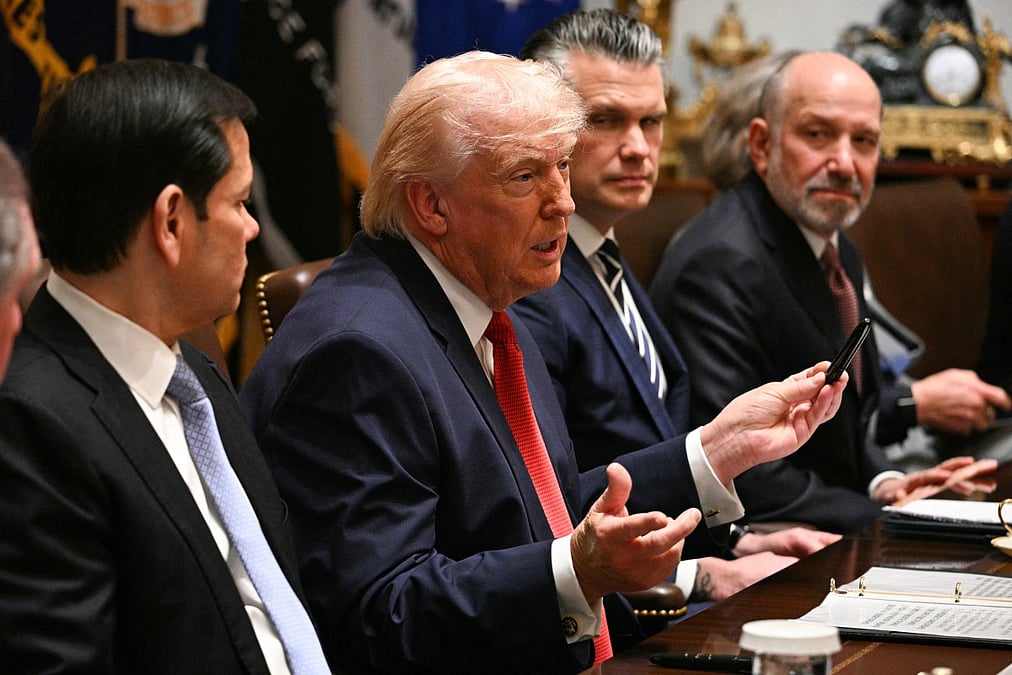
President Donald Trump is telling the American people that they have won.
“Nothing!” Mr. Trump wrote on June 18 in a post on his social media account, where he also listed the benefits of a memorandum of understanding to continue negotiations with Iran over the next 60 days.
But an objective analysis reveals that more than 100 days of conflict have fundamentally altered the landscape for the United States. The deaths of 13 U.S. service members alongside more than 7,500 civilians in the region tell a far more complicated story than the one painted by President Trump.
Specifically, while the estimated cost of the war hovers around $40 billion, the true total is much higher. According to preliminary data from an upcoming analysis by the Center for Strategic and International Studies (CSIS), the conflict has cost the U.S. Department of War approximately $40 billion. This figure includes the cost of munitions, destroyed equipment, and damage to bases, but excludes operational costs already factored into the department’s more than $1 trillion budget for fiscal year 2026.
The war has also strained the U.S. arsenal. Experts and officials told CNN that the military has expended a significant portion of its critical missile stockpiles. CSIS estimates that the first 100 hours of the conflict alone cost the U.S. $3.7 billion. By the 12th day, the cumulative total had ballooned to roughly $16.5 billion. President Trump invoked the Defense Production Act in early June to compel defense companies to manufacture more weapons, but such efforts take time to yield results.
Domestic and global oil prices remain elevated as a consequence of the blockade on the Strait of Hormuz—the world’s strategic chokepoint for oil transit. This has proven a bitter pill to swallow for Mr. Trump, who has championed fossil fuel extraction as a cornerstone of his agenda. Gas prices in the U.S. surged from a national average of under $3 per gallon to over $4 for most of the war. Now, as crude oil shipments through the Strait of Hormuz resume, the public is waiting for prices to drop. However, that relief will likely take time, and Americans continue to feel the pinch at the pump daily.
The conflict with Iran has simultaneously driven up fertilizer prices, threatening long-term impacts on the agricultural sector and American farmers’ incomes. Meanwhile, the world’s largest economy sees its Strategic Petroleum Reserve sitting at its lowest levels since 1983.
All of these costs have pushed U.S. inflation above 4% for the first time in three years, according to recent data from the Bureau of Labor Statistics. While that figure remains far below the peaks seen during the Covid pandemic years, it is double the target the Federal Reserve typically demands before lowering interest rates. Stubbornly high inflation helps explain why the Fed refused to cut rates last week, defying Mr. Trump’s wishes. Ironically, prices are currently rising faster than the average wage growth of Americans over the past year. In other words, inflation effectively eroded wage gains in April and May—the first time this has occurred since 2023.
Domestic Political Pressure The political risk for Mr. Trump and the Republican Party is now immense, a direct consequence of the economic burdens everyday Americans are enduring. Rising inflation driven by the conflict has squeezed many of his core voters, forcing the White House to scramble for economic stability ahead of the midterm elections in November.
A Fox News poll released last week showed that 58% of American voters believed Washington was wrong to launch military action against Iran back in February. Meanwhile, 75% of Republican voters maintained the decision was correct, and only 35% of overall voters expressed satisfaction with how Mr. Trump has handled the Iran portfolio.
Depleted Leverage Over Iran The return of the U.S. and Iranian delegations to the negotiating table on June 21, coupled with initial breakthroughs on core disagreements, offers a glimmer of good news.
However, Mr. Trump may now possess less leverage than he did when negotiations took place in February before the outbreak of war. At that time, Iranian leadership feared a U.S. assault could trigger a regime collapse. Today, Tehran’s establishment has demonstrated its capacity to survive, even following the death of Supreme Leader Ayatollah Ali Khamenei on February 28.
Meanwhile, the American president has repeatedly acknowledged that disruptions to oil flows through the Persian Gulf represent a U.S. vulnerability. Tehran has also proven it is willing and able to shock global energy markets using little more than threats aimed at maritime shipping.
Vice President JD Vance and senior U.S. officials must now resolve a mountain of issues that Mr. Trump sidelined in order to secure a ceasefire and reopen the Strait of Hormuz, effectively attempting to roll back the clock to the status quo before the first U.S. airstrikes on February 28. Yet, the concessions made by the White House to revive talks have now become a primary target of criticism from Mr. Trump’s political opponents.
The U.S. president has adopted a softer tone, backing away from calls for regime change in Iran. He also stated he understands Tehran’s need for ballistic missiles—a stance that has unnerved many U.S. allies. Even so, he continued to issue threats, such as in his message on June 21 just as talks were getting underway. But Iran’s defiant pushback during the meetings in Switzerland signals that the dynamic has shifted.
“Mr. Trump has very little room left to escalate or retaliate against Iran,” said Aaron David Miller, a U.S.-Israel relations expert who has advised both Republican and Democratic administrations.
According to Miller, applying pressure on Iran at this juncture would mean restarting the war or reimposing a naval blockade—options fraught with the exact consequences Mr. Trump wishes to avoid.
“We have significantly undermined our own deterrence against Iran,” he said.
Furthermore, the Strait of Hormuz has now been transformed into a leverage point for Iran to apply counter-pressure on the United States.

New Rifts in the U.S.-Israel Alliance The U.S. and its allies once lauded the damage inflicted on Iran by the airstrikes. Now, however, both Mr. Trump and Vice President Vance are facing a growing backlash from the very factions that initially supported the strikes against Iran, particularly after the two U.S. leaders ramped up their criticism of Israel for failing to comply with the terms of the agreement.
Israel has continued to launch retaliatory strikes against what it identifies as Hezbollah bases in Lebanon, following ambushes on Israeli soldiers by the militant group. U.S. intelligence agencies are now warning that Israel will likely seek to undermine the current agreement. For its part, Tel Aviv argues it has a legitimate case, maintaining that it bears the direct brunt of Iranian proxy forces in the region and therefore reserves the right to respond.
The inclusion of a Lebanese ceasefire in the agreement is expected to strain the U.S.-Israel alliance further, as it effectively forces Washington to align with Iran’s posture regarding security in Lebanon.
Israel is anticipated to balk at the U.S.-Iran blueprint, having been kept in the dark about the details of the agreement and excluded from the negotiations, only to find itself suddenly bound by the deal. Consequently, the ultimate success of the U.S.-Iran negotiations in Switzerland may well be decided in Jerusalem.
Trump Gets Negative Reviews Internationally as Fewer Say U.S. Is a Reliable Partner
36-country survey finds declining ratings for the U.S. amid rising concerns about its foreign policy and the health of its democracy
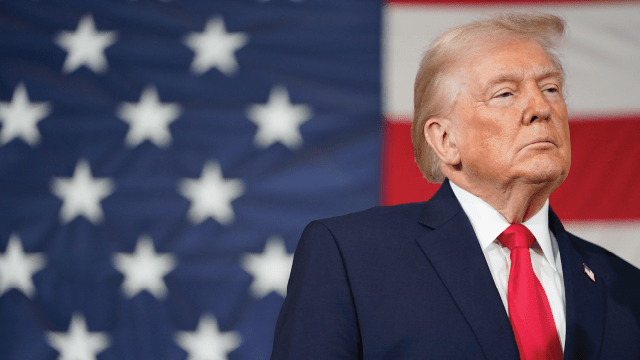
A new Pew Research Center survey finds negative – and often overwhelmingly negative – views of U.S. President Donald Trump in regions around the globe.
Across 36 nations polled, a median of 23% of adults express confidence in his leadership of world affairs. In many countries, confidence in Trump has slipped since last year.
Overall ratings for the United States are also largely negative. Favorable views of the country have declined in many places over the past year, including double-digit drops in Indonesia, Italy, Nigeria, South Africa, South Korea and Turkey.
There are seven nations in the study where a majority of adults rate the U.S. positively. The highest rating (81% favorable) comes from Israel. Some of the lowest ratings are from predominantly Muslim publics, such as Malaysians, Pakistanis, Turks, and Palestinians in the West Bank and East Jerusalem. (We were unable to survey in Gaza.)
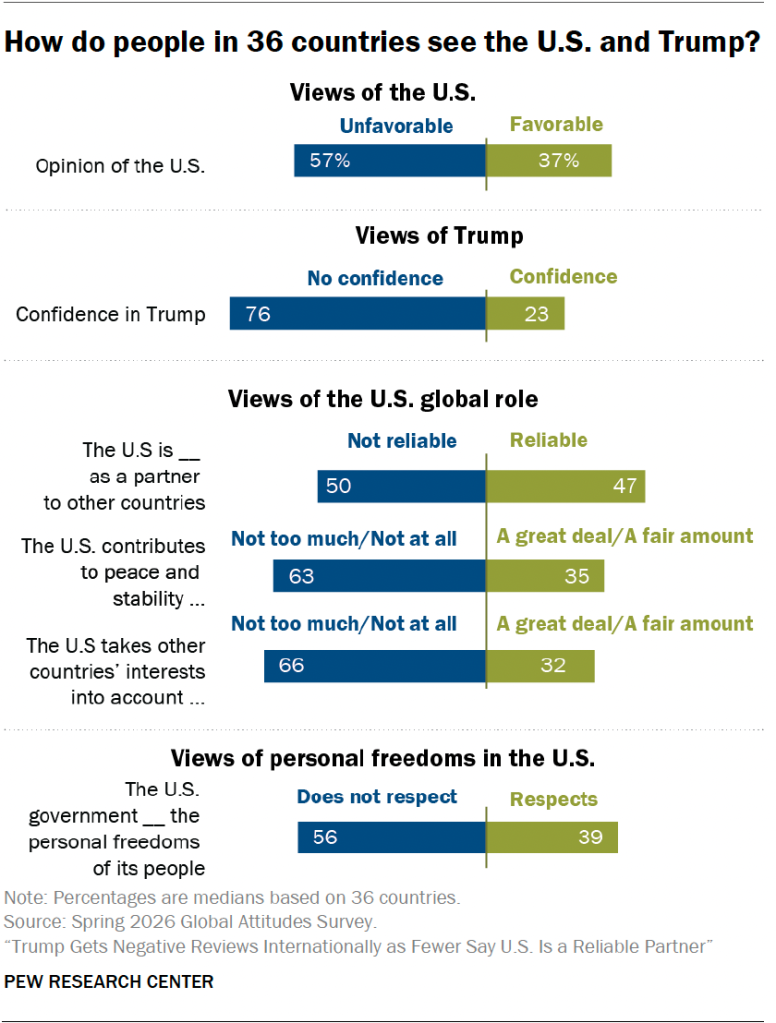
Trump gets mostly poor marks for his handling of key foreign policy issues, including tariffs, Gaza, Iran, Greenland and the Russia-Ukraine war.
The survey reveals striking changes over time in how people perceive the U.S. and its role in world affairs.
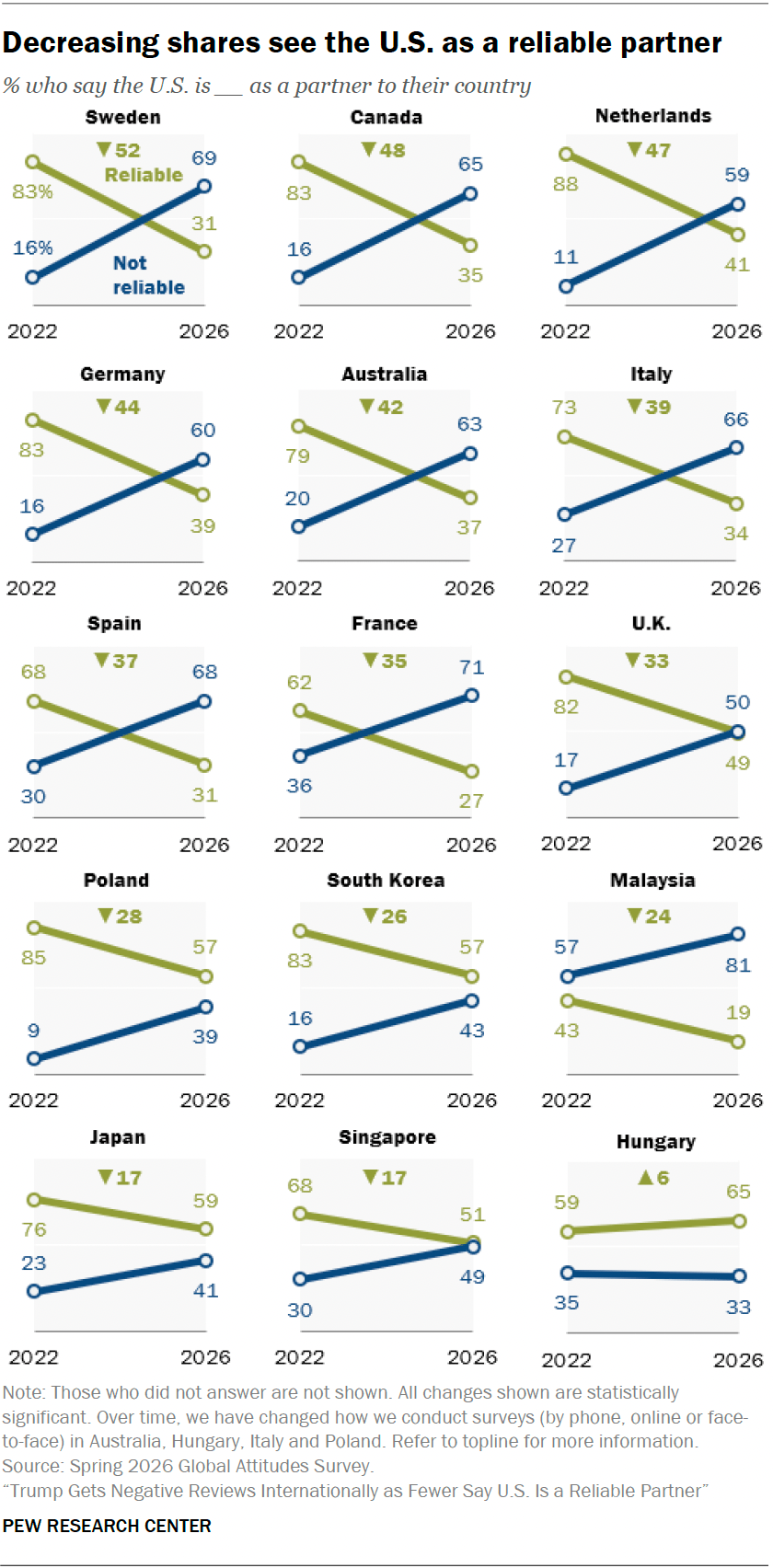
The share of the public who considers the U.S. a reliable partner has declined steeply in many countries since we last asked this question in 2022, during Joe Biden’s presidency.
This downward turn in opinion has taken place in several nations with which the U.S. has longstanding economic and security ties. For example, in Canada, 83% described the U.S. as a reliable partner in 2022, compared with 35% today. Large declines have also been measured in some of America’s key Asia-Pacific partners.
For more views of U.S. reliability over time, refer to Appendix A.
A 36-country median of 35% say the U.S. contributes to peace and stability around the world. The share of people who hold this view is down significantly in many countries since 2023.
Similarly, the share who think the U.S. takes into account the interests of other countries when making foreign policy decisions has declined in most nations where trends from 2023 are available.
For instance, 60% of Germans three years ago said the U.S. considers other countries’ interests, but that share has dropped to 23% today. German public opinion is now similar to or more negative than what was measured during George W. Bush’s presidency, when many people in Europe and elsewhere strongly opposed the war in Iraq and other major elements of U.S. foreign policy. In surveys conducted from 2002 to 2007, between 27% and 53% of Germans said the U.S. considers the interests of countries like theirs when making foreign policy.
Our polling over the past few years has found widespread concerns about the health of American democracy in many places, and the new survey shows that large shares of people around the world no longer believe the U.S. respects individual liberty.
A 36-country median of 39% say the U.S. government respects the personal freedoms of its people, while 56% say it does not.
In 12 of the 13 countries where we last asked about this in 2021, during the Biden administration, there have been double-digit declines in the shares who say the U.S. respects personal freedoms.

Over a longer span, some of these shares have fallen even farther in several of these nations.
A 2013 Center survey represented a high point for this measure in several nations we have polled regularly. That year, as Barack Obama began his second term as president, three-quarters or more in Australia, Brazil, Canada, France, Germany, Israel, Italy, Japan, Poland, the Philippines, South Korea and the United Kingdom said the U.S. respected personal freedoms.
However, in 2014, this view became less common in some countries after disclosures by former National Security Agency contractor Edward Snowden revealed the government’s vast capacity to intercept communications around the world.
This year, the share of the public saying the U.S. respects personal freedoms is the lowest it’s been in several countries we have surveyed for years, including Australia, Brazil, Chile, Greece, Indonesia, Italy, Kenya, Mexico, the Netherlands, Peru, the Philippines, Poland, South Africa, South Korea and Sweden.
For more views of the U.S. government’s respect for personal freedoms over time, refer to Appendix A.
For this report, we surveyed 42,151 people in 36 countries from Feb. 8 to May 13, 2026.
Where does Trump get his highest and lowest ratings?
Trump gets his best ratings in the Philippines, Israel, Nigeria, Kenya and Ghana.
In Israel, views of Trump are considerably more positive among Jews (79% have confidence in him) than among Arabs (13%).
And in Nigeria, Trump receives more positive ratings among Christians (87%) than Muslims (33%). Since last year, confidence in him has risen by 6 percentage points among Christians but dropped by 41 points among Muslims.
There are 26 places surveyed in which 30% of the public or less expresses confidence in the U.S. president. In Turkey, as well as in the West Bank and East Jerusalem, that share is in the single digits.
Confidence in Trump has declined since last year in 16 of 24 nations where trend data is available. There is no country surveyed in which attitudes toward him have become more positive.
In 18 of 27 countries where we measure political ideology, people on the right are more likely than those on the left to express confidence in Trump. He receives particularly positive marks from Europeans with favorable views of right-wing populist parties. Still, even among supporters of some of these parties, Trump’s ratings have worsened since last year.

How do ratings of Trump compare with previous presidents?
Pew Research Center has measured international attitudes toward U.S. presidents for over two decades, charting large shifts in public opinion in many regions. Findings from France, Germany, Spain and the U.K. highlight some long-term trends in views of recent presidents.
The latest ratings for Trump in these four nations, while low, tend to be slightly higher than at the end of his first term. They’re about equal to or somewhat higher than ratings for Bush at the end of his second term.

Obama consistently received much higher ratings in these Western European countries during his two terms in the White House. Views of Biden were also relatively positive, although attitudes toward Biden turned more negative over the course of his presidency.
For more on confidence in Trump and previous U.S. presidents over time, refer to our detailed data sheet.
Do people approve of how Trump is handling major international issues?
We asked respondents whether they approve or disapprove of how Trump is dealing with eight key global issues. At least half of adults in most countries disapprove of how he is handling each of these.
In every nation surveyed, most or all interviews took place after the U.S. and Israel launched the military conflict with Iran on Feb. 28, 2026.
Related: Israelis, Palestinians, Americans See War in Iran Differently
Overall, a median of 74% of adults across 36 nations disapprove of how Trump is dealing with Iran. Israel is the only country where a clear majority (73%) approve, though 51% also express this view in Kenya and Nigeria.
Relatively few approve in Pakistan (21%) and Turkey (5%), which share a border with Iran. Similarly, just 5% of Palestinians in the West Bank and East Jerusalem approve.

To explore how the war may have affected overall views of the U.S., we conducted a separate analysis using a statistical technique called regression. The results suggest that as the war – and our survey fieldwork – progressed, attitudes toward the U.S. became more negative in some countries.
For more, read: “What happens when war breaks out in the middle of a survey?”
Trump gets his highest ratings on international humanitarian aid, though most disapprove of how he’s handling this issue. (We did not ask about knowledge of the Trump administration’s cuts to foreign aid or knowledge of its other policies.) Majorities approve of how he has dealt with humanitarian aid in five of the middle-income nations (as defined by World Bank lending groups) surveyed: the Philippines (66%), Kenya (65%), Sri Lanka (57%), Colombia (56%) and Peru (55%).
Trump gets his second-highest ratings on immigration. His immigration policies tend to be more popular among people on the ideological right, and especially Europeans who support right-wing populist parties.
A median of just 22% approve of the way Trump has dealt with Venezuela. Still, views are slightly more positive in some Latin American nations, including Venezuela’s neighbor Colombia (46%).
Trump receives low marks in Europe for his handling of both Greenland and the Russia-Ukraine war. For more, read: “European views of Trump and the U.S. are especially negative.”
There is no country in which a majority approves of how Trump is dealing with the conflict in Gaza. (At the time of our survey, a fragile ceasefire existed between Israel and Hamas.) Very few Palestinians in the West Bank and East Jerusalem approve (3%), while Israelis are divided: 48% approve and 48% disapprove, with Israeli Jews (57% approve) and Israeli Arabs (14%) expressing very different views.
The Trump administration’s tariff policies are widely unpopular. Kenya is the only country surveyed in which a majority (55%) approve of how Trump is handling this issue. Attitudes are especially negative in many nations with which the U.S. has major trade relationships, including the U.K. (27% approve), India (18%), Canada (17%), Japan (15%), South Korea (14%), Mexico (11%) and Germany (8%).
For more views of Trump’s foreign policy actions, refer to Appendix A.
Do people around the world view the U.S. favorably or unfavorably?
Across the 36 countries surveyed, a median of 37% of adults express a favorable view of the U.S., while 57% have an unfavorable view.
In Europe and the Asia-Pacific region, opinions are largely negative: Seven-in-ten or more in many of these nations rate the U.S. unfavorably.
The U.S. receives its highest rating in Israel, at 81% favorable, while roughly eight-in-ten in Turkey and in the West Bank and East Jerusalem see the U.S. negatively.
In past surveys, the U.S. has received largely favorable ratings in the African nations surveyed. This year, views are relatively more positive than not in Ghana, Kenya and Nigeria. Still, favorable ratings are down 15 points since last year in Nigeria, as well as in South Africa.
Latin Americans express a range of opinions. Most Colombians rate the U.S. positively, while views are more divided in Peru, Brazil and Argentina. Around half or more Mexicans and Chileans have an unfavorable opinion.
Favorable views have declined significantly in 15 of 24 nations where trends from last year are available. Mexico is the only country where views improved, from 29% to 40% favorable.
In many of the countries we have surveyed since 2002 – including Canada, France, Germany, Italy, the Philippines, South Africa, South Korea and the U.K. – positive ratings are at or near the lowest they’ve been.

And although overall ratings for the U.S. are positive in Israel and Nigeria, they are at historic lows in our polling among some subgroups in both countries. Only 19% of Arab Israelis express a favorable view of the U.S., down from 29% last year and the lowest share we’ve measured in any of our Israel surveys. In contrast, 96% of Jewish Israelis have a favorable opinion of the U.S.
Similarly, a record-low 36% of Nigerian Muslims rate the U.S. favorably, down drastically from 73% last year. Roughly eight-in-ten Nigerian Christians (82%) express a favorable view.
For more on views of the U.S. over time, refer to our detailed data sheet.
Does the U.S. contribute to peace and stability?
A median of 35% of adults across the 36 nations polled think the U.S. contributes a great deal or a fair amount to peace and stability around the world.
However, opinions vary widely. Around seven-in-ten or more in the Philippines (77%), Kenya (74%) and Israel (73%) say the U.S. contributes to global stability, while one-in-five or fewer share this view in Argentina (20%), the Netherlands (19%), the West Bank and East Jerusalem (14%) and Turkey (10%).
People have become much less likely to believe the U.S. adds to global peace and security since we last asked this question in 2023, during the Biden administration. This share of the public has shrunk in 19 of 22 countries where trend data is available. In Sweden, the Netherlands, Poland, Canada and Australia, it’s fallen by 30 points or more.
For more views of the U.S. contributing to peace and stability over time, refer to Appendix A.

Does the U.S. consider other countries’ interests?
Across the 36 nations polled, a median of 32% of adults think the U.S. takes into account the interests of countries like theirs a great deal or a fair amount in its foreign policy decisions.
Majorities hold this view in the Philippines (74%), Kenya (68%), Israel (68%), Nigeria (64%) and Sri Lanka (62%).
Few in the NATO member states surveyed say the U.S. considers their interests. Hungarians (35%) are the most likely of these allies to say it takes other nations’ interests into account, followed by the U.K. (26%). Only 10% in France and 8% in Sweden express this opinion.
For more, read: “European views of Trump and the U.S. are especially negative.”
This view has become less common in 19 of 22 countries where trend data from 2023 is available.
In many nations where we have been asking this question over many years, the share of the public who think the U.S. considers other countries’ interests is at or near an all-time low, while the share who say it does not is at or near an all-time high. This is the case in Germany, Indonesia, Japan, Mexico, South Africa and the U.K.


:max_bytes(150000):strip_icc():focal(749x0:751x2):format(webp)/Christianna-Apps-5-121825-ae06cb988405460987109364d7c522c3.jpg?fit=750,500&ssl=1 "Mom Captures Toddler’s ‘Dramatic’ Reaction to His New Sibling, Jokes ‘He Woke Up and Chose Violence’ (Exclusive)")




:max_bytes(150000):strip_icc():focal(753x271:755x273):format(webp)/cole-the-deaf-dog-112125-1a-ad248101bd174108a795d88d6afd93d8.jpg?fit=750,500&ssl=1 "Elementary School Throws Deaf Therapy Dog a Surprise Birthday Party as Students Learn Sign Language to Sing ‘Happy Birthday’")


:max_bytes(150000):strip_icc():focal(749x0:751x2)/Shillington-Police-Department-111325-c65821925fbf4f959879c38a06d24fa6.jpg?fit=1500,1000&ssl=1 "Dog shoots owner in the back after jumping on shotgun left on bed: Police")



:max_bytes(150000):strip_icc():focal(608x271:610x273)/CHER-poses-with-Dolly-Parton-for-a-portrait-in-1978-in-Los-Angeles-082625-6ed6da39310343ba97c5b376375a3cdc.jpg?fit=1500,1000&ssl=1 "Dolly Parton’s niece Danielle Parton opens up about cancer battle, new estate role")


