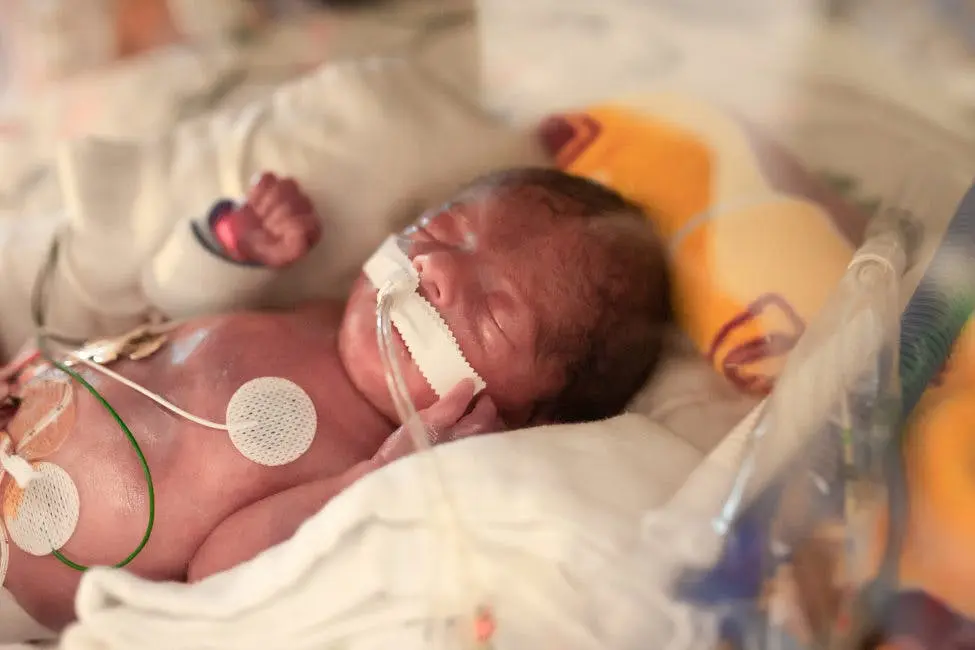
Apreemie born at just 27 weeks is finally home from the hospital 14 months after his birth. In his short life, he has had to overcome medical challenge but is now reportedly doing well. Hospital staff celebrated his discharge with cheers.
According to People magazine, Judea “Juju” Monogan weighed just 1.5 pounds when he was born and spent the first year of his life after birth at three different hospitals getting the care he needed. It is unclear at which hospital he was born, but shortly after his birth he received care at a second hospital, before being transferred to Children’s Hospital Los Angeles (CHLA) on September 4, 2024.
There, he was treated for severe infant chronic lung disease, also called bronchopulmonary dysplasia. It is caused by poor lung growth and lung injury and often occurs in premature babies who require respiratory support after birth.
“Juju was born very premature and when he came to CHLA, he suffered from severe lung disease and needed very specialized care that we provide in our NICCU [Newborn and Infant Critical Care Unit],” said Dr. Narayan Iyer, a neonatologist at CHLA. “He has a lot of growth and development in front of him, but we fully expect him to play T-ball like every kid by the time he is five.”
Dr. Iyer said Juju’s recovery had a lot to do with his family’s presence at the hospital. They were able to stay close to him during those long months in the hospital thanks to the Ronald McDonald House. Juju spent nine months in the NICCU.
“We have lived in the NICCU with Juju,” said his mother, Irish. “To go from thinking you would not walk out of here with your son, to then doing just that — walking out of here with your son — it is an indescribable feeling.”
Although Juju will continue to require outpatient care through CHLA’s Infant Chronic Lung Disease Program, he is expected to do well.
Babies born at 27 weeks reportedly have a 91% chance of survival.

Rare doesn’t mean random. My daughter’s life proves it.

Disclaimer: Opinions expressed in this guest post are solely those of the author.
In 2022, my second pregnancy quickly shifted from a joyful, “typical” experience to something I never could have prepared for. My routine anatomy scan revealed that my daughter, Marsaili, had multiple serious complications.
I went in expecting to get ultrasound pictures I could show to our then four-year-old. I expected to celebrate his baby sister with him and my husband. Instead, I walked away traumatized after hours of detailed scans, an unexpected amniocentesis, and a doctor asking me if I wanted to terminate.
As frightened as we were, termination was never an option. Marsaili was our daughter. She was created with great purpose, even if we didn’t fully understand that purpose just yet. We still don’t fully understand why God chose this path for us, but I can say that He has slowly revealed pieces to us over time.
Finding God in the wilderness
For a while, I didn’t understand why my husband and I went to high school together but didn’t meet until years later. I didn’t understand why I spent nearly a decade earning a doctorate degree in physical therapy just to quit within five years and come home.
But after the anatomy scan, I found comfort in this: God brought me home at the right time. He blessed me with a wonderful husband and the perfect former career. Both my studies and my choice to be home were ways God had prepared me for what was to come. It made me confident that He would sustain us, and He did.
Through every hospital stay, every ambulance call, every uncertainty, God met us in the wilderness. Even as Marsaili’s last days were approaching, I knew He would not forsake us. He had comforted us from the moment Marsaili was conceived.
We felt the presence of the Holy Spirit as she took her last breath in my arms, and we still feel His comfort to this day. But even with the knowledge that He is so good and faithful, we still find ourselves baffled by the chances of our story actually happening.

Astronomically small odds
It wasn’t until weeks before Marsaili passed that we finally got answers from genetic testing revealing why she had so many complications. She had an ultra-rare genetic disorder, and there is only one study in existence examining the condition. The study included fewer than 20 patients, which means Marsaili was likely one of fewer than 20 known cases globally with this condition.
Marsaili’s condition involves loss-of-function variants in the PPFIBP1 gene. It is autosomal recessive, which means a child has to inherit two non-working copies of the gene (one from each parent) in order to be affected. If both parents are carriers, there’s a 25% chance with each pregnancy that the child will inherit both copies of the dysfunctional gene.
I could make sense of that math. I had studied basic genetics in school. But I couldn’t comprehend how two unrelated people (my husband and I) from different ancestral backgrounds could both carry this rare genetic anomaly, meet, fall in love, get married, and then have children. If life were just a system of random events, what were the odds of that?
Given the extremely rare nature of the condition, the exact carrier frequency of PPFIBP1 loss-of-function variants is unknown. However, the study identified these variants as “ultra-rare” and absent from large population databases, such as gnomAD. Based on general population genetics modeling for recessive conditions with very few cases, carrier frequencies for variants this rare are often estimated at roughly 1 in 5,000 to 1 in 10,000 individuals.
For context, the carrier frequency for cystic fibrosis (a more widely known autosomal recessive condition) is about 1 in 25 to 1 in 30 people. That’s wildly different than 1 in 10,000.
To estimate the odds of both my husband and I being carriers of this ultra-rare gene:
• Using the higher estimate, 1 in 5,000 × 1 in 5,000 = 1 in 25,000,000.
• Using the lower estimate, 1 in 10,000 × 1 in 10,000 = 1 in 100,000,000.
So, the likelihood of two unrelated individuals both being carriers and then marrying could be tens of millions to one. And that’s before we even consider the next layer: the astronomical odds of any one person existing at all.
Biologists estimate the probability of one specific sperm meeting one specific egg (the exact combination that makes you who you are) is astronomically small. Some estimates put it at one in hundreds of trillions. And that’s just for any single person.
In our story, we’re not just talking about the improbability of a person existing in general. We’re talking about the improbability of this specific little girl existing—our Marsaili. Her exact genetic code was so rare. She was born to two parents from completely different ancestral backgrounds who unknowingly carried the same ultra-rare gene that hadn’t even been described in medical literature yet.
The blessing
When the odds are all stacked on top of one another, it is unfathomable how miraculous it is that Marsaili existed at all. Other than divine intervention, God-breathed creation, I have no explanation for the blessing of her life.
Now some people have told me that God couldn’t be responsible for something like this. I understand that, but I don’t believe my daughter’s life was random. Where some see her as just a statistic, I see the fingerprints of God. One who is sovereign over biology, over my existence, over DNA replication, and over probability itself.
Rare does not mean random. Marsaili was not a statistical accident. She was (and still is) our daughter. She was fully and intentionally created by the God who made the stars in the sky and every hair on her head.
I still don’t fully know why the path He chose for us required us to release her into the arms of Jesus so soon, but I do know this: she was not an anomaly. She was a miracle. Her life and her story have great purpose.
And because of Jesus, we will see her again.
:max_bytes(150000):strip_icc():focal(749x0:751x2):format(webp)/Mary-B-Premature-Baby-121925-8be6c0dca6784de0879dbeab3aab0038.jpg?fit=750,500&ssl=1 "Mom Brings Home 1 Lb. Baby After 146 Days in NICU. Now 11 Months, the ‘Tough Little Cookie’ Has More to Overcome (Exclusive)")




:max_bytes(150000):strip_icc():focal(952x337:954x339):format(webp)/my-extroardinary-family-la-triplets-82725-2e8ea06ef062473485958c7058a94c01.jpg?fit=750,500&ssl=1 "Pregnant Woman Went to Check Baby’s Heartbeat. Then She Found Out She Was Expecting Rare Identical Triplets (Exclusive)")



:max_bytes(150000):strip_icc():focal(753x271:755x273):format(webp)/cole-the-deaf-dog-112125-1a-ad248101bd174108a795d88d6afd93d8.jpg?fit=750,500&ssl=1 "Elementary School Throws Deaf Therapy Dog a Surprise Birthday Party as Students Learn Sign Language to Sing ‘Happy Birthday’")



:max_bytes(150000):strip_icc():focal(999x0:1001x2)/catherine-ohara-013026-7-4b5b413a646d4f15a1fd15ac8b933811.jpg?fit=2000,1334&ssl=1 "Catherine O’Hara was being treated for cancer when she died of a pulmonary embolism, death certificate says")

:max_bytes(150000):strip_icc():focal(787x286:789x288)/kate-middleton-national-portrait-gallery-london-020625-2-9f9c0e144582457683b62672597dbf19.jpg?fit=1500,1000&ssl=1 "King Charles set to give Kate Middleton power to put billion ‘Kate Effect’ into action")


:max_bytes(150000):strip_icc():focal(749x0:751x2):format(webp)/Katie-Bates-Pregnancy-Loss-011726-d6421e92f38a431b92ff1cd350c5226c.jpg?fit=750,500&ssl=1 "Bringing Up Bates’ Katie Bates Announces Pregnancy Loss: ‘I Will Spend the Rest of My Life Missing You’")


:max_bytes(150000):strip_icc():focal(740x142:742x144)/woman-with-baby-arguing-with-husband-050625-7cb080a983fc464eb184f294a1e43332.jpg?fit=128,85&ssl=1 "A new mom asked her husband for help with their newborn at 4 AM. His mother’s response enraged me")