
The Trump administration launched a major military attack on Venezuela on Saturday morning, bombing facilities and capturing leader Nicolás Maduro and his wife and flying them to the United States to face charges. President Donald Trump said the U.S. will temporarily “run” Venezuela and work to tap the country’s massive oil reserves.
“We’re going to run the country until such time as we can do a safe, proper and judicious transition” to new leadership, Trump said during a press conference in Florida. He didn’t provide more detail about how the U.S. would control Venezuela, saying that a group of officials would be named to oversee it.
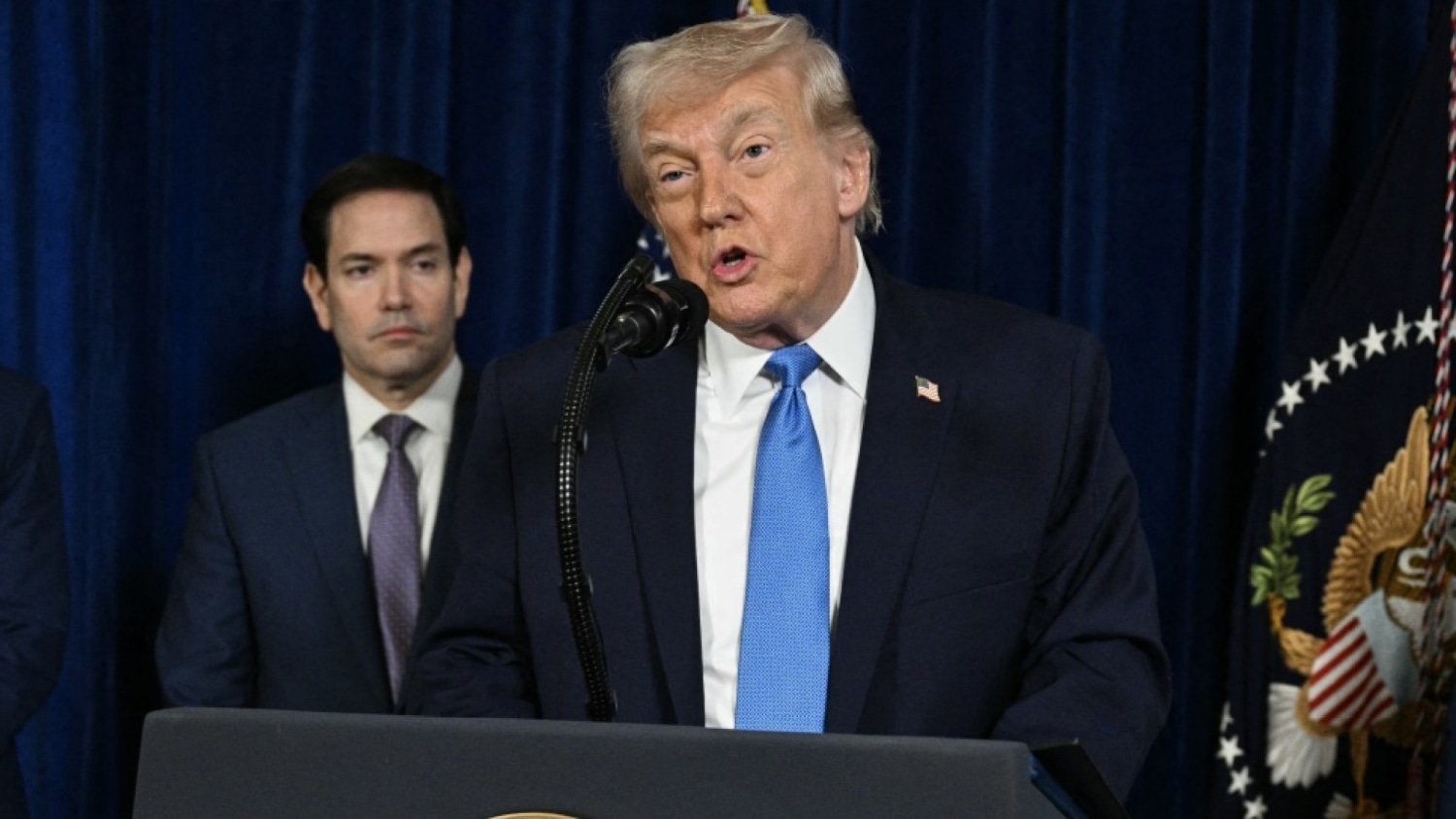
Trump said he didn’t want a new leader to take over in the wake of Maduro’s capture who would result in “the same situation that we had for the last long period of years.”
“We can’t take a chance that somebody else takes over Venezuela that doesn’t have the good of the Venezuelan people in mind,” Trump said.
The U.S. president added that the U.S. military was prepared to strike Venezuela again if needed.
“We are ready to stage a second and much larger attack if we need to do so. So we were prepared to do a second wave if we need to do so,” Trump added.
After questions from reporters about whether the U.S. running Venezuela will involve military personnel on the ground, the president said, “We’re not afraid of boots on the ground.”
“We don’t mind saying it, but we’re going to make sure that that country is run properly. We’re not doing this in vain,” he added.
At the press conference Saturday, Trump confirmed that the Venezuelan president and first lady were en route to New York, where he said Maduro had been indicted. The Venezuelan leader arrived in New York on Saturday afternoon and could appear in court as early as Monday.
The U.S. president said that Venezuelan Vice President Delcy Rodriguez “was sworn in as president just a little while ago” and had a “gracious” conversation with Secretary of State Marco Rubio to offer her support. But on state television later, Rodriguez told the Venezuelan public, “We demand the immediate liberation of President Nicolás Maduro and his wife, Cilia Flores,” calling Maduro “the only president of Venezuela.”
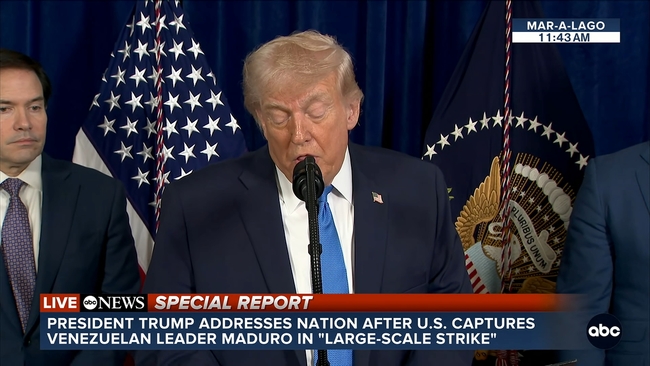
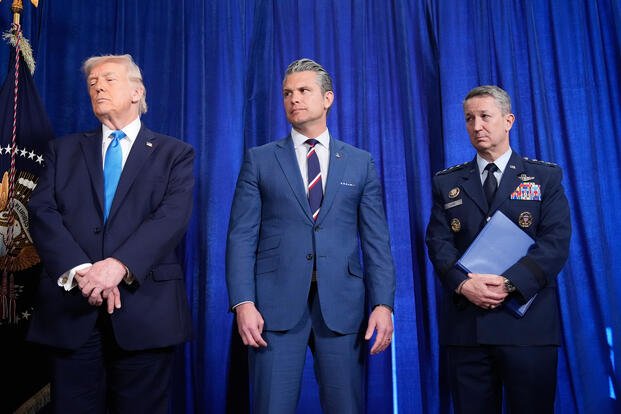
Trump’s remarks were delivered at his Mar-a-Lago resort in Florida, where he was flanked by some of his top advisers — including Rubio, Defense Secretary Pete Hegseth and Gen. Dan Caine, the chairman of the Joint Chiefs of Staff.
The military operation, which officials said had been planned for months and took several hours, is the latest move that the Trump administration has described as part of a crackdown on drugs entering the U.S. It comes just weeks before the first anniversary of Trump’s second inauguration.
Two U.S. officials familiar with the planning told NBC News on Saturday that Trump approved the military and law enforcement actions in Venezuela more than a week ago.
In remarks Saturday, Caine confirmed that military forces waited over a week for the weather to clear up.
“Weather in Venezuela is always a factor this time of the year, and over the weeks through Christmas and New Year’s, the men and women of the United States military sat ready, patiently waiting for the right triggers to be met and the president to order us into action,” Caine told reporters.
“Last night, the weather broke just enough, clearing a path that only the most skilled aviators in the world could maneuver through,” he added.
Caine said that Trump gave the order to go at 10:46 p.m. ET on Friday night and military forces arrived at Maduro’s compound by 1:01 a.m. ET on Saturday morning. By 3:29 a.m. on Saturday morning, Caine said, the military forces were back over water with Maduro and Flores.
Trump, who said he watched the operation unfold live from Mar-a-Lago, said that Maduro “was trying to get into a safe place” made of steel as U.S. military forces stormed his compound.

“He was trying to get to a safe place, which wasn’t safe, because we would have had the door blown up in about 47 — I think, 47 seconds,” the U.S. president added. “It was a very thick door, a very heavy door, but he was unable to get to that door. He made it to the door. He was unable to close it.”
Caine said that the aircraft used in the operation included multiple types of military planes, plus remotely piloted drones, all of which he said helped protect the helicopters and personnel in Caracas. Caine added that the U.S. helicopters were fired on and U.S. forces “replied to that fire with overwhelming force in self-defense.”
Caine added that one U.S. military aircraft sustained damage but was still able to fly. Later Saturday, one U.S. official and one White House official told NBC News that the operation in Caracas resulted in several injuries to U.S. troops, all of whom remain in stable condition.
Vice President JD Vance was also involved in the military operations, according to a spokesperson.
The vice president “joined several late night meetings via secure video conference with National Security principals leading up to the operation,” the spokesperson said.
The U.S. action was a stunning culmination of months of rising threats from Trump and his administration toward the Venezuelan leader. Carried out without congressional authorization, it immediately received pushback and questions from lawmakers. In his remarks, Trump said that U.S. oil companies were prepared to make major investments in the country.
“We’re going to have our very large United States oil companies, the biggest anywhere in the world, go in, spend billions of dollars, fix the badly broken infrastructure, the oil infrastructure, and start making money for the country,” he said.
Trump said that it wouldn’t cost the U.S. anything to “run” Venezuela, pointing to the country’s oil production.
“It won’t cost us anything, because the money coming out of the ground is very substantial,” Trump said.
Later, he added to reporters, “We’re going to be taking out a tremendous amount of wealth out of the ground, and that wealth is going to the people of Venezuela and people from outside of Venezuela that used to be in Venezuela, and it goes also to the United States of America in the form of reimbursement for the damages caused us by that country.”
In her remarks on state television, Rodriguez accused the U.S. of instituting regime change in her country solely for the purpose of extracting oil and other natural resources from Venezuela.
The U.S. “only had one objective: regime change in Venezuela. And that this regime change allows them to capture our energy resources, mineral resources and natural resources,” Rodriguez said.
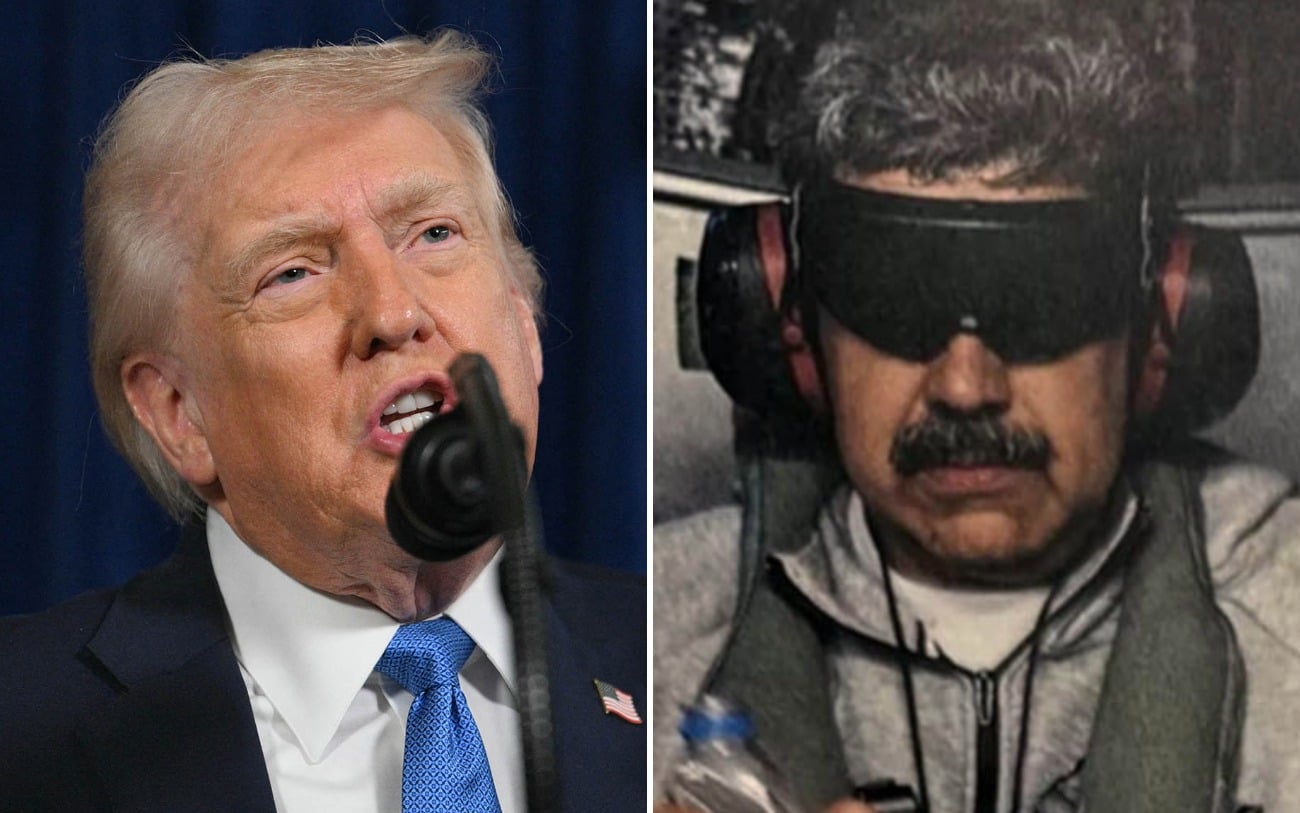
Minutes before he spoke at Mar-a-Lago, Trump posted on Truth Social a photo appearing to show Maduro aboard the USS Iwo Jima wearing an apparent blindfold and holding a bottle of water. Trump also posted a video of the U.S. strikes on Venezuela set to “Fortunate Son,” a famous anti-war song by Creedence Clearwater Revival.
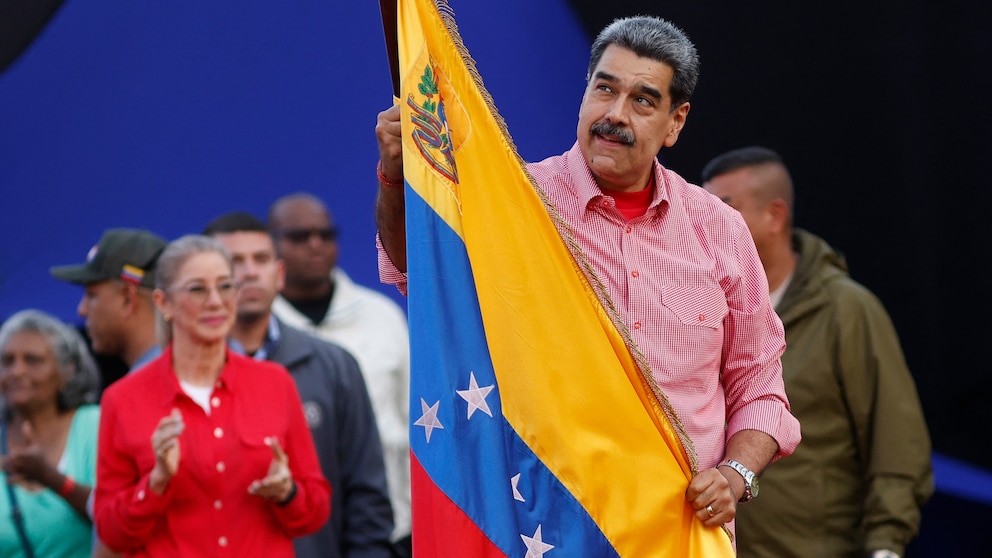
In a post on X, Attorney General Pam Bondi said the Venezuelan leader would “face the full wrath” of the U.S. justice system.
The charges against Maduro, in an indictment unsealed Saturday, include narco-terrorism conspiracy, cocaine importation conspiracy, possession of machine guns and destructive devices, and conspiracy to possess machine guns and destructive devices.
In the indictment, federal prosecutors alleged that Maduro “is at the forefront of that corruption and has partnered with his co-conspirators to use his illegally obtained authority and the institutions he corroded to transport thousands of tons of cocaine to the United States.”
They also allege that Maduro and other members of the Venezuelan government sold passports, provided protection and enabled the sale and transportation of hundreds of tons of illegal drugs through their ports, including drugs from several recognized Mexican drug cartels.
In his remarks, Trump said he had seen the evidence against Maduro that was gathered for the indictment, and he blamed the Venezuelan leader for drug trafficking and crime in the U.S.
“I’ve seen what we have. It’s both horrible and breathtaking that something like this could have been allowed to take place for many years after his term as president of Venezuela expired,” the U.S. president said. “Maduro remained in power and waged a ceaseless campaign of violence, terror and subversion against the United States of America, threatening not only our people, but the stability of the entire region.”
Maduro was first indicted, alongside 14 others in 2020, during Trump’s first administration, in the Southern District of New York. The Venezuelan leader first came to power in 2013 and was sworn in to a third term as president one year ago, despite evidence that Maduro did not win the preceding presidential election.
On Saturday, Stéphane Dujarric, a spokesman for United Nations Secretary-General António Guterres, said Guterres was “deeply alarmed by the recent escalation in Venezuela” and that the U.S. military operation had “potential worrying implications for the region.”
In a statement after the strikes, Venezuelan opposition leader Maria Corina Machado, who won the Nobel Peace Prize last year, celebrated, writing, “Venezuelans, the hour of freedom has arrived.”

Back in the U.S., Trump’s allies celebrated the unprecedented incursion on Venezuelan soil as a win against drug trafficking and for the rule of law, while Trump’s foes — including Democratic leadership in on Capitol Hill — lambasted the president for striking Venezuela without approval from Congress and questioned whether his agenda is really “America First.”
For months, Trump has hinted at taking action in Venezuela, telling NBC News last month, “I don’t rule it out,” when asked about going to war with Venezuela.
Days before that interview, the U.S. president announced a blockade of all “sanctioned” oil tankers entering and leaving Venezuela.
Last month, the U.S. also seized two oil tankers off the coast of Venezuela and the U.S. military continued its strikes on boats allegedly carrying drugs in the Caribbean Sea.
On Friday, just a day before he was captured, Maduro said in an interview on Venezuelan state television that he would be open to working with the U.S. to combat drug trafficking.
“The U.S. government knows, because we’ve told many of their spokespeople, that if they want to seriously discuss an agreement to combat drug trafficking, we’re ready,” the Venezuelan president said.

On Saturday morning, Democratic lawmakers criticized the Trump administration for launching strikes on Venezuela, specifically pointing to the fact that the White House did not seek approval from Congress for the military action.
“Maduro is an illegitimate ruler, but I have seen no evidence that his presidency poses a threat that would justify military action without Congressional authorization,” Rep. Jim Himes, D-Conn., the top Democrat on the House Intelligence Committee, said in a statement Saturday.
In a separate statement, Sen. Andy Kim, D-N.J., said, “Trump rejected our Constitutionally required approval process for armed conflict because the Administration knows the American people overwhelmingly reject risks pulling our nation into another war.”
In the phone interview on Fox News late Saturday morning, Trump pushed back on Democrats’ criticism, calling them, “weak, stupid people.”
“As far as last night is concerned, it was really genius. What they did is genius, and the Democrats, maybe they’ll take a shot, you know? They’ll take a shot. All they do is complain,” the president added. “They should say, ‘You know what, we did a great job.’ … They do say, ‘Oh, gee, maybe it’s not constitutional.’ You know, the same old stuff that we’ve been hearing for years and years and years.”
During the press conference in Florida, Rubio added, “This is not the kind of mission that you do congressional notification.”
“On a trigger-based mission in which conditions had to be met night after night, we watch them monitor that for a number of days. So it’s just simply not the kind of mission you can call people and say, ‘Hey, we may do this at some point in the next 15 days.’”
Trump added that congressional leaders were not notified in part because “Congress has a tendency to leak.”
Two U.S. officials told NBC News that information about the operation was so closely guarded that the Pentagon was not brought into its exact timing until last night.
Some of Trump’s allies on Capitol Hill defended his decision to execute the strikes and capture Maduro without congressional authorization.
“Today’s military action in Venezuela was a decisive and justified operation that will protect American lives,” Speaker Mike Johnson, R-La., wrote in a post on X.
The Trump administration informed top lawmakers on the Senate and House intelligence committees about the U.S. military action to capture Maduro after the operation was underway, three sources with knowledge of the matter told NBC News.
The Republican chairs and the Democratic ranking members on the congressional intelligence committees were notified about the operation, the sources said.
Senate Majority Leader John Thune, R-S.D., said in a statement Saturday that he had spoken to Rubio and is expecting further briefings next week when the Senate returns from the holiday recess.
“I spoke to Secretary Rubio early this morning, and I look forward to receiving further briefings from the administration on this operation as part of its comprehensive counternarcotics strategy when the Senate returns to Washington next week,” Thune said.
In early November, a bipartisan group of senators voted in favor of a measure that would have required congressional approval for all future military action by the Trump administration in Venezuela. The measure fell short of the 50 votes needed for passage.
The effort behind that measure came after the Trump administration began to publicize declassified videos of the military conducting kinetic strikes on boats allegedly carrying drugs in the Caribbean Sea.
In October, Trump said the strikes were part of his administration’s fight against drug cartels but stopped short of saying he’d need a declaration of war to continue striking the boats.
“Well, I don’t think we’re going to necessarily ask for a declaration of war. I think we’re just going to kill people that are bringing drugs into our country. OK, we’re gonna kill them. You know, they’re gonna be like, dead,” he said at the White House at the time.

Trump spoke about these claims again on Saturday, telling reporters in Florida, “The Maduro regime emptied out their prisons, sent their worst and most violent monsters into the United States to steal American lives, and they came from mental institutions and insane asylums. They came from prisons and jails.”
In October, the U.S. president confirmed that he had authorized covert action by the CIA in Venezuela, but did not specify what the action was.
A source with knowledge of the matter said Saturday that the CIA had a small, clandestine team on the ground in Venezuela starting in August that was able to provide “extraordinary insight” into Maduro’s movements, which made capturing him “seamless.”
Near the end of his press conference today, Trump called the situation in Cuba “similar” to that of Venezuela, responding to a question about potential military involvement in that nation.
“Cuba is an interesting case. Cuba is, you know, not doing very well right now. That system has not been a very good one for Cuba. The people there have suffered for many, many years,” he said.
The president added, “I think Cuba is going to be something we’ll end up talking about, because Cuba is a failing nation right now, a very badly failing nation, and we want to help the people. It’s very similar in the sense that we want to help the people in Cuba.”
Rubio also spoke about the island nation, adding, “If I lived in Havana and I was in the government, I’d be concerned.”
In a post on X Saturday, Cuban President Miguel Diaz-Canel said that Cuba “denounces” the U.S. strikes on Venezuela.
His nation “urgently demands the reaction of the international community against the criminal attack by the U.S. on #Venezuela. Our #ZonaDePaz [Zone of Peace] is being brutally assaulted. State terrorism against the brave Venezuelan people and against Our America. Homeland or Death We Shall Overcome!” he added.
Trump Says US Captured Venezuela’s President and Plans to “Run the Country”
Trump did not request congressional approval for the attack, saying “Congress has a tendency to leak.”

In a steep escalation in the United States’ ongoing military offensive in the region, President Donald Trump said early Saturday that the US had captured Venezuelan President Nicolas Maduro and his wife, Cilia Flores.
Trump did not seek congressional approval for this move.
In a Truth Social post, Trump wrote that the US had “successfully carried out a large scale strike against Venezuela and its leader” in an operation “done in conjunction with U.S. Law Enforcement.” Later, he posted a photo that he said was of a captured Maduro, blindfolded.
During a Saturday morning press conference at Mar-a-Lago, Trump said several times—without citing any international rule of law that would permit such an action—that the US was “going to run the country” until “we can do a safe, proper and judicious transition,” signaling an American occupation of Venezuela. The president, flanked by national security officials like Defense Secretary Pete Hegseth, Secretary of State Marco Rubio, and Stephen Miller, said the capture of Maduro and his wife was a “spectacular assault” like “people haven’t seen since WWII.”
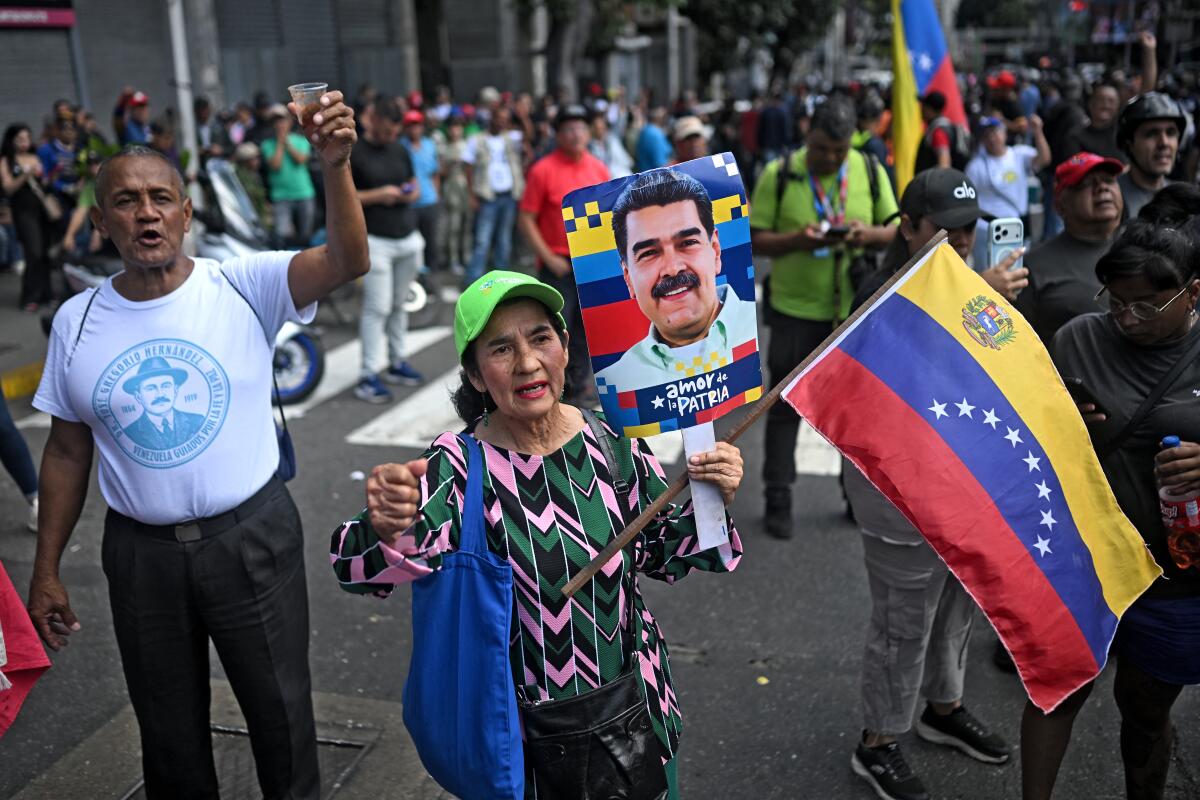
Trump also warned that the US is prepared to attack Venezuela again if necessary, and claimed that if other leaders go against the US, they may face military action: “What happened to Maduro can happen to them,” he said.
In an earlier morning interview with Fox News, the president said that Maduro and Flores were taken to the U.S.S. Iwo Jima, one of the American warships that have been operating in the Caribbean. They are set to be taken to New York, where “he will face drugs and weapons charges in Manhattan federal court,” according to CNN.
Venezuela’s Vice President Delcy Rodríguez addressed the US’s actions on a state-run television station, calling it a “brutal attack” and adding that she does not know the whereabouts of Maduro or his wife. Rodríguez, who is next in line to step into power, demanded “proof of life” from Trump.
The Trump administration’s announcement on Saturday came after months of military action in the region with the purported goal of stifling drugs coming into the US. Starting in the late summer, US forces conducted 35 known strikes against alleged drug smuggling boats in South American waters, killing at least 115 people. Videos appearing to show these strikes—which also did not go through a congressional approval process—have been shared on social media by members of the Trump administration. The US has also seized multiple oil tankers off the country’s coast, conducted a CIA-led drone strike on a dock where drugs were allegedly being prepared for loading on boats, and, early on Saturday in connection with the capture operation, carried out several strikes throughout the Venezuelan capital.
During Trump’s Saturday interview with Fox News, he said the US is “going to be very strongly involved” in Venezuela’s oil reserves. The country is home to the largest known oil reserve in the world, controlled by a nationalized company called Petróleos de Venezuela, S.A., or PDVSA. For the US, greater control over that industry could be a boon. Following one of the US seizures of tankers off Venezuela’s coast last year, Trump was asked what the US planned to do with the oil on board. He answered: “Well, we keep it, I guess.”
Several leaders from around the region condemned Saturday’s US operation in Venezuela. Cuba’s president, Miguel Diaz-Canel, accused Washington of carrying out a “criminal attack,” President Claudia Sheinbaum posted an article in the UN Charter on refraining from threat or use of force, and Brazilian President Luiz Inacio Lula da Silva said that these moves recall the “worst moments of interference” by the United States into Latin American politics.
In a scathing piece, the New York Times’ editorial board decried Saturday’s actions, saying Trump was violating US law. “We fear that the result of Mr. Trump’s adventurism is increased suffering for Venezuelans, rising regional instability and lasting damage for America’s interests around the world,” the board wrote, adding, “We know that Mr. Trump’s warmongering violates the law.”
America’s strongman places a huge Venezuela wager but evokes nightmares of regime change disasters

Millions of Americans woke up with the same question on the first Saturday of a new year: Are we at war with Venezuela?
President Donald Trump’s ouster of President Nicolás Maduro has stunning implications for Venezuela, American global power, and the shattered remnants of constitutional curbs on US presidents and international law.
The ostensible justification is that Maduro was the pinnacle of a cartel state that threatens America’s security and the well-being of its citizens with narcotics trafficking. But Trump’s claims overplay Venezuela’s role, and his transparent relish at wielding a big stick in his geopolitical backyard highlights more ambitious motives.
Few of Venezuela’s repressed citizens will lament the removal of a dictator who wrecked lives and ruined economic opportunity.
But the swoop against Maduro was a stunner, and not just because the overthrow of a foreign leader is considered an act of war.
Trump’s entire political philosophy was rooted in avoiding any more US shock-and-awe operations to enforce overseas regime change after two decades of quagmires.
What happened to the plan to stop meddling in intractable foreign politics that the US doesn’t understand? Is “America First” over?
Probably not. Instead, it’s on steroids.

Trump is still acting in the hard-eyed pursuit of what he perceives to be vital US national interests. It’s just that his definition of the concept has expanded massively since 2016. So has his appetite for wielding unchecked power, which has burst US borders and is racing through the Americas and beyond.
“America will never allow foreign powers to rob our people or drive us back into and out of our own hemisphere,” Trump warned at a remarkable news conference Saturday at his Mar-a-Lago resort. “Under our new national security strategy, American dominance in the Western Hemisphere will never be questioned again.”
Saturday proves that the United States has reverted to days when presidents and intelligence agencies sought to topple autocratic or inconvenient leaders in favor of puppet governments. It also conjures dark reminders of CIA political meddling, including in Latin America, which has often backfired.
How the Venezuela swoop could succeed
If upside projections of Trump’s bet play out, his domestic political exposure could be limited. He might ease the torment of the Venezuelan people; create stability in the northern part of South America; allow a return home of Venezuelan refugees; and blunt efforts by US foes China and Russia to gain a foothold that could threaten US security and interests.
An apparently well executed military operation without US combat deaths to grab Maduro will only enhance Trump’s reputation for orchestrating thunderclaps of military power after his strikes on Iran’s nuclear installations last year.

His recharged strongman’s personality cult will please some Republican voters, as will his defiance of constitutional limits and liberal critics. This may discourage rebellions from GOP dissidents who understand that the Constitution stipulates that Congress and not presidents declare war.
But the president is taking a risk with many in his fraying political base already chafing at his strikes in Iran, Nigeria, Syria and now Venezuela and apparent obliviousness to grinding economic conditions at home. Democrats are already hammering the theme as a bedrock of their campaign ahead of November’s midterm elections.
It’s critical to GOP political prospects that the US does not get sucked into Venezuela in vast ground troop deployments that mirror the chaos of the post-9/11 wars. But if the initial shock ouster of Maduro degenerates into violence — as it did with earlier US regime change operations in Iraq, Afghanistan and Libya, he will slide into deep political trouble.
Was this Trump’s ‘Mission Accomplished’ moment?
Trump’s triumphant morning news conference at Mar-a-Lago, as Maduro was transported into US custody in New York, dripped with hubris. It was hard not to recall President George W. Bush’s “Mission Accomplished” victory lap on an aircraft carrier in 2003, shortly before a bloody insurgency rocked Iraq.
“No other president has ever shown this kind of leadership, courage, and resolve, the most powerful combination the world has ever seen,” Defense Secretary Pete Hegseth gushed, ignoring Abraham Lincoln’s Civil War heroism, Franklin Roosevelt’s daring oversight of the D-Day Normandy landings and John F. Kennedy’s steely resolve preventing nuclear war in the Cuban Missile Crisis.
The administration’s hagiography could be especially dangerous for the mindset of a president who already thinks he’s infallible and omnipotent.
Disasters in Iraq and Afghanistan, as well Libya after the ouster of Moammer Gadhafi in 2011, cut deep into Americans’ psyche because they were born from Washington’s negligence after an initial triumph. Venezuela — with its 28 million people; brutal security forces; criminal and gang culture; and fractured governance and economy — looks a prime candidate for the societal implosion that often results when tyrants are suddenly deposed.
Trump was glib on what exactly comes next, but his candor was shocking. And his true motives appear to add up to a modern form of colonialism.

“We are going to run the country until such time as we can do a safe, proper, and judicious transition,” Trump said, seemingly playing into every regime change trope. “We’re not afraid of boots on the ground if we have to have,” he said, apparently raising the possibility of sending American forces into a volatile semi-failed state where government thugs and militia run rampant.
And remember the incessant complaint of anti-Iraq war campaigners that the war there was “really about the oil”? There’s no confusion this time.
“The oil companies are going to go in. They’re going to spend money. We’re going to take back the oil that, frankly, we should have taken back a long time ago,” Trump said.
But he had no answers on how the United States would “run” Venezuela, although he suggested at one point that Secretary of State Marco Rubio, Chairman of the Joint Chiefs of Staff Dan Caine and Hegseth would be involved.
Any attempt to revive the oil industry wrecked by Maduro and his predecessor Hugo Chávez will take years and require a huge US security footprint. So this is no quick in-and-out operation by the US. Trump will own the aftermath, whether there’s peace, civil disintegration, or a new tyrant to replace Maduro.
Still, no one can comfortably predict what will happen.
The first wave of criticism of regime change Trump-style carried the whiff of critics rhetorically fighting the last war. The Iraq template may not fit Venezuela. Although the latter is often seen as a vast criminal enterprise, the country lacks the religious and tribal schisms and the belligerent neighbors such as Iran that helped push Iraq into hell in 2003. And the Trump administration has not so far dismantled the state apparatus, as Bush’s viceroys did in Baghdad to disastrous results.
Trump seemed to imply that his administration was talking to Venezuelan Vice President Delcy Rodríguez. He said she was “essentially willing to do what we think is necessary to make Venezuela great again.”
The vice president, however, seemed defiant in an address from Caracas, saying that the US was guilty of “kidnapping” Maduro and demanding his return. And while calling for a “judicious” transition, Trump didn’t commit to a return to democracy, leaving open the implication that a pliant regime in Caracas is his preference.
Democrats are irate, but Republicans fold behind Trump as usual
The president’s actions have already ignited a political firestorm at home.
While officials initially tried to portray Maduro’s capture as a law enforcement operation to fulfill a narcotics indictment he faces, Trump’s expansive new claims about running the Western hemisphere and taking Venezuelan oil put the operation onto even shakier legal and constitutional grounds.
Attacks on air and land in Venezuela seem to clearly meet the definition of US combat action that requires the prior authorization of Congress — as was sought and received by Bush before the war on terrorism and the invasion of Iraq.
“Last night, President Trump waged war on a foreign nation without authorization, without notification, and without any explanation to the American people,” Sen. Jack Reed, the top Democrat on the Senate Armed Services Committee, said in a statement. “Whatever comes next, President Trump will own the consequences.”
Reed added: “This has been a profound constitutional failure. Congress – not the President – has the sole power to authorize war. Pursuing regime change without the consent of the American people is a reckless overreach and an abuse of power.”
Virginia Democratic Sen. Tim Kaine, who has long sought to narrow presidential discretion in taking the US to war following White House overreach in the post-9/11 years, said, “Congress must reassert our critical constitutional role in matters of war, peace, diplomacy, and trade.”
But in the short term, at least, Trump appears immune from pressure on Capitol Hill. Leaders of the GOP Senate and House majorities expressed support and said they expected briefings in the coming week. Kentucky Sen. Rand Paul, who has questioned the legality of Trump’s boat strikes against alleged drug traffickers off Venezuela, said he supported Maduro’s removal, while noting that the founders limited the president’s power to wage war.

But Trump’s political foundation is still thin. Before he acted, the prospect of US adventures in Venezuela was deeply unpopular. A CBS poll in November found 70% of Americans would oppose military action. The disaffected include members of his already-cracking MAGA coalition. Georgia Rep. Marjorie Taylor Greene wrote on X that never-ending military aggression and costly foreign wars were “what many in MAGA thought they voted to end.”
Abroad, Trump’s strike against Maduro confirmed that his contentious US national security strategy — which calls for US dominance in its own sphere of influence and a narrowed focus elsewhere — is for real. When Russia and China get over the shock of losing an ally in Maduro, they’ll work out how to use this new global organizing principle of the strong over the weak to their advantage.
“The 47th president of the United States is not a game player,” Rubio said. “When he tells you he’s going to address a problem, he means it. He actions it.”
The big question about Trump is now more acute than ever.
How far will he go? And who is going to stop him?






:max_bytes(150000):strip_icc():focal(753x271:755x273):format(webp)/cole-the-deaf-dog-112125-1a-ad248101bd174108a795d88d6afd93d8.jpg?fit=750,500&ssl=1 "Elementary School Throws Deaf Therapy Dog a Surprise Birthday Party as Students Learn Sign Language to Sing ‘Happy Birthday’")


:max_bytes(150000):strip_icc():focal(739x261:741x263):format(webp)/paris-hilton-091925-f66fa0ea6b2d417bb03c9e1d63a97538.jpg?fit=750,500&ssl=1 "Paris Hilton’s Kids Phoenix and London Have the Most Adorable Reaction to Family’s New ‘Fur Baby’")


