I knew the exact dosage required to stop a seventy-pound heart. But last Tuesday, I learned that a single word written in red ink can kill a dog faster than any needle.
His name, according to the laminated card zip-tied to the chain-link, was just “Intake #402.” But the staff called him “The Ghost.” He was a massive, scarred Pitbull mix who had been brought in by animal control three days prior.
The shelter was overflowing. We were in “Code Red,” which is a polite administrative term for “we have too many dogs and not enough cages.” As a volunteer photographer, my job was to take pictures that stopped the scroll. I had seconds to make someone fall in love with a stranger.
I stopped at cage 402. The clipboard told a grim story: Male. Approx 6 years. Found wandering. Signs of aggression. lunged at staff. Outcome: Euthanasia scheduled 5:00 PM.
I looked through the wire. The dog was pressed into the furthest corner of the concrete run, facing the wall. He was shaking so hard his heavy collar rattled against the floor.
“Don’t bother with that one,” a kennel attendant said, walking past with a hose. “He’s a liability. Tried to take a chunk out of me when I filled his bowl. He’s too broken.”
I looked at the clock. 4:15 PM.
I should have moved on. I had cute puppies in the next run that would be easy to “sell” on Facebook. But something about the way he faced the wall bothered me. It wasn’t the posture of a killer. It was the posture of a child trying to hide.
I opened the gate and slipped inside, locking it behind me. This was technically against protocol. I sat on the wet concrete, my back to him, and placed my camera on my lap. I didn’t look at him. I just breathed.
The kennel was a cacophony of barking, yipping, and metal clanging. But in cage 402, there was only silence.
Five minutes passed. Then ten.
I felt a hot breath on my neck. I didn’t flinch. I slowly slid a high-value treat—a piece of dried liver—across the floor. He didn’t eat it. Instead, I felt a heavy, blocky head rest tentatively on my shoulder.
I slowly turned. He wasn’t snarling. His eyes, amber and exhausted, were wide with panic. The “aggression” the staff saw? He was guarding the only thing he had left: his own space.
I noticed something then. A faint, white ring of fur around his neck, worn down by years of a collar that had recently been removed. And on his chest, a peculiar pattern of white fur.
I took a gamble. My grandfather used to train working dogs, and he always used German commands because the hard consonants cut through the noise.
“Sitz!” I said, my voice firm but low.
The reaction was instant. The trembling stopped. The dog’s spine straightened. He sat with perfect, military precision, his chest puffed out, ears pricked forward. He wasn’t a stray. He was a soldier waiting for orders.
“Pfote,” I whispered. Paw.
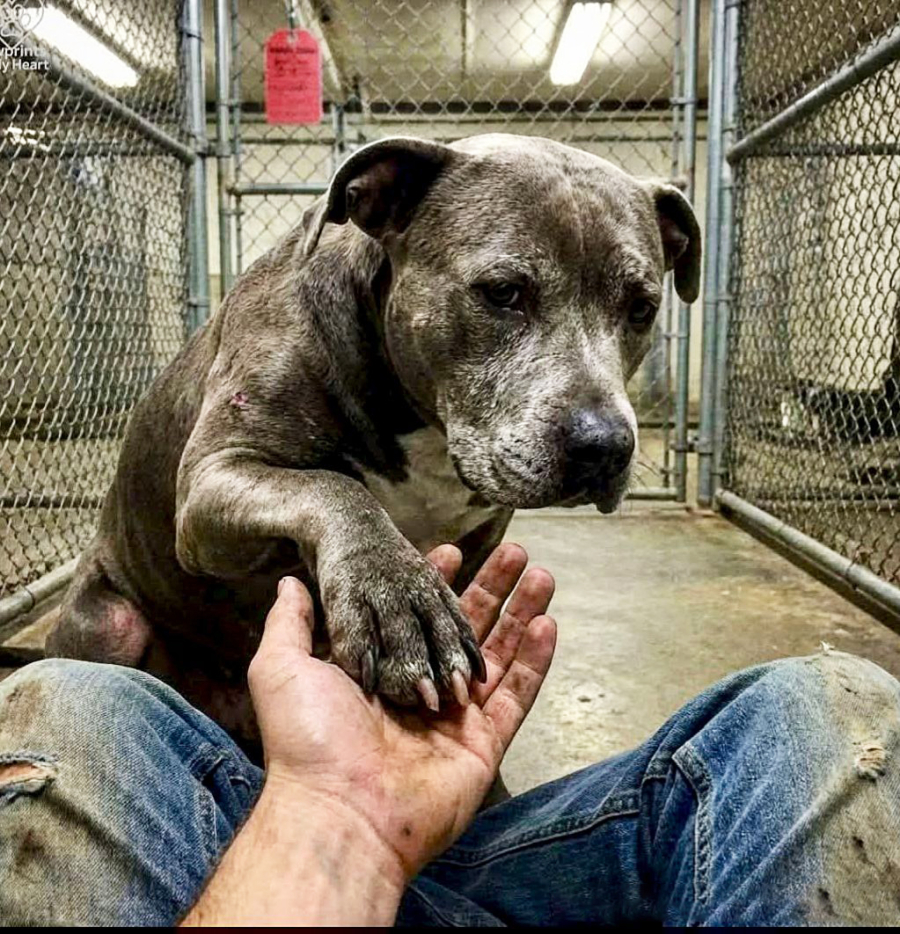
He lifted a massive, scarred paw and placed it gently in my hand. He didn’t squeeze. He just held on, as if he were drowning and I was the raft.
I realized then that “Intake #402” hadn’t lunged at the staff because he was mean. He had lunged because in the chaos of the shelter, without a command, he was lost. He didn’t need a cage; he needed a mission.
I snapped the photo. Not of a cowering victim, but of a proud dog shaking my hand.
I ran to the front desk. “He’s not aggressive,” I told the shelter manager, showing her the picture. “He’s trained. He’s grieving.”
I rewrote his bio on the shelter’s digital adoption page. I deleted “Aggressive Pit Mix.”
Instead, I wrote: “My name is Sergeant. I know my commands in German. I walk perfectly on a leash. I have guarded a family my whole life until I lost them. I am not dangerous; I am disciplined. I am looking for a new commanding officer to serve.”
The post was shared four thousand times in an hour.
At 4:55 PM, five minutes before his time was up, a truck pulled into the lot. An older man stepped out. He walked with a cane, wearing a faded cap from a local VFW post. He saw the post. He knew the look in those eyes.
When they brought the dog out to the meet-and-greet yard, the staff braced themselves on the leashes.
The man didn’t flinch. He dropped his cane and slapped his thigh. “Hier!”
The dog dragged the handler across the grass, burying his face in the man’s chest, letting out a sound that was half-howl, half-sob. The man buried his face in the dog’s neck. “I got you, buddy,” he whispered. “Stand down. You’re home.”
The system is designed to document liability. It tracks bite histories, breed restrictions, and stray holds. It tells the story of why a dog is dangerous.
But it fails to record the only thing that matters: why a dog is good.
We are taught to judge by the label on the cage, but we save lives by looking at the soul behind the bars. In a world quick to write people—and dogs—off as “damaged goods,” the most radical thing you can do is take a second look.
Sometimes, the one growling at the world isn’t hateful. They’re just waiting for someone to speak their language.






:max_bytes(150000):strip_icc():focal(753x271:755x273):format(webp)/cole-the-deaf-dog-112125-1a-ad248101bd174108a795d88d6afd93d8.jpg?fit=750,500&ssl=1 "Elementary School Throws Deaf Therapy Dog a Surprise Birthday Party as Students Learn Sign Language to Sing ‘Happy Birthday’")
:max_bytes(150000):strip_icc():focal(899x646:901x648)/Tatiana-Schlossberg-Jack-Schlossberg-030126-02-ffbc8841a935444d9a68bdeab3cfe504.jpg?fit=1500,1000&ssl=1 "Jack Schlossberg Reveals the Last Thing Sister Tatiana Told Him Before Her Death")
:max_bytes(150000):strip_icc():focal(658x345:660x347):format(webp)/nacho-the-dog-tout-10212024-027bc33d675c4321b7d23a1c9b0d1188.jpg?fit=750,500&ssl=1 "Woman Adopts Dog She Fostered Years Earlier After He’s Found as a Stray: ‘I Knew I Had to Get Him’ (Exclusive)")




:max_bytes(150000):strip_icc():focal(608x271:610x273)/CHER-poses-with-Dolly-Parton-for-a-portrait-in-1978-in-Los-Angeles-082625-6ed6da39310343ba97c5b376375a3cdc.jpg?fit=1500,1000&ssl=1 "Dolly Parton’s niece Danielle Parton opens up about cancer battle, new estate role")


