
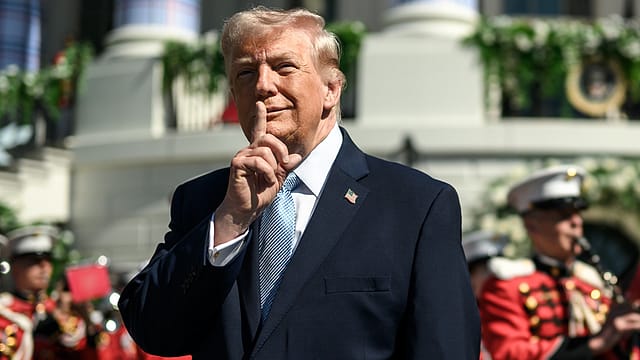
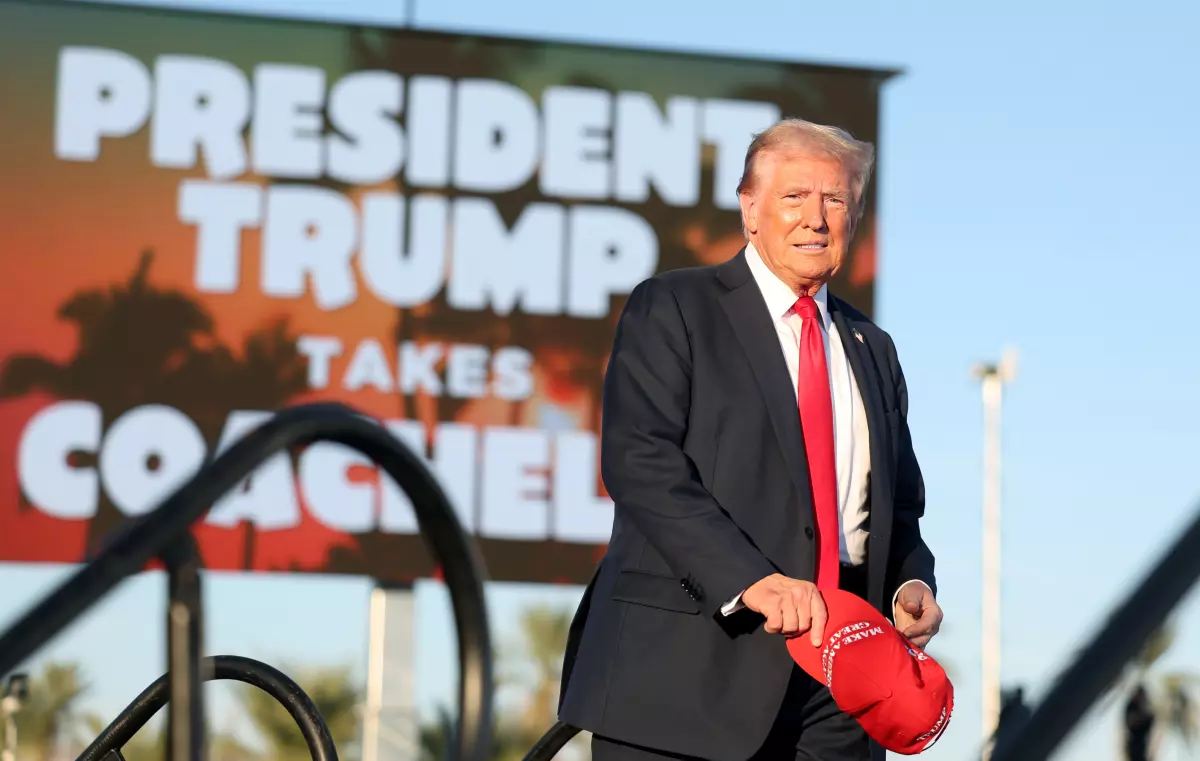
U.S. President Donald Trump walks as he attends to host a back-to-school-themed event to highlight his administration’s education policies, in the Rose Garden at the White House in Washington, D.C., U.S
Summary
Support for US military action against Iran falls to 31%, Reuters/Ipsos poll shows
Trump job approval stays at 33% for second straight survey, matching record low
Poll finds 83% of Americans expect war to continue for an extended period

Canada to announce retaliatory tariffs as Trump tells its leaders to ‘fall in line’
WASHINGTON, (Reuters) – U.S. public approval of the war with Iran fell to its lowest level since the conflict’s early days, helping to hold President Donald Trump’s popularity at a record low, according to a Reuters/Ipsos poll that closed on Monday.
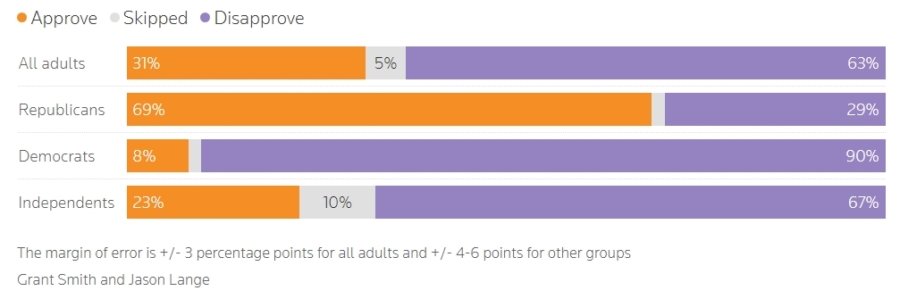
The four-day poll showed just 31% of Americans support U.S. military action against Iran, down from 37% in a March Reuters/Ipsos poll and 34% earlier this month. The decline was driven by fewer self-identified Republicans backing the conflict. Some 69% of Republican respondents support the war, compared with 77% in March.
What Americans think about US attacks on Iran
Reuters/Ipsos survey of 1,215 adults nationwide on Aug. 21-24
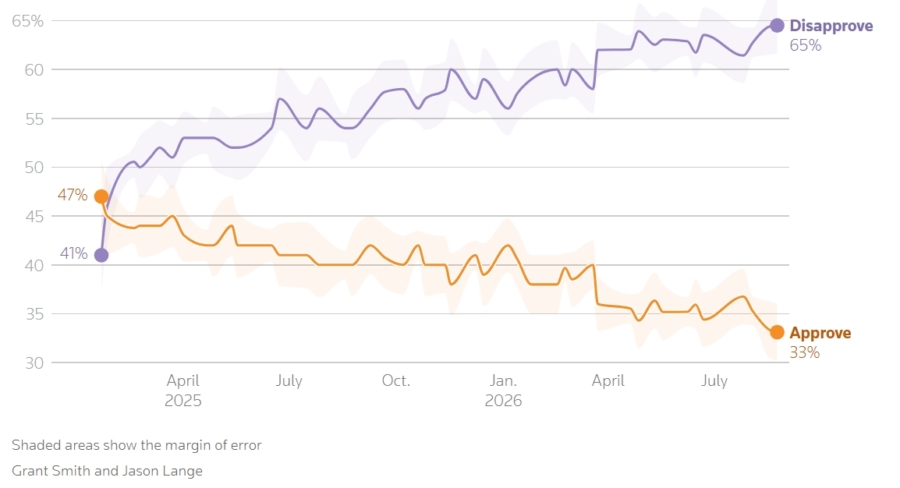
The war has been dragging on Trump’s public standing this year, and for the second survey in a row just 33% of respondents said they approved of the Republican’s performance in the White House, the lowest level in Reuters/Ipsos polls in Trump’s first or second term.
Trump approval stuck at lowest of second term
Reuters/Ipsos polls gather responses from adults nationwide
Trump has told Americans that the war – which started with U.S.-Israeli attacks on Iran on February 28 – is necessary to keep Tehran from developing a nuclear weapon. The conflict has cooled in recent months but Iran has kept in place a de facto blockade of oil exports from the region, which has pushed U.S. gasoline prices near record highs.

Trump has vowed to ramp up economic pressure on Iran and Treasury Secretary Scott Bessent on Monday announced a possible expansion of sanctions on countries doing business with the country, but stopped short of actually imposing penalties, a sign of how thorny the conflict has become for the administration.
FEARS OF A LONG WAR
Some 83% of the country thinks the war will go on “for an extended period of time,” the latest Reuters/Ipsos poll found, up from 80% earlier this month.
Trump campaigned ahead of the 2024 presidential election on promises to control inflation and avoid lengthy military conflicts. Six months into the war with Iran, U.S. gasoline prices are more than a dollar higher per gallon than they were before the war. That is weighing on Trump’s Republican allies who will be defending narrow congressional majorities in the November 3 midterm elections.
Independent voters in the poll favored Democrats over Republicans – 33% to 19% – when asked who they would vote for in congressional elections if the election were held today.
The poll surveyed 1,215 U.S. adults nationwide and had a margin of error of 3 percentage points in either direction.
Reporting by Jason Lange in Washington; editing by Scott Malone and Deepa Babington

Trump announces new 50% tariff on Canadian cars, trucks and steel
Move is latest deterioration in trade relations between neighbors with historically strong economic ties

Donald Trump announced a new 50% tariff on automobiles and crucial raw materials from Canada, the latest deterioration in trade relations between the two neighbors with historically strong economic ties.
The US president said that the increased tariffs would start on 1 January 2027 on all cars, trucks, automobile parts and steel. He also derided the nation’s tariffs on American farmers, writing on social media that Canada has been “ripping off” the US “for years”.
“On Trade, and in other ways, also, they are among the worst Nations in the World to deal with,” he wrote on Truth Social. “They feel entitled, and yet, WE DON’T NEED CANADA, THEY NEED US! They do 95% of their business with the U.S., with us, the exact opposite!”
In response, Mark Carney told reporters on Monday that Trump’s announcement was largely expected.

“It’s not a surprise for us that the US would take some form of reprisal to our response to their unjustified tariff, which was on top of other unjustified tariffs,” the Canadian prime minister said from Quebec.
“But what message does that send to the workers in Michigan, in Ohio, in Kentucky, in Alabama, who rely on Canadian demand?” Carney continued. “We’re their largest customer for automobiles, more than the European Union, Japan, Korea, many others combined, and the United Kingdom.”
He added that Canada would be ready to move forward with talks “when the Americans go to the negotiating table first with the right attitude toward our industry and a true partnership”.
Trump’s announcement follows the last-minute collapse this weekend of a potential deal to lower tariffs on automobiles and other materials. After Trump imposed another 50% tariff on $20bn worth of Canadian exports, including hockey equipment and electronics, Carney, rejected the latest deal between the two nations on Saturday.
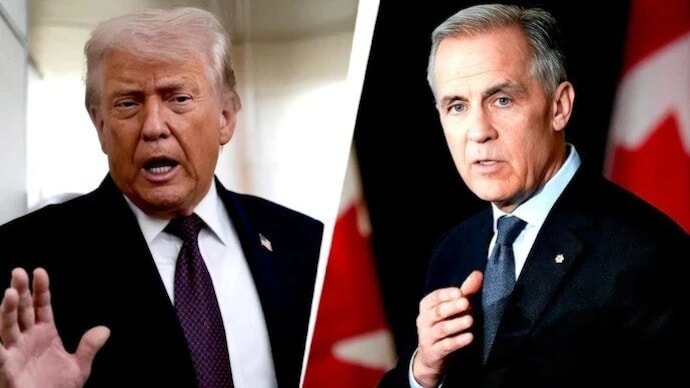
Carney said that the US “asked too much and they offered too little”, and he has vowed to match the American tariffs “dollar for dollar”.
Canada and the US have been longtime partners, trading roughly $909bn, according to the office of the US trade representative. But Trump’s second presidential term and his aggressive trade policies have brought the era of “deep ties” between the two nations to a close, Carney said last year, vowing to fight Trump’s sweeping tariffs.
US threatens severe sanctions against countries with economic ties to Iran
Washington launches campaign to isolate Tehran but it is unclear whether it will apply measures to China
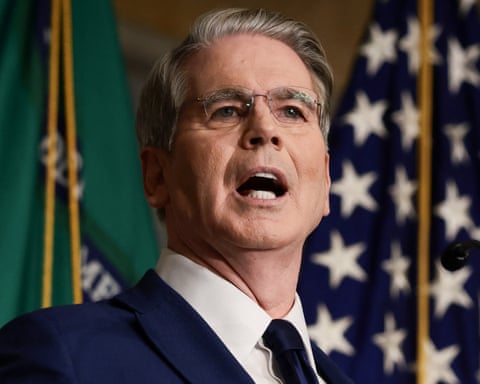
The US has threatened to impose severe sanctions against any country or entity maintaining economic ties with Iran, hoping to achieve with economic measures what military means have so far failed to do.
It is unclear, however, how far the Trump administration is prepared to go in confronting China, Iran’s biggest trading partner, which has signalled its resistance to US economic pressure to cut off links with an ally.
Iran, meanwhile, vowed retaliation against any country that took part in the US-led isolation campaign.
Launching what he called Operation Economic Outcast, the US treasury secretary, Scott Bessent, called it an unprecedented campaign and compared it with the D-day Normandy landings, a turning point in the second world war.
“Today, in that same spirit, we are launching an economic onslaught against Iran’s financial connections around the globe,” Bessent said on Monday. “Our objective is to sever every economic lifeline that sustains this tyrannical regime until Tehran stands alone.”

Asked whether sanctions would be applied to China, which bought an estimated 80% of Iran’s shipped oil last year, he replied: “We want to make clear here today that no one is above the reach of US sanctions. That if they facilitate transactions and are part of the ecosystem that turns Iranian oil into money, into repression, they will be targeted.”
Bessent said the US had identified those that continued to deal with Iran and each violator would be given a deadline to cut ties or face US sanctions. He said the deadlines imposed would depend on individual circumstances.
“Any entity that facilitates money laundering on behalf of Iran will be removed from the US dollar system,” he said. “The clock just started ticking.”
Bessent said Donald Trump was “making phone calls to world leaders with specific requests to cease their interactions with the regime”, but he did not specify whether the US president would talk to his Chinese counterpart, Xi Jinping.
China’s embassy in Washington told reporters: “Regarding the Iran issue, sanctions and pressure do not help resolve the problem. China calls on the relevant parties to take responsible actions and resolve the issue through political and diplomatic means.”
Tehran said it would retaliate against the sanctions using a range of measures. Maj Gen Ali Abdollahi, the armed forces’ chief of staff, said the retaliation could take the form of land, sea or air operations or cyber-attacks.
The announcement of secondary sanctions against Iran comes nearly six months after the the US and Israel launched an attack on Iran that killed its supreme leader Ali Khamenei. Early expectations that the regime in Tehran would collapse or agree to Washington’s demands to give up uranium enrichment and other key elements of its nuclear programme were dashed.
Hardliners appeared to strengthen their grip on government in Tehran and responded by declaring the closure of the strait of Hormuz, attacking ships that ignored its declaration. Trump imposed a counter-blockage on Iranian oil exports through the strait, leading to an impasse that has had profound effects on the global economy.
Sina Toossi, a senior non-resident fellow at the Center for International Policy, said: “After nearly six months without a military or diplomatic victory, Washington appears to be trying to accomplish through intensified economic strangulation what military force has so far failed to achieve. But Tehran is answering that zero-sum approach with one of its own.”
The US defense secretary, Pete Hegseth, however, said further military action was not off the table. “By no means are we foreclosing using kinetic strikes anywhere in the strait of Hormuz or around Iran,” Hegseth told reporters on Monday.
In apparent anticipation of the US measures, the United Arab Emirates, a close US and Israeli ally, announced it was suspending trade ties with Iran. Turkey, another trading partner with Iran, which has been critical of the US-led campaign against the Islamic Republic, has yet to respond to the US threat of sanctions.
Andrew Miller, a senior fellow at the Center for American Progress, said: “The announcement of new economic sanctions on Iran and those countries trading with it signals what is plain to all: this war has brought the United States no closer to eliminating Iran’s nuclear programme or crippling the Iranian regime. But while sanctions can be effective, it is highly unlikely they will produce a quick settlement favourable to the United States.”
Trump Rocked by Most Seismic Departure of His Term
The president’s close advisor becomes the latest woman to leave the president’s core team.
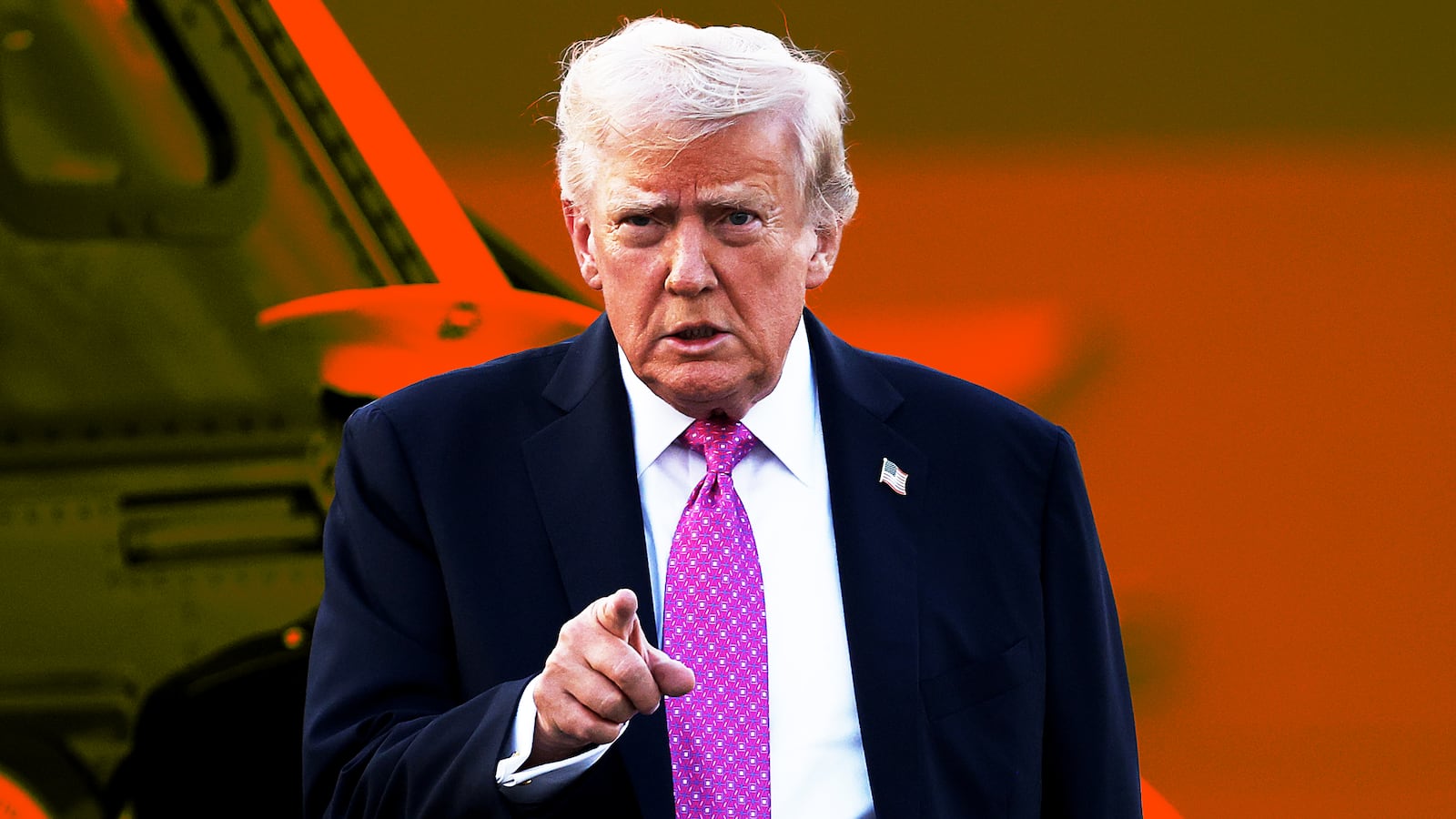
Donald Trump’s administration has been rocked by the seismic departure of White House Press Secretary Karoline Leavitt months before the midterm elections.
With the president’s popularity tanking over soaring prices and the war in Iran, Trump has now lost one of his most effective defenders as he desperately tries to convince voters of his achievements.
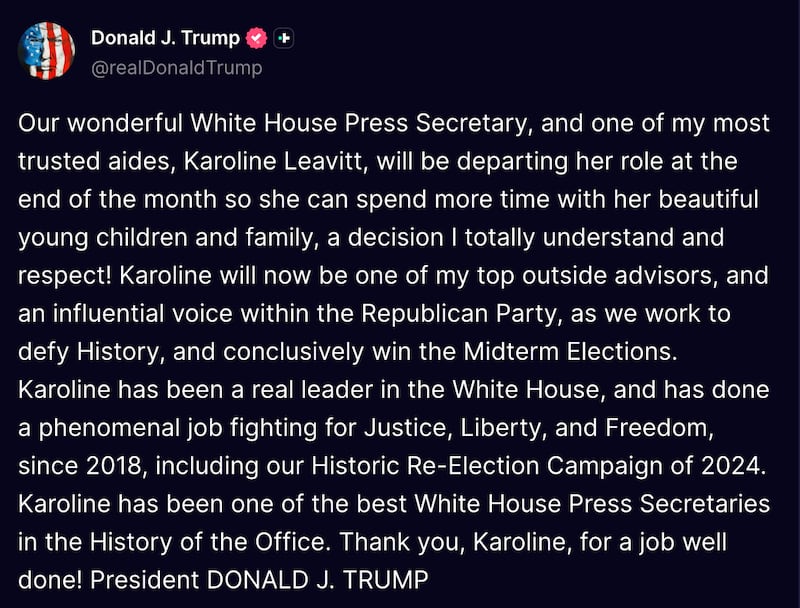
Trump made the announcement on Truth Social on Wednesday, in a post that immediately reverberated across Washington.
“Our wonderful White House Press Secretary, and one of my most trusted aides, Karoline Leavitt, will be departing her role at the end of the month so she can spend more time with her beautiful young children and family, a decision I totally understand and respect!” he wrote.
The president added that Leavitt would remain one of his “top outside advisors, and an influential voice within the Republican Party, as we work to defy History, and conclusively win the Midterm Elections.”
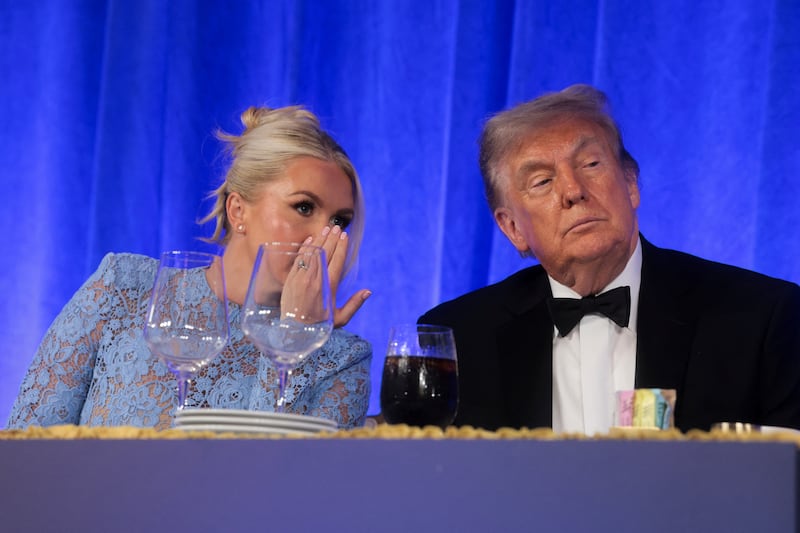
But the loss of yet another woman from his inner sanctum—and one who has spent the past 18 months sparring with the White House press and going to war with Trump’s critics—is a major blow to Trump’s White House operation.
The fact that Leavitt effectively gave less than three weeks of notice, and there was no immediate successor named, also raised eyebrows.
Many women in Trump’s orbit have also been forced out – such as former Attorney General Pam Bondi, former Homeland Security Secretary Kristi Noem and former Labor Secretary Lori Chavez-DeRemer – but Leavitt appears to have departed on her own terms.
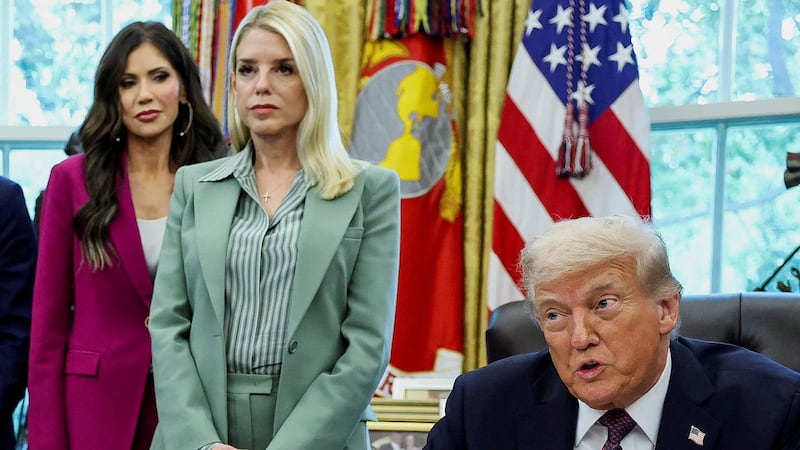
In a statement issued after the president’s announcement, Leavitt, 28, explained that “being a mother and welcoming a new baby while working in one of the most demanding jobs in the world has been the most rewarding yet challenging season of my life, to say the least.”
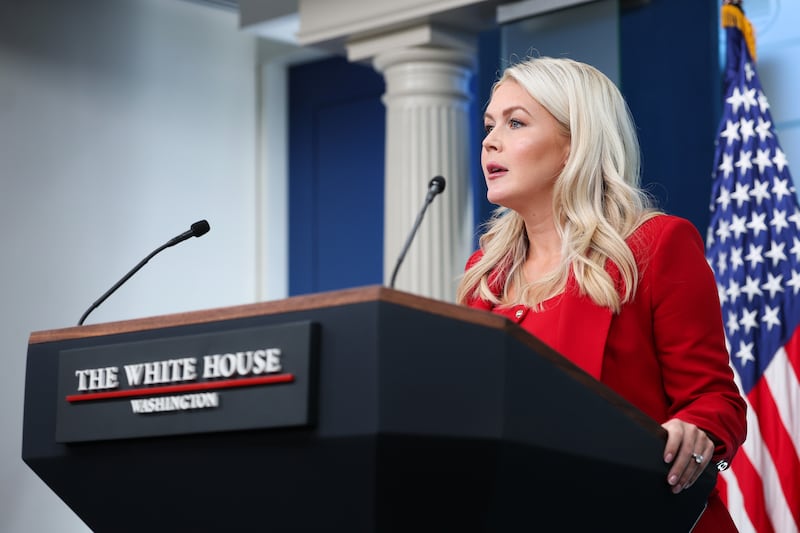
“The truth is since returning to the White House after the birth of my daughter, I have felt in my heart that I cannot be the best mom my two young children deserve while devoting the constant time, energy, and attention required of the White House Press Secretary — and that is why I have ultimately made the bittersweet decision to depart the White House and embark on a new chapter in my life,” she said.
“I will always remain a vocal advocate for MAGA and the Republican Party,” she added.
“Our country is facing an existential threat from an increasingly extremist Democrat Party that seeks to destroy everything great about America, and I believe it is incumbent upon all of us who care about this country to fight back against that threat. My fight is entering a new phase, but it is far from over.”
Leavitt has been with Trump for years, but has taken a noticeably lighter workload since she returned from maternity leave a few weeks ago. July 16 marked her first official press briefing after the birth of her second child, in which noted: “Let’s get back to work.”
Leavitt worked in the president’s first administration, writing constituent mail before transitioning to the press office.

She later worked for New York Congresswoman Elise Stefanik and ran as an unsuccessful congressional candidate in New Hampshire, where she met her husband, 60-year-old real estate developer Nicolas Riccio. The couple have two children, Niko, born in 2024, and Viviana, born in May this year.
But she was only 27 when she became Trump’s White House press secretary, making her the youngest person to ever occupy the role.
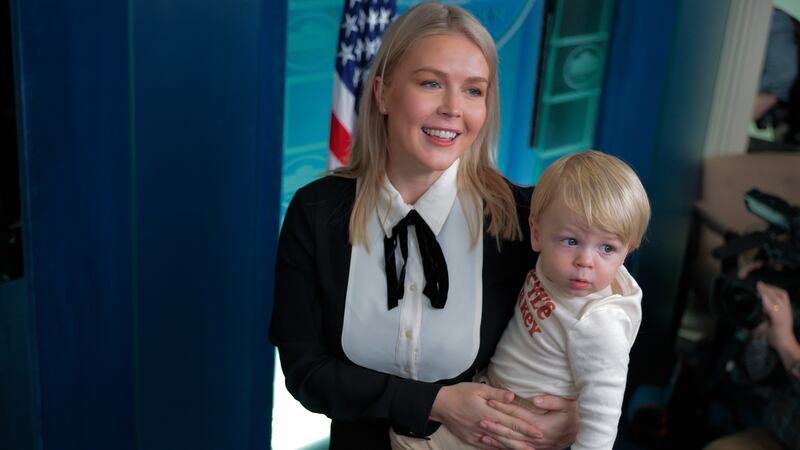
Adored within MAGA circles, the conservative firebrand quickly became a quintessential Trump communicator: combative, disciplined, and ready to take the fight to the media on his behalf.
But critics will likely remember her as one of the most prolific purveyors of Trump’s falsehoods to ever take the White House podium.
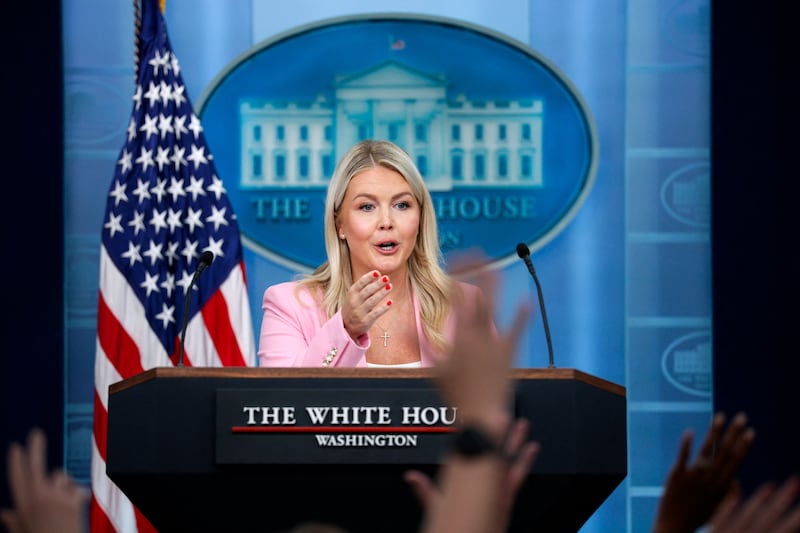
Fact checkers repeatedly caught her making claims that did not withstand scrutiny, from declaring that “tariffs are a tax cut for the American people” to insisting that $50 million in taxpayer money had been earmarked for condoms in Gaza.
As tributes poured in from MAGA world on Wednesday, others took a different tone.
“She knows she won’t be able to spin what will happen in November,” quipped one political observer on X, a reference to the midterm elections when many Republicans expect they will lose control of Congress.
“I’m sure it’s just a coincidence that Karoline Leavitt resigned as White House press secretary after being an unwitting decoy on Air Force One,” said another, a reference to Trump leaving top aides and cabinet officials with members of the press on a plane that was being targeted by Iran while he escaped to a safer aircraft.
Trump, on the other hand, often referred to Leavitt as “a superstar”. During a bizarre interview last year, the 80-year-old even gave her a new moniker: “Machine Gun” Leavitt.
“When she gets up there with that beautiful face and those lips that don’t stop – ‘op-op-op’, like a little machine gun,” he said, making bizarre sound effects.
Trump’s post on Wednesday was far more presidential.
“Karoline has been one of the best White House Press Secretaries in the History of the Office,” Trump concluded. “Thank you, Karoline, for a job well done!”









:max_bytes(150000):strip_icc():focal(753x271:755x273):format(webp)/cole-the-deaf-dog-112125-1a-ad248101bd174108a795d88d6afd93d8.jpg?fit=750,500&ssl=1 "Elementary School Throws Deaf Therapy Dog a Surprise Birthday Party as Students Learn Sign Language to Sing ‘Happy Birthday’")



:max_bytes(150000):strip_icc():focal(608x271:610x273)/CHER-poses-with-Dolly-Parton-for-a-portrait-in-1978-in-Los-Angeles-082625-6ed6da39310343ba97c5b376375a3cdc.jpg?fit=1500,1000&ssl=1 "Dolly Parton’s niece Danielle Parton opens up about cancer battle, new estate role")


