More than a year into President Donald Trump’s second term, a Newsweek analysis of new state-level polling suggests his standing has weakened across the country, with some of the sharpest drops in places that once backed him most strongly.
Key Points
- Net approval has declined in every state since Trump returned to office in January 2025.
- The steepest drops are in Republican-leaning states, not just Democratic strongholds.
- Several battlegrounds, including Florida, Ohio and Nevada, have shifted into net disapproval.
- Early pro‑Trump advantages have narrowed sharply, even in his strongest states.
- The political map still resembles the partisan divide, but with weaker margins across the board.

The figures come from Civiqs’ rolling online tracking poll of registered voters, based on more than 107,000 responses collected between January 20, 2025, and May 26, 2026. To measure change over time, Newsweek has compared state results from Trump’s first day in office with the latest estimates, with net approval calculated as approve minus disapprove.
Because the tracker uses continuous surveying and statistical modeling, the results reflect smoothed trends rather than a single snapshot. Every state in the tracker shows a decline in Trump’s net approval since the start of his second term—but the steepest falls are concentrated in a mix of Republican strongholds and key battlegrounds.
Use the date filter on the map below to compare Trump’s net approval rating by state at the start of his second term with the latest Civiqs estimate.
Trump’s Net Approval Rating in January 2025 vs. May 2026
Filter by polling date to see how the map has changed. Net approval rating = those who approve minus those who disapprove.
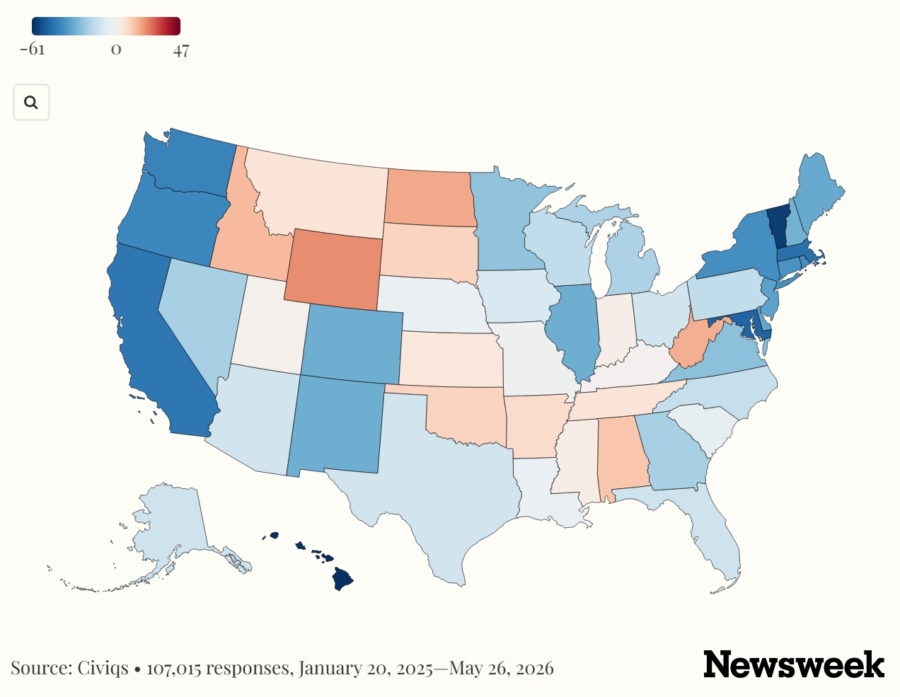
And you can search your state to see how approval has shifted since the start of the term. The sharpest changes occur where states flip from positive net approval to negative, or where early pro‑Trump margins have narrowed sharply.
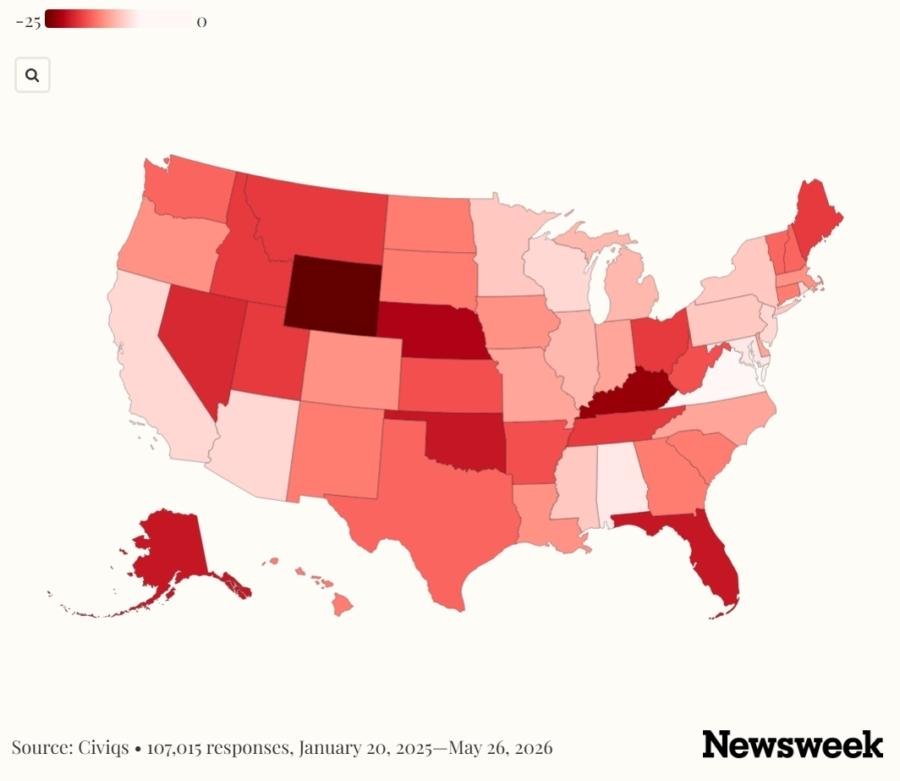
A second map shows the change over time, highlighting where net approval has fallen most.
Where Trump’s Approval Rating Has Crashed the Most
Darker red indicates a larger drop in net approval since January 2025.
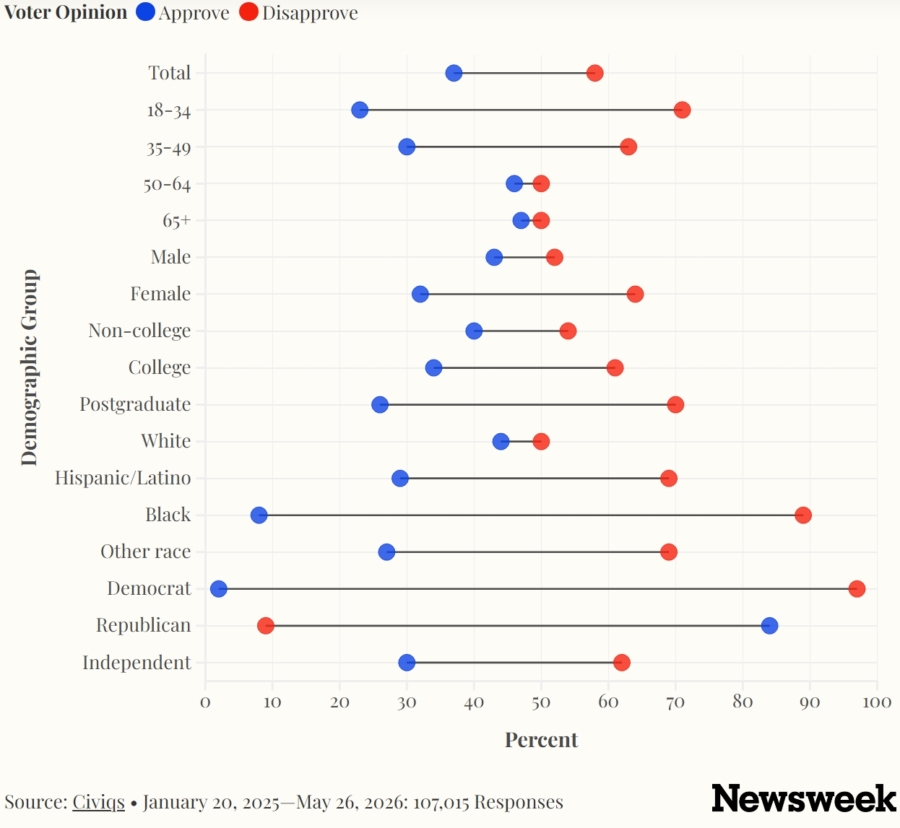
The divide is even clearer when you break the tracker down by age, education and party.
Trump Approval by Demographic Group
Approval and disapproval among registered voters, May 2026 (Civiqs tracking poll).
Biggest Drops: Where Approval Has Fallen the Most
The largest declines in net approval highlight just how much ground Trump has lost since taking office.
- Wyoming: +47 → +22 (down 25 points)
- Kentucky: +23 → 0 (down 23 points)
- Nebraska: +18 → -4 (down 22 points)
- Alaska: +9 → -12 (down 21 points)
- Florida: +9 → -12 (down 21 points)
- Oklahoma: +31 → +10 (down 21 points)
- Nevada: 0 → -20 (down 20 points)
- Maine: -12 → -31 (down 19 points)
- Ohio: +8 → -11 (down 19 points)
- Utah: +20 → +1 (down 19 points)
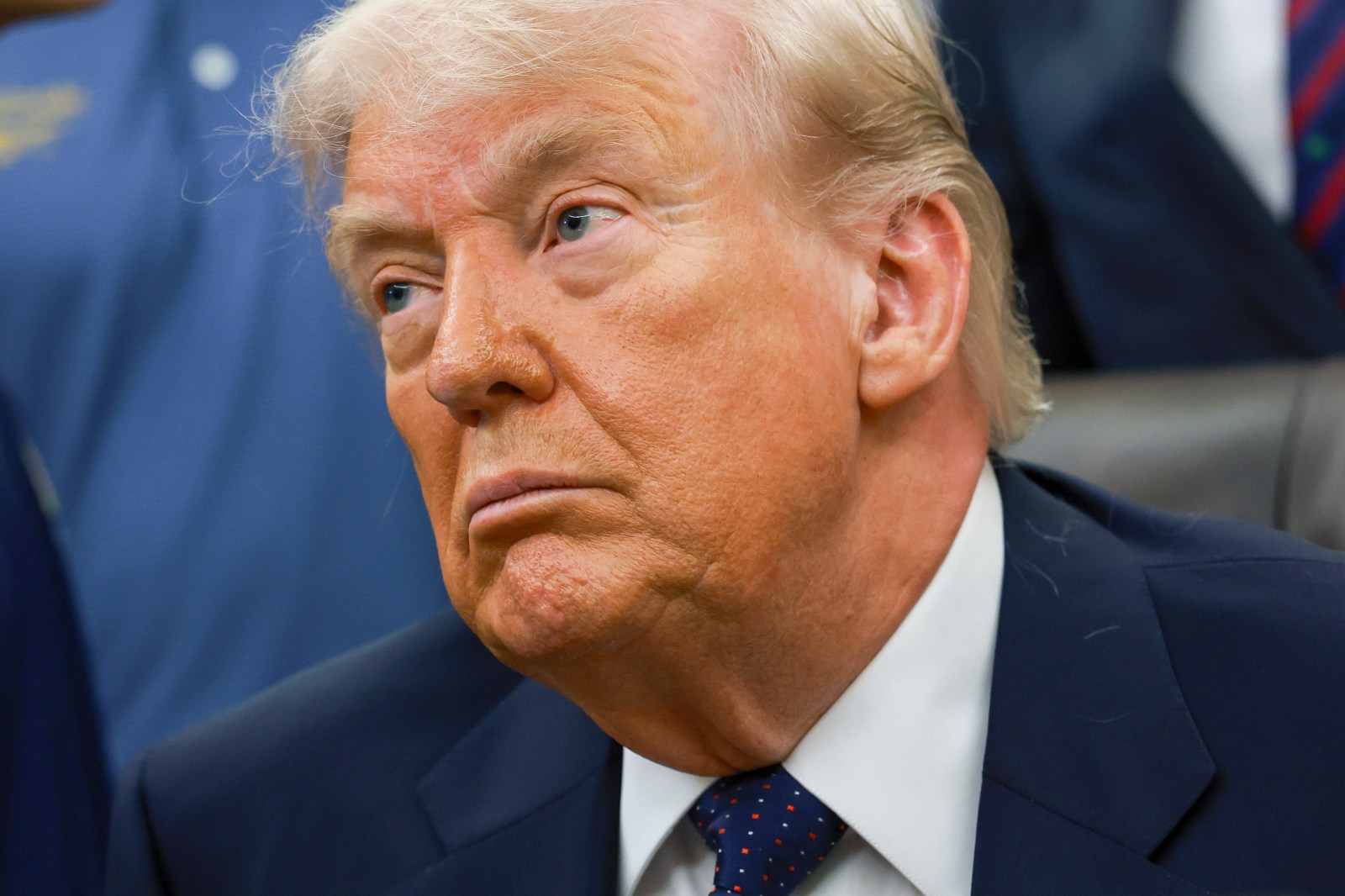
Just outside the top tier, Idaho, Tennessee and Montana also fall by 19 points, while Kansas and West Virginia are down 18 points. These numbers point to a simple shift: states that began the term with comfortable pro‑Trump margins now look far less secure—and in several cases have slipped into negative territory.
Wyoming remains Trump’s strongest state, but even there the margin has narrowed sharply. Kentucky, meanwhile, has dropped from solidly positive to dead even, illustrating how quickly the landscape has shifted.
Swing States: From Competitive to Negative
The movement is most politically significant in battleground states, where relatively small changes can have outsized consequences.
Several have crossed key lines:
- Florida: +9 → -12 (positive to negative)
- Ohio: +8 → -11 (positive to negative)
- Nevada: 0 → -20 (from even to clearly underwater)
- Nebraska: +18 → -4 (positive to negative)
Elsewhere, states like Pennsylvania and North Carolina remain competitive but show further slippage compared to the start of the term.
The pattern reinforces a broader reality: Trump is now underwater in many of the states that typically decide national elections, even if the margins are not yet overwhelming.

Deep Red States: Still Positive, but Erodin
Trump’s support remains strongest across much of the Republican map, but the margins are noticeably narrower than they were at the start of his presidency.
States such as Oklahoma, Idaho, Tennessee and Montana still show positive net approval, yet each has lost close to 20 points since January 2025. Even in deeply conservative Wyoming, the country’s most pro‑Trump state, the net advantage has been cut by more than half.
That suggests his base remains intact—but less dominant than it was at the outset of the second term.

Deep Blue States: Opposition Holds Firm
In Democratic-leaning states, Trump started his term with sharply negative ratings, and those numbers have generally worsened further. States like California, New York and Massachusetts all register deeper negative net approval today than at the start of the term, though the scale of change is smaller than in red states simply because there was less room to fall.
Here, the story is less about dramatic movement and more about entrenched opposition becoming even more firmly embedded.

What’s Driving the Drop
Across the states with the biggest declines, one pattern stands out: approval is down, and disapproval is up—often by similar margins.
In many cases:
- Approval has fallen by around 10 to 14 points
- Disapproval has risen by roughly 8 to 11 points
That two-way movement matters. It means the drop is not just about waning enthusiasm; it reflects a broader shift in voter sentiment.
Wyoming illustrates the trend clearly:
- Approval: 72 → 58 (down 14)
- Disapproval: 25 → 36 (up 11)
- Net: +47 → +22 (down 25)
When both sides move at once, net approval can fall quickly—and across the country, that is exactly what has happened.
A National Map That Looks Familiar—But Weaker
Taken together, the data show a political map that still looks familiar in structure but weaker in strength. Trump’s best states remain his best states. His weakest states remain firmly opposed. But across the board, the margins have shifted downward.
At the start of his second term, Trump held clear positive net approval across much of the Republican map and was competitive in several battlegrounds. More than a year later, many of those same states are now narrowly positive, evenly split or clearly negative.
The result is a landscape where the dividing lines are unchanged—but the ground beneath them has moved.
What the White House Says
The White House has dismissed the significance of recent polling, instead pointing to Trump’s 2024 election victory as the clearest measure of public support.
Spokesperson Davis Ingle has repeatedly cited the nearly 80 million Americans who voted for Trump as evidence of the administration’s mandate, framing that result as the overriding verdict on its agenda.
In a response that the White House has consistently used, Ingle said the administration remains focused on economic priorities such as jobs, inflation and housing affordability, while arguing that the impact of the president’s policies will become clearer over time.

Is Trump Drawing Up a ‘Self-Defense’ Plan After Leaving the White House?
The administration of U.S. President Donald Trump is deploying a series of policies aimed at protecting him from the possibility of prosecution after he leaves the White House in 2029.
Immediately after losing the 2020 election, U.S. President Donald Trump faced a barrage of legal challenges. He was nearly impeached over allegations of trying to overturn the presidential election results and was continuously investigated on various charges, ultimately facing criminal indictment in 2024.
It appears the master of the White House does not want a repeat of this scenario. His administration is implementing a suite of measures to limit the possibility of his continued prosecution over past matters—ranging from civil to criminal cases.
Most recently, Mr. Trump and the Internal Revenue Service (IRS) reached a settlement agreement regarding the leaking of his tax records. Under the agreement, the IRS will no longer have the authority to seek back taxes from Mr. Trump, his businesses, or his family. In exchange, the Trump family will drop their $10 billion compensation claim over the unauthorized disclosure of the White House leader’s tax files.
Although this is strictly a tax agreement, some observers assess that the language of the settlement could shield Mr. Trump from issues extending far beyond the scope of taxation.
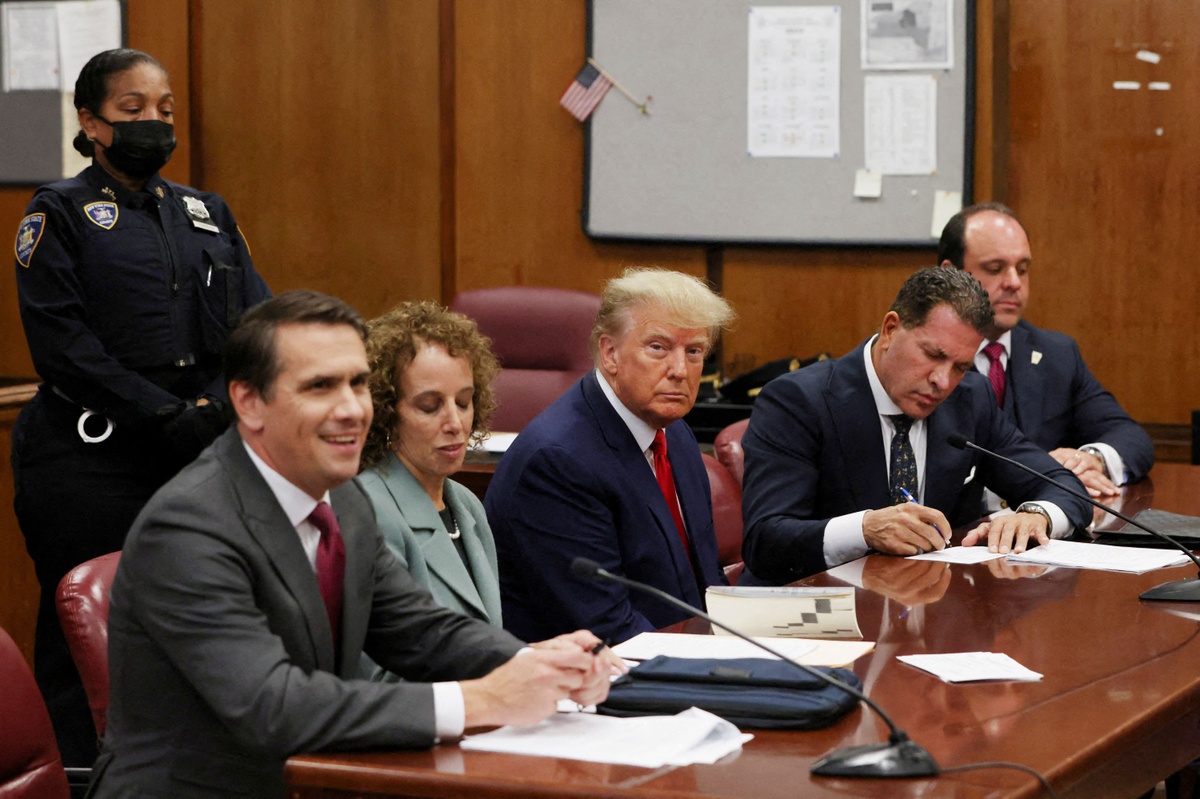
A “Gift” for Trump
The language of the settlement agreement could be interpreted to mean that the deal applies not only to cases involving the tax agency and the U.S. Department of the Treasury, but to all agencies, provided the actions are deemed “lawfare” or “weaponization.”
The U.S. Department of Justice confirmed to CNN that the settlement focuses on civil matters rather than criminal ones. The agency also emphasized that the agreement is effective only for tax records prior to May 19.
The terms “lawfare” or “weaponization” are not tightly defined under U.S. law. The settlement agreement defines these terms rather broadly, leading experts to note that the agreement aims to block any investigations targeting the past conduct of Mr. Trump and his family.
“In any agreement, both sides have to give something up,” Acting Attorney General Todd Blanche said in defense of the deal. The agreement is currently being reviewed under a federal judge’s order.
Alongside this, the Trump administration is employing pressure tactics: punishing those who intend to participate in investigations targeting Mr. Trump, while preventing his supporters from being prosecuted.
Prosecutors and Justice Department officials who participated in the investigation of the January 6, 2021, Capitol riot have been dismissed. Former FBI Director James Comey and New York Attorney General Letitia James—who previously investigated Mr. Trump—have also become the targets of criminal allegations.
Back in 2024, a U.S. Supreme Court ruling affirmed presidential immunity against criminal charges. The U.S. Department of Justice is now attempting to extend this right to civil claims targeting Mr. Trump regarding the 2021 riot.
The Justice Department is also drafting a regulation aimed at neutralizing state bar association disciplinary investigations targeting the department’s lawyers. Previously, numerous disciplinary proceedings had been initiated against individuals involved in the plan to overturn the 2020 election results.
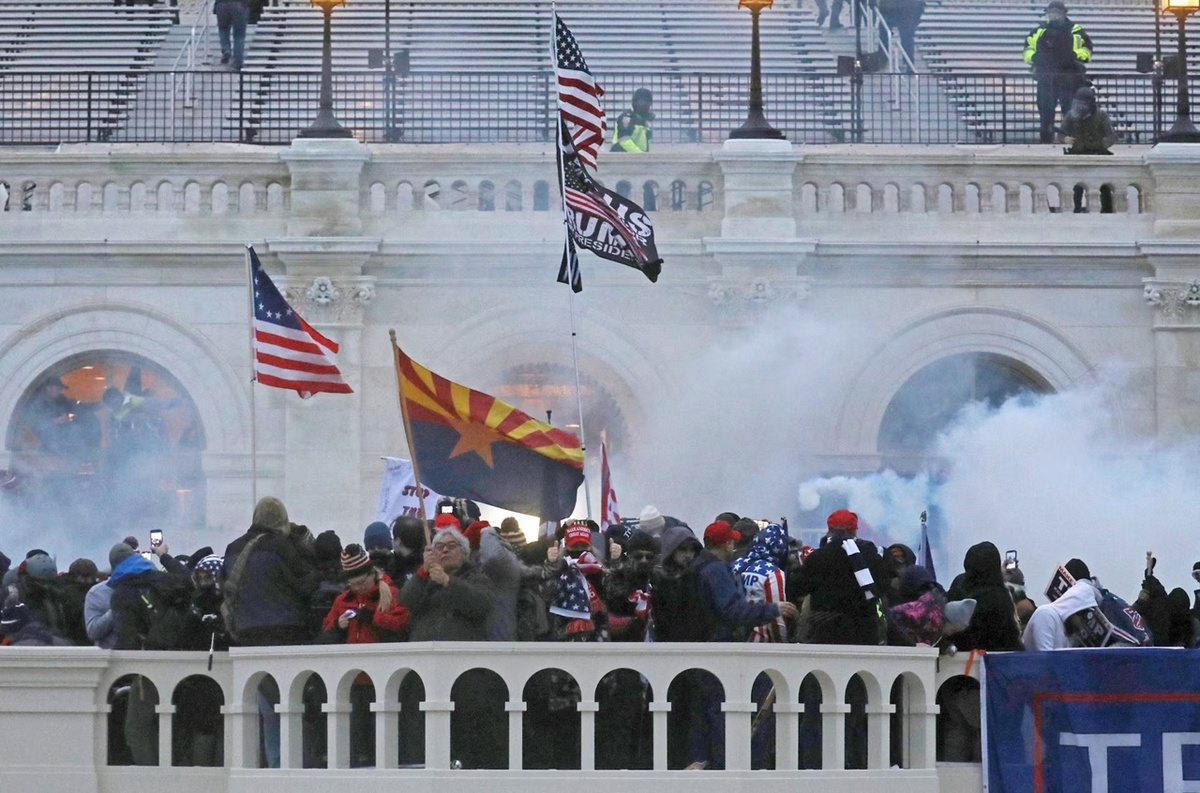
The White House’s Multi-Pronged Effort
In its efforts to block investigations that could implicate President Trump, the administration has chipped away at post-Watergate reforms—reforms originally intended to create internal checks and balances and oversight mechanisms within the executive branch.
At the very beginning of his second term, Mr. Trump fired a succession of inspectors general across various departments. During his first term, these watchdogs had initiated multiple investigations into the Trump administration, leading to congressional actions—including the 2019 impeachment inquiry against Mr. Trump.
Earlier this year, a legal advisor to the Department of Justice told Mr. Trump that he was no longer obligated to comply with the Presidential Records Act, which mandates that White House documents be preserved and turned over to the National Archives. The argument put forward by the Justice Department was that the act is unconstitutional because Congress cannot pass legislation that infringes upon the president’s executive power.

Meanwhile, the U.S. Supreme Court has also made a series of moves supporting arguments that elevate presidential power. The conservative-majority Supreme Court has allowed Mr. Trump to fire heads of independent agencies—an authority previously restricted by Congress—helping the White House leader reshape the personnel apparatus to his benefit.
Even the ranks of Republican lawmakers have been reshaped by Mr. Trump to his advantage: a wave of lawmakers who previously voted against him were ousted in this year’s primary elections. It appears he has not forgotten that many Republicans voted against him during his 2021 impeachment trial.
Furthermore, by 2029, when Mr. Trump will be in his 80s, investigating or prosecuting him will become significantly more difficult: “reopening the files” on a president of such an advanced age would face substantial public backlash.
Why Did U.S. President Trump Abruptly Tighten Negotiation Terms with Iran?
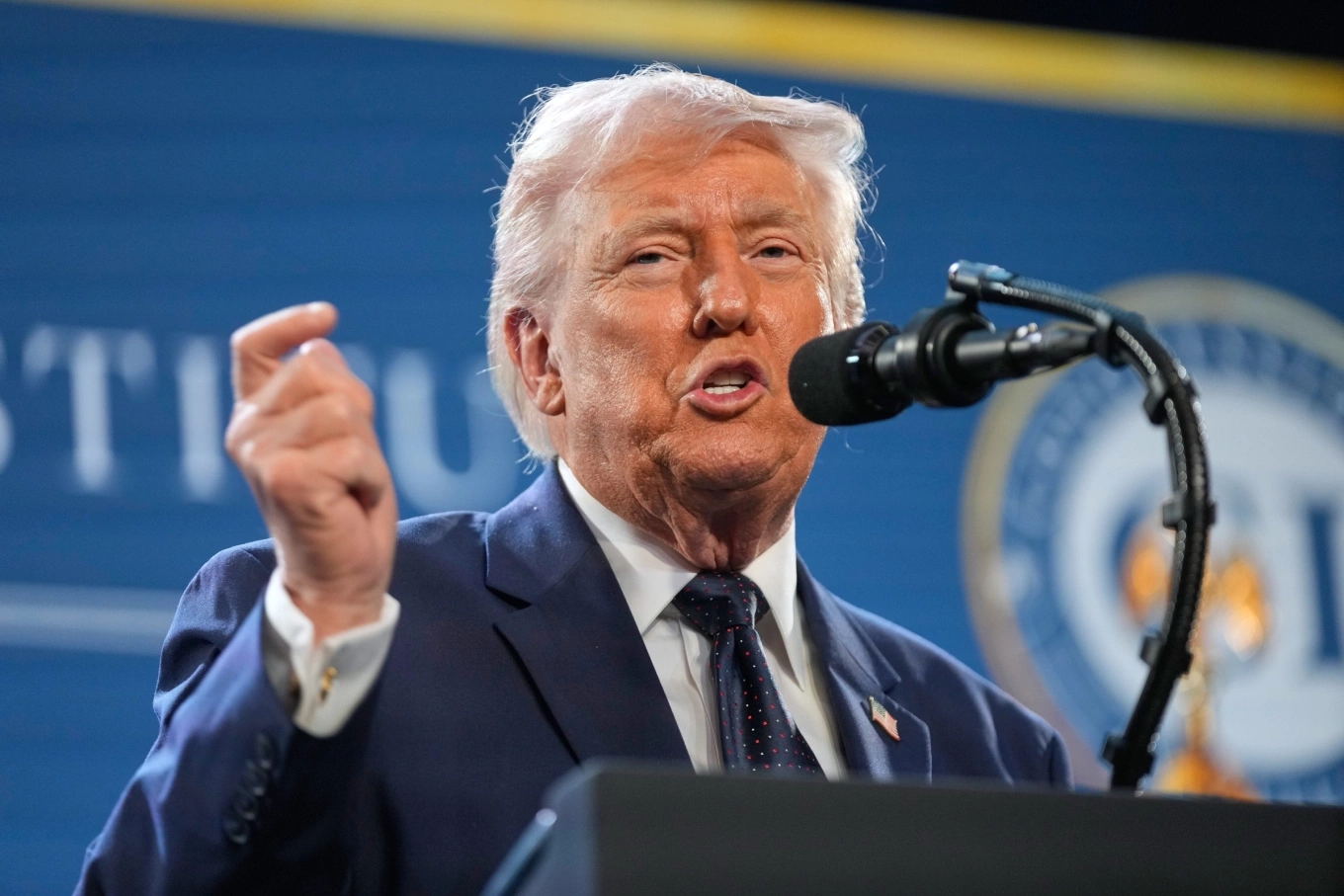
TPO – U.S. President Donald Trump has reportedly tightened the terms for peace negotiations with Iran, after expressing frustration with the pace of Tehran’s response to previous proposals.
According to The New York Times, U.S. President Donald Trump has reportedly raised concerns regarding clauses in the agreement related to the unfreezing of Iranian assets, and expressed frustration over the speed of Tehran’s response to prior proposals. Consequently, the terms have been revised with the objective of increasing pressure on Iranian leaders.
The news outlet Axios, citing a senior U.S. official, reported that Mr. Trump wants to incorporate “more specific details” into the text regarding when and how the U.S. will seize Iran’s enriched uranium stockpile.
In an interview with Fox News on May 30, President Trump stated he is determined to achieve a “great deal” to ensure there “will be no nuclear weapons” in Iran.
While initially stating that he was in no rush to reach an agreement, later in the same interview, the U.S. leader admitted that he is “in a hurry because gas prices are rising.” He threatened to “deliver a decisive military blow” if Iran does not yield to American demands.
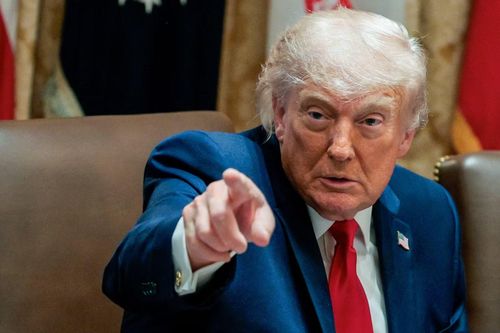
Iran has repeatedly declared that its right to develop nuclear energy for peaceful purposes is non-negotiable, and has denied that the country is seeking to possess nuclear weapons. Iranian officials have also ruled out the possibility of handing over enriched uranium to the United States.
Iranian Foreign Minister Abbas Araghchi accused the U.S. of a “betrayal of diplomacy,” stating that military pressure will not force Iran to make concessions. Iran’s chief negotiator, Mohammad Bagher Ghalibaf, asserted that the country will not compromise on its sovereign rights.
Previously, on May 28, the two countries had reportedly agreed on a memorandum of understanding to extend the ceasefire reached in April by an additional 60 days, and to resume negotiations over Iran’s nuclear program. A day later, Mr. Trump summoned senior national security advisors to the White House Situation Room.





:max_bytes(150000):strip_icc():focal(753x271:755x273):format(webp)/cole-the-deaf-dog-112125-1a-ad248101bd174108a795d88d6afd93d8.jpg?fit=750,500&ssl=1 "Elementary School Throws Deaf Therapy Dog a Surprise Birthday Party as Students Learn Sign Language to Sing ‘Happy Birthday’")