Donald Trump’s Tariffs Were a Big Mistake. Now America Will Pay the Price
Yesterday’s Supreme Court ruling striking down a large part of Trump’s import tariff hikes is both very bad and some good news for Donald Trump.
The bad news is that it deals a severe blow to a signature part of Trump’s economic program and aggravates an already troubling budget situation.
The good news is that it offers Trump an off-ramp from his highly unorthodox import tariff policy, which is plainly not delivering the results he promised.

Jordan Peterson was ‘near death’ after he was hospitalized with pneumonia and sepsis: daughter
Trump and the Tariffs: A Historic Policy Shift
Over the past year, Trump sharply hiked US import tariffs to their highest level in the past 100-years.
He did so with a view to reducing the country’s gaping trade deficit and to increasing US manufacturing output and employment.
He justified around two-thirds of those tariff hikes under the International Emergency Economic Powers Act.
The Supreme Court has now ruled that Trump exceeded his authority in using those powers and that he needs Congress’s authorization to impose what is effectively a tax on those grounds.
A Policy That Has Failed
Almost one year into Trump’s aggressive import tariff policy, it is not too early to conclude that it is not working.
Start with the trade deficit. According to the Bureau of Economic Analysis, despite Trump’s tariffs, the US trade deficit in goods and services remained around $900 billion in 2025, virtually unchanged from 2024. That is a far cry from Trump’s promise to eliminate that deficit.
That the trade deficit is not narrowing should come as no surprise.
Contrary to what Trump might believe, the trade deficit is simply a reflection of the fact that the country is spending more on consumption and investment than it produces. This remains true irrespective of the tariff level. Given the profligate way our government finances are being run, our rate of spending must be expected to keep outrunning the level of our production.
According to the Congressional Budget Office (CBO), the budget deficit was close to 6 percent of GDP in 2025 or virtually unchanged from the previous year. With the CBO now projecting that, absent policy changes, the US budget deficit will remain over 6 percent of GDP over the next decade, it would be surprising if much progress were made in reducing the trade deficit in the period ahead.
Trump hits lowest point in YouGov poll since return to office
Where Are Those Factory Jobs Trump Promised?
If Trump’s import tariffs are not reducing the trade deficit, they are also not bringing manufacturing jobs back home.
Indeed, this year the US has lost 50,000 manufacturing jobs while manufacturing output has been virtually flat.
Meanwhile, yesterday’s GDP report shows that the economy grew at a slower rate in 2025 than in the previous year, while unemployment has risen from 4.0 percent at the start of Trump’s second term to 4.3 percent today.
The Inflation Problem Isn’t Going Away
Contrary to Trump’s claim that foreigners would pay for the tariffs, it has turned out that the tariffs have kept inflation uncomfortably high.
According to a recent Federal Reserve study, US households and companies are paying about 92 percent of the costs of Trump’s tariff increases.
That is now causing Trump an affordability problem. Instead of prices falling as Trump had promised on the campaign trail, inflation is currently still running at around the same 3 percent that prevailed at the start of his second term.
Biden’s battle with advancing cancer renews focus on prostate disease
The Budget Problem
The Supreme Court’s invalidation of a major part of Trump’s tariffs creates a big budget headache for his administration. Not only will the budget be losing an important source of funding going forward.
The government will also have to refund companies between $100 and $150 billion for tariffs collected in error.
The Committee for a Responsible Budget Policy estimates that over the next decade, the Supreme Court’s ruling could cost the government around $2 trillion in lost revenues. This has raised anew the question of how the government will finance its budget deficit in a non-inflationary way.
The Supreme Court’s decision offers Trump an off-ramp from a highly unorthodox tariff policy that has not been delivering the intended results.
However, judging by Trump’s vitriolic response to the court’s ruling, it is reasonable to expect that he will seek other means (like Sections 201, 232, and 301) to replicate those tariffs.
The country will pay an economic price for Trump’s seeming inability to learn from his economic policy mistakes.
Trump hits lowest point in YouGov poll since return to office
President Trump’s approval rating has hit its lowest mark in the poll conducted by The Economist/YouGov since he returned to office last year.
In the poll, 34 percent of respondents said that they either “somewhat” or “strongly” back Trump’s job performance, while 62 percent said they either “strongly” or “somewhat” do not back his job performance. Four percent were unsure about his job performance.
According to YouGov, the 34 percent backing Trump’s efforts in his role is “tied” with a historic low throughout both Trump terms in its polling.

Two Major Blunders in War with Iran Leave Trump in a Tight Corner
Trump’s Approval Rating Plummets to All-Time Low With Uneducated Americans
Trump and the GOP are facing rocky political territory as they head into this year’s midterm elections, with Americans largely disapproving of the U.S. war in Iran in recent polling.
Polls also suggest concerns about the economy, as stubborn inflation has been exacerbated by rising gas and fertilizer prices caused by the disturbance to the oil market by the Iran war.
According to a polling average from Decision Desk HQ, Trump’s approval rating was sitting at 41 percent as of Tuesday evening, while his disapproval rating was at 56.9 percent.
Analyst Nate Silver suggested Sunday that Americans may be “moving on” from Trump.
“It’s kind of striking how, apart from Iran, most of the Trump-related stories this summer have been boring and dumb (reflection pool, White House Correspondents’ Dinner) or kind of funny (FIFA), maybe we’re moving on from him being the central figure in American politics,” Silver said in a post Sunday morning on the social platform X.
The Economist/YouGov poll took place between July 25 and 27, featuring 1,559 respondents and plus or minus 3.3 percentage points as its margin of error.
How Donald Trump’s Approval Rating Compares to Joe Biden’s
Two Major Blunders in War with Iran Leave Trump in a Tight Corner
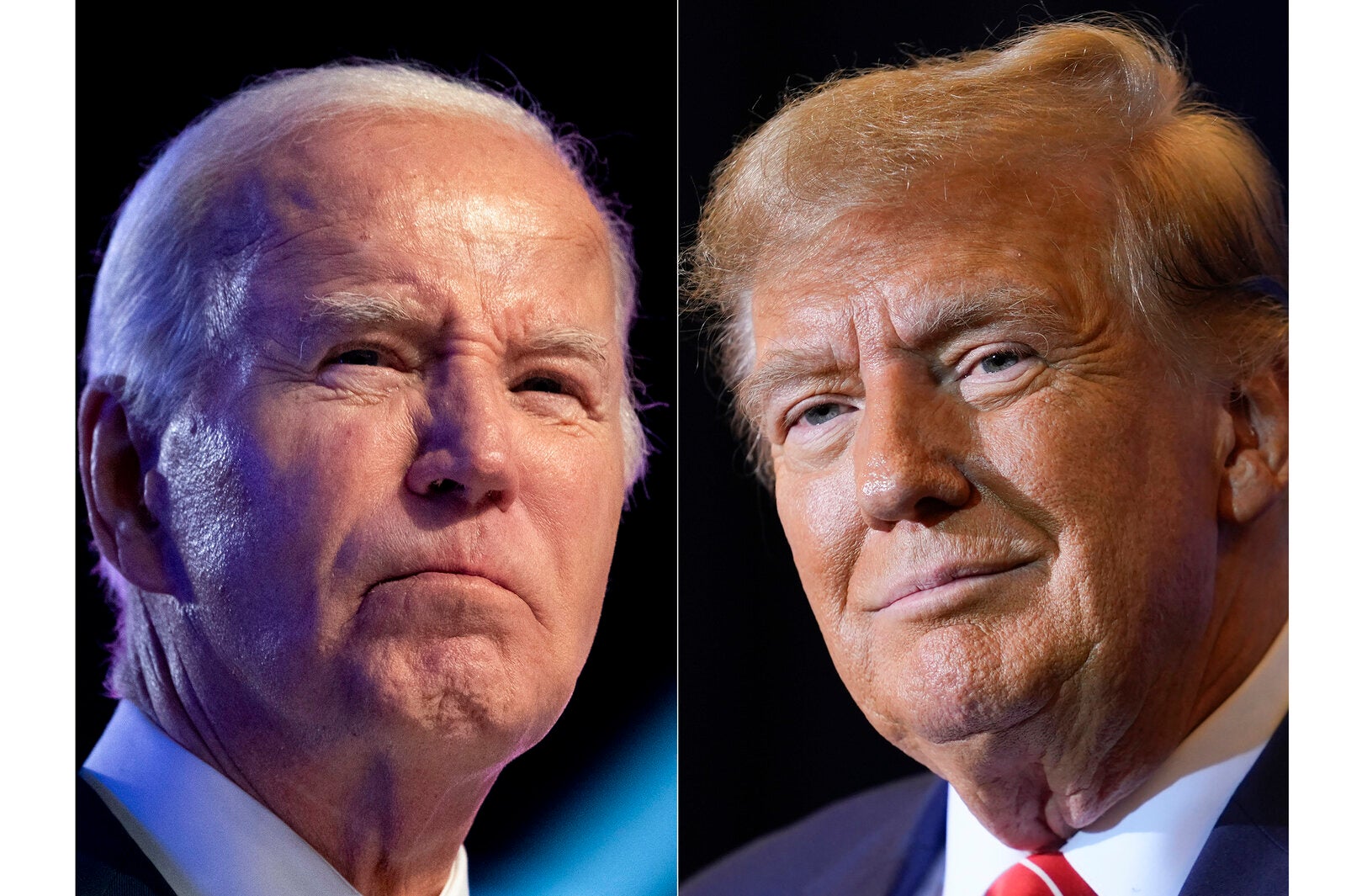
President Donald Trump’s approval rating “has improved somewhat over the last few weeks,” according to Nate Silver’s Silver Bulletin tracker, putting him slightly ahead of Joe Biden at the comparable point in his White House term.
But a Reuters/Ipsos comparison tells a more mixed story: Trump is at the same approval level Biden had at this stage, while drawing higher disapproval.
A new Reuters/Ipsos survey put Trump at 37 percent approval and 61 percent disapproval, a negative 24-point spread (or net approval rating)—calculated by subtracting those who approve from those who disapprove.

E. Jean Carroll calls for Trump to pay $5.8M after high court appeal fails
At the comparable point in Biden’s first term, an Ipsos presidential approval tracker conducted July 25-26, 2022, also put Biden at 37 percent approval, with 58 percent disapproving.
That means a term-aligned Reuters/Ipsos comparison is less a story of Trump clearly outperforming Biden than one of convergence: Biden began much higher and fell sharply. In contrast, Trump began lower and remained in a narrower, consistently negative band.
The White House has consistently rejected the idea that Trump’s approval numbers reflect weakness in his presidency.
“No other President in history has accomplished more for the American people than President Trump, who is working tirelessly to create jobs, cool inflation, increase housing affordability, and more,” Davis Ingle, a White House spokesman, said in a statement.
“The President has already made historic progress not only in America but around the world, and this is just the beginning as his agenda continues taking effect.”
Newsweek contacted Biden’s office for comment via its website on Tuesday morning outside of regular working hours.
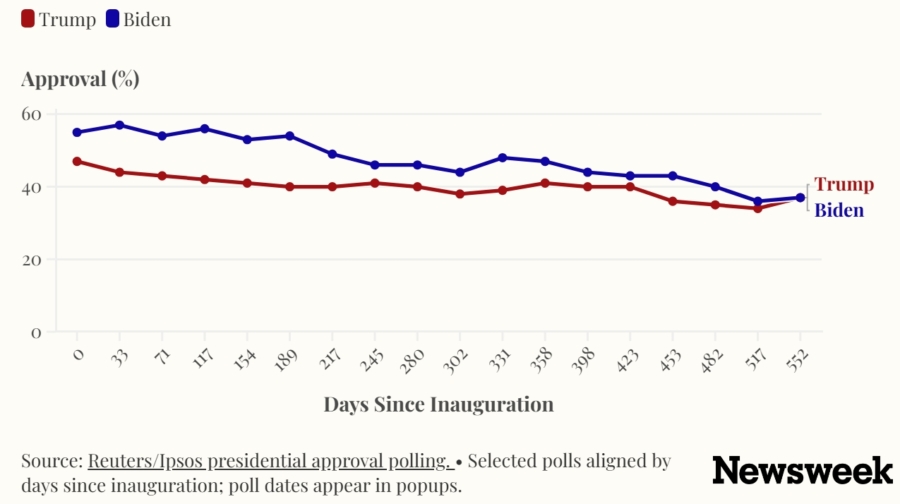
Trump And Biden Approval Ratings At The Same Point In Their Terms
Reuters/Ipsos presidential approval polling, aligned by days since inauguration.
Two Measures Tell Slightly Different Stories
Trump and Biden are at the same approval level when aligned by days since inauguration, according to data from the Reuters/Ipsos tracker poll.
But Nate Silver’s Silver Bulletin tracker tells a somewhat different story because it is a polling average rather than a single poll or single pollster trend line.
According to its latest figures, Silver Bulletin put Trump at a net approval of negative 17.4, an improvement from his second-term low of negative 20.2 in May.
Senior elections analyst Eli McKown-Dawson wrote for the website that Trump was “actually slightly more popular than Joe Biden was at the equivalent point,” with Biden at negative 19.2 and Trump at negative 17.4.
It means Trump is marginally less underwater in that tracker than Biden was at the same point.
Silver Bulletin lists its presidential approval tracker as measuring how popular Trump is, alongside approval ratings for presidents since Harry Truman in the final months of World War II.
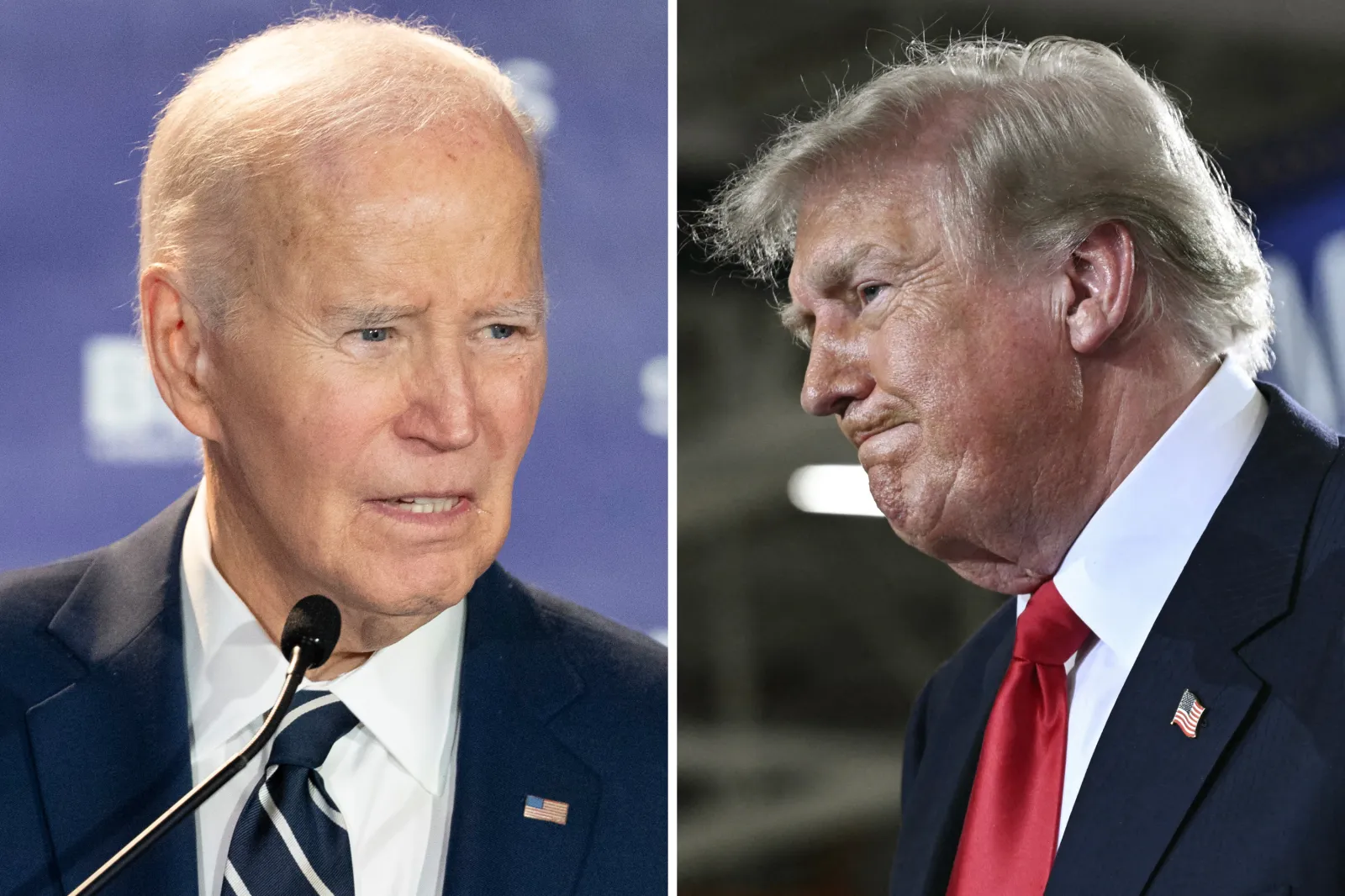
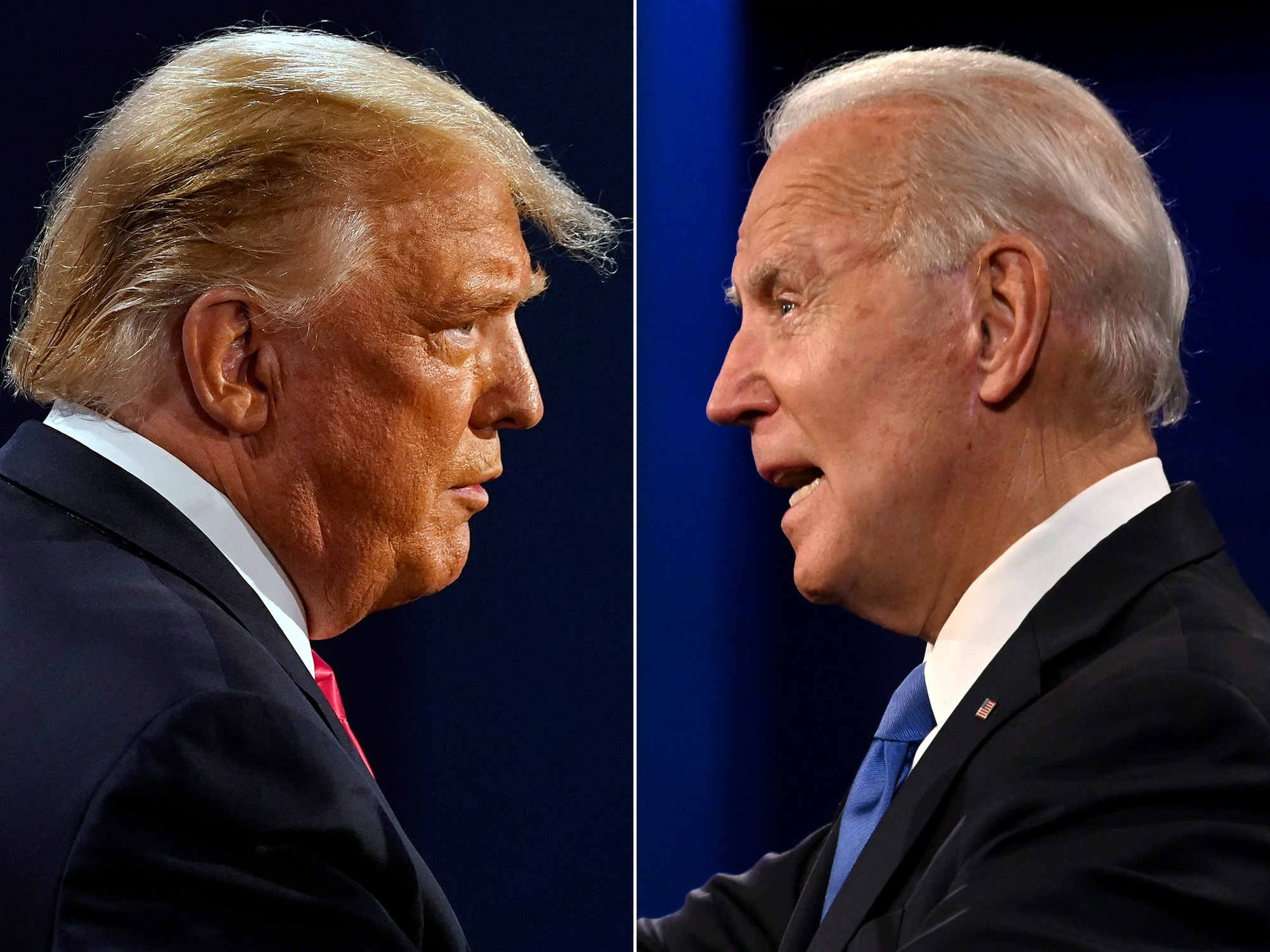
Left: Joe Biden at the Columbia Museum of Art on February 27, 2026, in Columbia, South Carolina. Right: Donald Trump at General Motors’ Milford Proving Ground in Milford, Michigan, on July 27, 2026.
Former aide reveals why Melania Trump ‘will never leave’ Donald
Reuters/Ipsos Shows a Harsher Snapshot
The newest Reuters/Ipsos poll gives a tougher picture than the average.
The July 24-26 survey found Trump at 37 percent approval and 61 percent disapproval.
That was an improvement from the June 18-22 Reuters/Ipsos reading, which put him at 34 percent approval and 64 percent disapproval, but it still left him with nearly three in five Americans disapproving of his presidency.
The poll also fits a longer weakening trend. Reuters/Ipsos showed Trump beginning his second term at 47 percent approval and 41 percent disapproval from January 20-21, 2025, a positive 6-point spread. By July 2026, that had become a negative 24-point spread.
The July 2026 Reuters/Ipsos survey sampled 1,246 U.S. adults nationwide and had a margin of error of 3 percentage points in either direction, according to Reuters.
Why Averages and Single Polls Differ
The difference between Silver Bulletin and Reuters/Ipsos is not necessarily a contradiction. It reflects the difference between a polling average and a single pollster’s trend.
A single poll captures one field period, one sample and one methodology. A polling average blends multiple surveys, which can smooth the volatility caused by timing, sample composition, question wording and pollster effects.
Two Major Blunders in War with Iran Leave Trump in a Tight Corner
Reuters says Reuters/Ipsos polls use Ipsos’ KnowledgePanel, a representative sample of Americans aged 18 and older selected through postal address-based sampling.
Respondents are polled online, and those without internet access are provided internet service and a tablet at no cost, according to Reuters.
Reuters also says its data are weighted to reflect U.S. Census benchmarks including gender, age, race, Hispanic ethnicity, education, household income and region, and may also be weighted for political composition.
That methodology matters because a 3-point change can be politically meaningful without proving that public opinion has fundamentally shifted.
Trump has improved from the June Reuters/Ipsos low, but the broader picture is still a presidency operating underwater.

A woman walks past a large billboard pledging revenge against US President Donald Trump along Jomhouri Street in central Tehran on July 27, 2026. | AFP via Getty Images
The Iran War Is Part of the Approval Story
The newest Reuters/Ipsos numbers arrived alongside weak public support for the war on Iran.
Reuters reported that just one in three Americans supported the conflict, the lowest reading in Reuters/Ipsos polling since the early days of the five-month-old war.
Reuters also reported that 69 percent of Americans, including four in 10 Republicans, said Trump had not “clearly explained the goals of U.S. military involvement in Iran.”
That matters because foreign policy can quickly become domestic politics when voters connect it to costs, gasoline prices and presidential focus.
Gasoline prices have been averaging just over $4 a gallon nationwide, up from about $3 before the war began on February 28.




:max_bytes(150000):strip_icc():focal(952x337:954x339):format(webp)/my-extroardinary-family-la-triplets-82725-2e8ea06ef062473485958c7058a94c01.jpg?fit=750,500&ssl=1 "Pregnant Woman Went to Check Baby’s Heartbeat. Then She Found Out She Was Expecting Rare Identical Triplets (Exclusive)")



:max_bytes(150000):strip_icc():focal(753x271:755x273):format(webp)/cole-the-deaf-dog-112125-1a-ad248101bd174108a795d88d6afd93d8.jpg?fit=750,500&ssl=1 "Elementary School Throws Deaf Therapy Dog a Surprise Birthday Party as Students Learn Sign Language to Sing ‘Happy Birthday’")