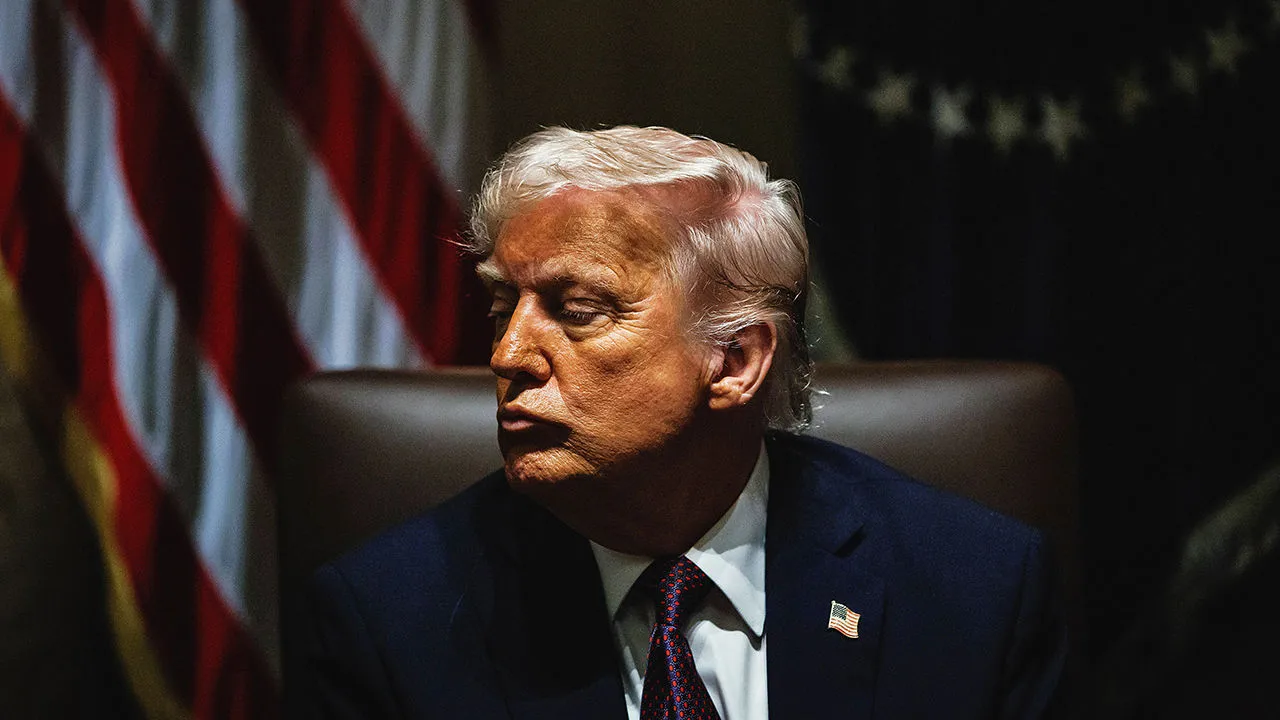
Donald Trump’s insatiable desire to name things after himself has been clear for a very long time. And as president, he’s rapidly pushed the envelope in that regard, naming things after himself in ways it appears no previous president ever has.
But even by his standards, this quest has taken a desperate — and seemingly politically unwise — turn.
Trump last month sought to have Congress rename Dulles International Airport near DC and New York City’s Penn Station after himself.
CNN’s Manu Raju and Adam Cancryn report that Trump pitched the renamings to Senate Minority Leader Chuck Schumer as a condition for releasing billions of dollars in frozen funds for a major New York infrastructure project. Schumer, a New York Democrat, turned it down. The news was first reported by Punchbowl.
(The president had a different spin on it Friday, claiming that Schumer had been the one to suggest renaming Penn Station after him – which Schumer quickly dismissed as an “absolute lie.”)
In a way, this might sound par-for-course. Trump has already applied his name (legally or otherwise) to a bevy of things — from the Kennedy Center, to the US Institute of Peace, to a class of battleships, to savings accounts for children. He even launched a “TrumpRx” prescription drug platform on Thursday, the very same day we learned about his designs on slapping his name on major transportation hubs in DC and New York.
While things are named after presidents, experts have said there is simply no precedent for naming things after a sitting president like this. The New York Times recently dug into the data, backing up that other presidents have almost always had to wait until after leaving office.
Why this is different
But even by the standards Trump has set for himself, his bid to rename this train station and airport are on another level.
The key difference here is that the president has sought to name these things after himself not by executive action, but through leverage — by effectively trading it as a political favor.
There’s good reason he appears to be going down that road. His previous bids to slap his name on buildings, like the Kennedy Center, are quite possibly illegal, and they could just as easily be reversed — especially once he leaves office. It would be altogether shocking if the next Democratic president didn’t remove Trump’s name from the Kennedy Center.

In order for the Trump brand to have lasting power on government entities, he really needs Congress to codify the changes. But Congress is not good at acting — especially when there’s not much in it for them.
Trump is not trying to leverage the New York infrastructure project for some conservative policy win — something that matters to the Republican base or GOP members of Congress ahead of the 2026 midterms. He’s trying to leverage it for his own personal tribute and glorification.
The president could seemingly use this as leverage for any number of other purposes, but he’s sought to use it for himself.
He has been transactional about lots of things, especially in his second term. He’s even used his leverage recently to get a Venezuelan opposition leader to gift him her recently awarded Nobel Peace Prize. As I wrote back then, that raised the prospect that Trump was in effect trading his personal glorification for major foreign policy decisions.
But usually his efforts to leverage his authority for personal glorification are a little more subtle like that — with the quid pro quo a little less direct. His proposition to Schumer practically slaps you across the face in its degree of blatant self-dealing.
Republicans should probably start asking themselves how much they’re willing to entertain this level of self service.
And it’s a political loser, too
But even beyond the “yuck” factor, there’s good reason to believe this is a rather poorly conceived move. Indeed, Trump’s efforts to glorify himself appear to be a major and growing problem for him right now.
We don’t have much high-quality polling on his bids to name things after himself specifically.
But polling early last year showed around two-thirds of Americans opposed his effort to unilaterally rename the Gulf of Mexico as the “Gulf of America.” That suggests Americans overwhelmingly don’t think he should just be able to do things like this by himself.
And a CNN poll last month asked about Trump “making changes to cultural institutions such as the Kennedy Center and the Smithsonian.” Fully 62% of Americans said he had “gone too far” on this count.
That question wasn’t specifically about renaming the Kennedy Center, though it’s logical to assume many had heard the board had voted to add Trump’s name in December. About 7 in 10 independents and even 3 in 10 Republicans said the president was going too far with those cultural changes.
But that might not be the worst and most relevant finding from that CNN poll.
The survey also found Trump hitting a record low on the percentage of Americans who said he “cares about people like you.” Just 33% said that applied to Trump. A whopping 77% of independents disagreed.
And Americans said 63%-37% that they disagreed with the idea that Trump “puts the good of the country above his personal gain.”
To put a fine point on that: Nearly two-thirds of Americans said Trump is mostly out for himself.
That may be fueled, in part, by perceptions Trump is enriching himself financially in office. (The White House has repeatedly maintained it’s committed to ethics and transparency.) But potential conflicts of interest are a lot more difficult to explain than PLASTERS HIS OWN NAME ACROSS A BUILDING.
And Trump’s quest to name things after himself seems especially ill-timed given the state of the economy. We’re currently in the midst of what the vast majority of Americans regard as bad economic times, and about three-quarters of Americans don’t think he’s done enough to lower prices.
The usual course for a president in such times would be to focus like a laser on righting the ship — and making people view him as worthy of bestowing honors upon him. And then, at some later date, Congress does just that.
But Trump would apparently rather slap his name on whatever he can, however he can — and hope it somehow sticks.

Trump plans to keep Democratic governors out of traditionally bipartisan meeting
The White House did not explain why Democrats were not invited to the meeting. In addition, at least two Democrats were uninvited to a White House dinner, according to their offices.
President Donald Trump plans to keep Democrats out of a traditionally bipartisan White House gathering of governors typically held as part of the National Governors Association’s annual Washington summit, the organization said.
According to the governors’ offices, the president also revoked invitations sent to Maryland Gov. Wes Moore (D), the NGA’s vice chair; and Colorado Gov. Jared Polis (D) to attend a second White House event scheduled to occur around the summit: a dinner for governors.
“This week, I learned that I was uninvited to this year’s National Governors Association dinner — a decades-long annual tradition meant to bring governors from both parties together to build bonds and celebrate a shared service to our citizens with the President of the United States,” Moore said in a statement Sunday. “… It’s hard not to see this decision as another example of blatant disrespect and a snub to the spirit of bipartisan federal-state partnership.”
Moore told CNN’s “State of the Union” on Sunday that he was confused by the White House’s decision, saying that, just a few weeks ago, he led a bipartisan group of governors who met with the president as Trump signed a memorandum on bringing down energy costs.
Moore also said on CNN that it was “not lost” on him that he is the only Black governor of a state.
“I find that to be particularly painful, considering the fact that the president is trying to exclude me from an organization that not only my peers have asked me to help to lead, but then also a place where I know I belong in,” he said. “I’m never in a room because of someone’s benevolence nor kindness. I’m not in a room because of a social experiment. I’m in the room because I belong there and the room was incomplete until I got there.”
Eric Maruyama, a spokesperson for Polis, said the decision to exclude the Colorado governor was “disappointing.”
“Gov. Polis has always been willing to work with anyone across the political spectrum who wants to help work on the hardest problems facing Colorado and America, regardless of party or who occupies the White House,” Maruyama said in a statement.
Spokespeople for the Democratic Governors Association did not immediately respond to a request for comment.
While Moore and Polis were excluded from the dinner with Trump, some Democrats remained invited to the gathering.
The White House did not explain why Democratic governors were not invited to the meeting with Trump, and a spokesperson did not respond to a request to provide a list of Democrats who were invited to the dinner.
Trump has frequently clashed with Moore and Polis, and his decision comes after months of conflict between the federal government and Democratic governors.
Moore has condemned the president’s threat to deploy the National Guard to Baltimore and defund the Maryland’s efforts to replace the fallen Key Bridge. Trump has also repeatedly claimed that Baltimore is “crime ridden” despite the fact that the city is experiencing its lowest homicide rate in 50 years.
Polis and Trump have repeatedly feuded over Tina Peters, a former county clerk in Colorado who was convicted in state court on felony charges related to efforts to overturn the 2020 presidential election. Polis has defended the conviction and refused the White House’s request to transfer Peters to a federal prison. Because of this, in December, Trump in a Truth Social post called Polis a “scumbag” and said he should “rot in Hell.”
The NGA’s Washington meetings are expected to take place Feb. 19 to 21. The organization said Friday that the White House meeting will no longer be part of the association’s official schedule.
In a statement Friday, Brandon Tatum, the interim CEO of the NGA, said that the “bipartisan White House governors meeting is an important tradition, and we are disappointed in the administration’s decision to make it a partisan occasion this year.”
“To disinvite individual governors to the White House sessions undermines an important opportunity for federal-state collaboration,” Tatum said. “At this moment in our nation’s history, it is critical that institutions continue to stand for unity, dignity and constructive engagement.”
When Trump makes election threats, it’s best to believe him

When President Donald Trump looks like he’s gearing up to meddle in an election, still-raw history suggests he should be believed.
He showed yet again Monday he’s obsessing about the midterm elections — two days after a Democratic upset in a reliably Republican state Senate district in Texas offered another ominous sign for the GOP in November.
“The Republicans should say, ‘We want to take over, we should take over the voting, the voting in at least many, 15 places.’ The Republicans ought to nationalize the voting,” Trump said. “We have states that are so crooked, and they’re counting votes. We have states that I won, that show I didn’t win.”
The president’s latest threat to the integrity of America’s elections came in an interview with Dan Bongino, until recently the deputy director of the FBI, who has now reclaimed his mantle as the “podfather” on his MAGA-boosting show.
In substance, Trump’s comment was nonsensical, since the Constitution requires states to run elections. That principle has been upheld multiple times in court, including in cases brought by the president falsely alleging fraud.
Article I, Section 4, of the Constitution could hardly be more plain. “The Times, Places and Manner of holding Elections for Senators and Representatives, shall be prescribed in each State by the Legislature thereof; but the Congress may at any time by Law make or alter such Regulations, except as to the Places of chusing Senators.”
There is no mention of the president. That’s deliberate.
David Becker, executive director of the Center for Election Innovation & Research, said Trump demonstrates an “incredible lack of understanding about the constitutional protections that our founders created so wisely when they established our nation.” He added: “The founders, when they drafted the Constitution, were very concerned about an unscrupulous executive trying to seize power through seizing the mechanics of an election.”
John Jones, a former Pennsylvania US district court judge, said Trump’s suggestion was flagrantly unconstitutional. “I don’t mean this disrespectfully, but I mean it directly. The president of the United States needs to read the Constitution,” Jones told CNN’s Brianna Keilar on Monday. “What he’s proposing is — is not legal.”
Trump’s warning was one of his most overt efforts yet to create a narrative of suspicion around November’s elections in case the Republican Party does poorly because of his tanking poll numbers. This is a familiar tactic. Trump laid groundwork for his false claims the election was stolen in 2020 months before the first votes were cast in his defeat to Joe Biden.
Now, as Trump blanches at the scrutiny he’d face if Democrats win back the House, this process looks more sinister. The administration has created an infrastructure to cast doubt on the legitimacy of federal elections, or to shape them before they happen. It’s a well of unquestioned loyalty to Trump.
Almost every modern president avoided casting doubt on the probity of elections, aware that trust of citizens is the critical thread that preserves democracy. But Trump incessantly does the opposite. His false claims of voter fraud in 2020, disproven by multiple courts and Republican officials, led to one of the most infamous days in American history when a group of his supporters beat up US Capitol Police officers and invaded the Capitol on January 6, 2021, in a bid to halt the certification of Biden’s victory.


Jokes about election fraud aren’t that funny
Often, Trump aides portray questions about his frequent attacks on the US electoral system as media hysteria. “The president was simply joking,” White House press secretary Karoline Leavitt said last month when asked about Trump’s comment to Reuters that “We shouldn’t even have an election.”
Leavitt added: “He was saying, ‘We’re doing such a great job, we’re doing everything the American people thought, maybe we should just keep rolling.’ But he was speaking facetiously.”
Yet Trump’s jokes about elections don’t seem that funny when refracted through the prism of 2020, his incessant efforts to whitewash his own conduct, and new efforts to pollute faith in American elections.
► Last week, FBI agents descended on Fulton County, Georgia, and served a warrant before confiscating 700 boxes of election materials, including ballots. Trump falsely claimed he won the state in 2020.
► In an even more shocking move, Director of National Intelligence Tulsi Gabbard was on hand for the search, despite having no authority over domestic elections. And America’s top spy put FBI agents conducting the operation on the phone with the president, as the New York Times first reported. The conversation obliterated investigative safeguards and could prejudice any cases that ensue. The president gave the agents a “pep talk,” CNN’s Kristen Holmes reported.
Gabbard released a letter to two Democratic lawmakers Monday evening saying that her department’s general counsel found her actions to be within her lawful authority. She said Trump had tasked the Office of the Director of National Intelligence with ensuring the integrity of US elections. The letter is only likely to further fuel concerns since she rejects the US intelligence community’s assessment that Russia interfered in the 2016 election.
► Trump told The Times in an interview last month that he “should have” seized voting machines after the 2020 election.
► Last March, Trump signed an executive order apparently designed to circumvent legal and constitutional prohibitions on a president taking control of the election system. It included requirements for people to provide documentary proof of citizenship when voting and new restrictions on mail-in ballots. Most of the provisions of the order have been blocked in a series of court orders.
► The DOJ has demanded voter rolls from two dozen states. These records contain personal information such as Social Security numbers and home addresses. In Minnesota last month after federal agents killed a second protester, Attorney General Pam Bondi called on the state to hand over its voter registration records.
► Trump also cajoled Texas into a mid-decade redrawing of its electoral map to try to make a handful of districts more favorable for Republicans. The move backfired by setting off reprisal gerrymandering in Democratic-led California. And Trump’s diving approval numbers might make the new Lone Star districts more competitive than he’d hoped.
► CNN’s Tierney Sneed has reported on how the administration is using the Civil Rights Act — passed to protect Black voters from disenfranchisement — to help “clean” voter rolls, in a move critics see as narrowing the franchise.

A presidential tantrum
This multifront initiative to inject the federal government into elections that should be the responsibility of states and Congress coincides with an accelerating effort to use the Justice Department for Trump’s political aims. This includes increasing pressure on journalists — for instance ex-CNN anchor Don Lemon, who was arrested last week — and prosecutions and investigations targeting the president’s political opponents and critics.
White House and DOJ officials insist their actions are simply intended to clean up US elections. But multiple academic and legal investigations, audits and recounts have repeatedly found that instances of fraud are miniscule.
Some of this is about salving Trump’s ego since the stain of defeat punctures the mythology of the president billed as life’s greatest winner. In 2020, a historic attempt to overturn the election result that led to scores of court cases, political chicanery and the bloodshed of January 6, started with an election night tantrum. “We were getting ready for a big celebration. We were winning everything and all of a sudden it was just called off,” Trump said, failing to understand that early GOP leads can be overtaken by ballots that are counted later.
Trump has much to fear from a potential Democratic Congress that would severely curtail his power. His final two years in office would be miserable.
“This sounds to me like somebody who sees a wipeout coming at the ballot box, based on the energy we’ve seen in the streets with ‘No Kings’ rallies, and also the results we’ve shown in special elections,” Rep. Eric Swalwell, who is running for California’s Democratic gubernatorial nomination, told CNN’s Kasie Hunt.
The attempt by officials to access voter rolls is especially notable since it suggests an organized attempt by federal officials to become involved in intimate details of elections administered by states. Officials have argued in legal filings that the central government has standing to perform maintenance on voter lists. They say they are ensuring that non-citizens cannot cast ballots and that the federal government has the right to flag ineligible voters.
Such heavy-handed interventions, which have attracted considerable resistance in the courts, have chilled election experts. Federal action could strike eligible voters from the rolls and remove their democratic rights. Government interference could disincentivize people from registering to vote amid concerns their vital data could be used for nefarious purposes. Some experts also believe that the Trump administration could flag minor irregularities to argue that elections across a key state or district are flawed. This might not pass muster in the courts. But it’s a political gambit and Trump has already displayed his talent for convincing millions of Americans that a fair election is fraudulent.


The seizing of election materials from Georgia — an epicenter of Trump’s interference in 2020 — raises concerns that a small or manufactured glitch could be misrepresented to proclaim that election and therefore the voting in 2026 as flawed.
Another worry is that many of the guardrails that thwarted Trump’s attempt to steal power in 2020 have been ripped away. Many senior officials are fully bought into Trump’s alternative electoral reality. There’s no one like then-Attorney General Bill Barr, who told Trump there was no evidence to support his voter fraud claims. Bondi has turned the DOJ into an arm of Trump’s political operation. Many lower-level officials are also true believers. In 2020, other federal officials — in the Department of Homeland Security, and even the White House counsel’s office — pushed back on Trump and stood up for the rule of law. Trump now has total power over his administration.
“I don’t know if there are members of this administration who are ready to stand up for their oath to the Constitution rather than their loyalty to this particular man,” said Becker, a former senior trial attorney in the Voting Section of the Department of Justice’s Civil Rights Division.
CNN reported last week on increasing preparations by Democratic officials for multiple scenarios following November’s election. And there are many Republican officials nationwide who will honor their oaths to the Constitution.
And there’s a shining reason why Americans may still be able to trust the 2026 election, whatever the president’s intentions. Dedicated legions of election workers and monitors of all political persuasions will again be guarding the most basic democratic right.
“Our election officials are strong. They’ve weathered some very significant challenges over years, and they are dedicated to giving us all our voice, and they’re going to continue to do that,” Becker said.
“I have every confidence that our voters in the United States are going to be able to vote conveniently and safely.”
Judge orders Trump administration to unfreeze more than $16 billion for NY tunnel project

A federal judge in New York ruled Friday that the Trump administration must unfreeze more than $16 billion earmarked for a major New York infrastructure project and allow construction to continue, saying that public interest would be “harmed by a delay.”
The temporary restraining order granted by US District Judge Jeanette Vargas in the Southern District of New York comes as President Donald Trump has withheld the funding meant for the long-planned project connecting New York and New Jersey through a new rail tunnel beneath the Hudson River.
Vargas said in a court filing that the states of New York and New Jersey would “suffer irreparable harm” if the Trump administration continued to withhold the funding for the project.
“Plaintiffs have adequately shown that the public interest would be harmed by a delay in a critical infrastructure project,” she wrote.
CNN has reached out to the White House for comment.
CNN previously reported Trump told Senate Minority Leader Chuck Schumer last month that he was prepared to drop his freeze on the funding under the condition that Schumer agree to rename New York’s Penn Station and Washington’s Dulles International Airport after Trump.
The president told reporters aboard Air Force One on Friday night it was Schumer’s idea to rename Penn Station to “Trump station.”
Schumer immediately dismissed Trump’s claim and accused him of lying about the details of their conversation.
“Absolute lie. He knows it. Everyone knows it. Only one man can restart the project and he can restart it with the snap of his fingers,” Schumer wrote on X.
The commission in charge of the tunnel project previously warned that it would soon have to shut down work on the project and lay off roughly 1,000 workers if the Trump administration does not release the funding it needs.
New York Attorney General Letitia James, who sued the Trump administration earlier this month, celebrated the ruling as a “critical victory for workers and commuters in New York and New Jersey.”
“I am grateful the court acted quickly to block this senseless funding freeze, which threatened to derail a project our entire region depends on. The Hudson Tunnel Project is one of the most important infrastructure projects in the nation, and we will keep fighting to ensure construction can continue without unnecessary federal interference,” James said in a statement.



:max_bytes(150000):strip_icc():focal(749x0:751x2)/rodham-3-4ded923ef9d94f978df175d5a2241bf4.jpg?fit=1500,1000&ssl=1 "The Heartbreaking Farewell: Bill Clinton’s Most Emotional Public Address Shakes the Nation to Its Core")




:max_bytes(150000):strip_icc():focal(753x271:755x273):format(webp)/cole-the-deaf-dog-112125-1a-ad248101bd174108a795d88d6afd93d8.jpg?fit=750,500&ssl=1 "Elementary School Throws Deaf Therapy Dog a Surprise Birthday Party as Students Learn Sign Language to Sing ‘Happy Birthday’")


:max_bytes(150000):strip_icc():focal(754x379:756x381):format(webp)/chow-chow-bowling-green-subway-70ac9e829e20441a978d9f05a1085374.jpg?fit=750,500&ssl=1 "Dog Dies After Getting Electrocuted by Third Rail At N.Y.C. Subway Station")