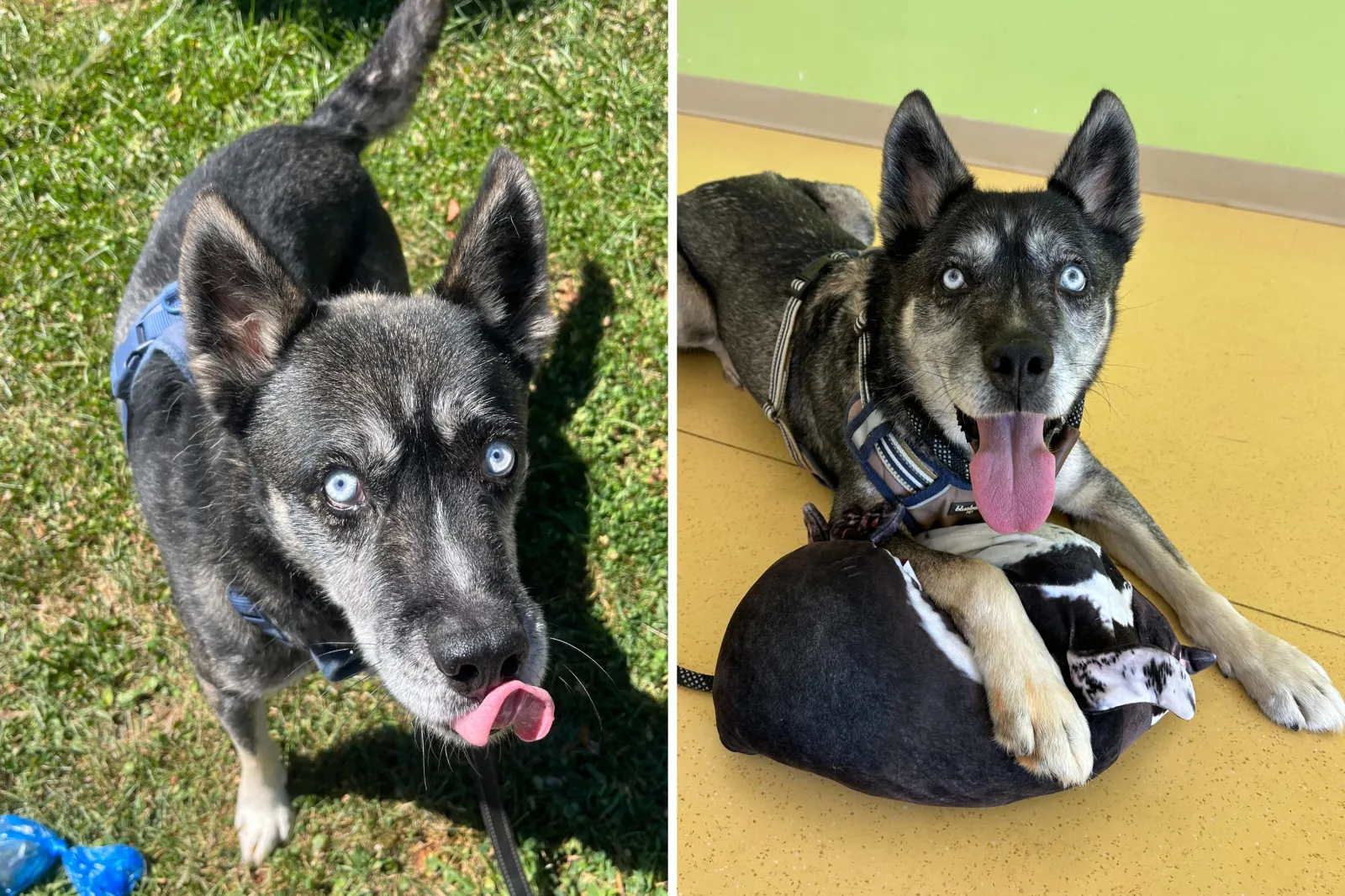
A dog called Bear has finally been adopted after being returned to an animal shelter twice—through no fault of his own.
Newsweek spoke to Claire LeFew, the development and communications manager at the Lynchburg Humane Society in Virginia, who explained that the road to his forever home has been far from smooth.
LeFew said: “Bear came to us as a lost pet several times and was ultimately surrendered into our care.
“He was first surrendered in August of 2024 and adopted for about five months in between into a loving home and was returned due to housing issues.”
Between 2019 and 2023, researchers studied over a million shelter intake records from 21 shelters across the United States and found that housing problems were a major reason pets were given up, accounting for about 14 percent of all cases.
The most-common issues included general housing problems, restrictions on pets in rental properties, landlord conflicts, loss of housing, and owners experiencing homelessness.
In January 2025, the 6-year-old husky mix was returned to the shelter, and posts about him frequently gained a lot of attention.
One Facebook post in September earned over 20,000 views, describing him as a “unique dog.” It noted that his uniqueness wasn’t because of his striking eyes—bright blue but almost white, reminiscent of something humans might wear at Halloween—nor because of his bunny hops when it is time for walkies.
“What makes Bear special is how codependent he is. Bear is a sensitive guy which also means he’s sensitive to people’s emotions, and therefore a GREAT companion!
“Not everyone loves a codependent clingy dog, but for those of you who do; Bear gets you, and you will get Bear. [He] loves everyone he meets, even does well with kids, and he hates being alone,” the post said.
A study conducted by researchers at the Norwegian School of Veterinary Science found that separation anxiety is one of the most-common behavioral issues in dogs.
Of nearly 1,000 canines seen at Manimal Behavior Clinic, in Oslo, Norway, more than 1 in 5 were diagnosed with separation anxiety. Owners reported destructive behavior, nonstop barking, and hyperactivity as the clearest signs of the condition—as demonstrated in a heartbreaking video shared by the shelter showing Bear howling in his kennel.
While some dogs showed separation anxiety alone, most also struggled with other behavioral problems, most notably noise sensitivities. Owners reported destructive behavior, nonstop barking, and hyperactivity as the clearest signs.
LeFew told Newsweek that Bear’s posts were performing well on social media, but he “wasn’t getting much interest” in real life.
In October, the shelter’s adoption counselors spoke with a family that had previously adopted a sweet long-stay dog called Tater, who had since passed away.
“They wanted to save another long-stay dog; they met a few, but Bear was who they fell in love with!” said LeFew.
Now, just a couple of months later, Bear is thriving in his new home and is set to spend Christmas with his new family.
References
Applebaum, Jennifer W., et al. “Housing-Related Companion Animal Relinquishment across 21 Animal Shelters in the United States from 2019—2023.” Frontiers in Veterinary Science, vol. 11, July 2024, p. 1430388. PubMed Central, https://doi.org/10.3389/fvets.2024.1430388.
Storengen, Linn Mari, et al. “A Descriptive Study of 215 Dogs Diagnosed with Separation Anxiety.” Applied Animal Behaviour Science, vol. 159, October 2014, pp. 82—89. ScienceDirect, https://doi.org/10.1016/j.applanim.2014.07.006.





:max_bytes(150000):strip_icc():focal(514x303:516x305)/011524-LOTD-Kelly-Ripa-SOC-baee131a1c334262b4550b95b303e67d.jpg?fit=1000,750&ssl=1 "Mark Consuelos Makes Big Confession About Sex Life With Kelly Ripa")



:max_bytes(150000):strip_icc():focal(753x271:755x273):format(webp)/cole-the-deaf-dog-112125-1a-ad248101bd174108a795d88d6afd93d8.jpg?fit=750,500&ssl=1 "Elementary School Throws Deaf Therapy Dog a Surprise Birthday Party as Students Learn Sign Language to Sing ‘Happy Birthday’")