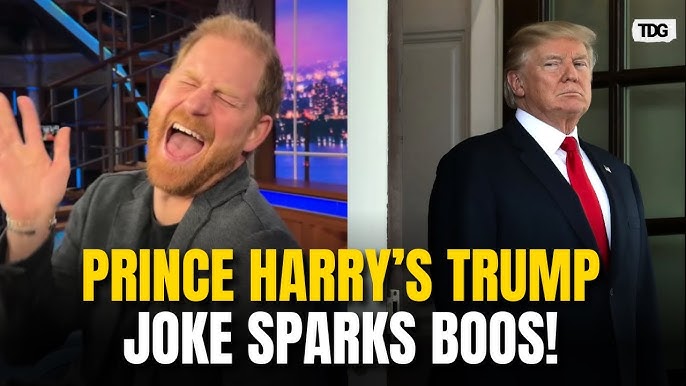
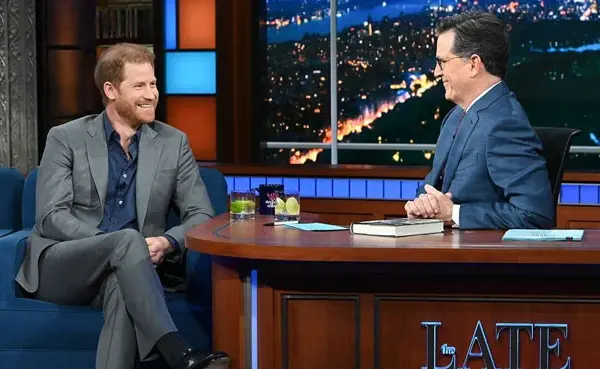
When Prince Harry appeared unannounced on The Late Show with Stephen Colbert on December 3, 2025, audiences expected a lighthearted, festive sketch to mark the holiday season.
Instead, the Duke of Sussex delivered a performance that was as much social commentary as it was comedy.
What started as a playful, self-deprecating moment quickly morphed into a sharp, pointed critique of former President Donald Trump, highlighting Harry’s unusual position as a former royal navigating American media, politics, and public opinion.
The surprise appearance immediately captured headlines, with media outlets describing it as a rare intersection of royal culture, entertainment, and political satire.
The sketch underscored the way Harry has transitioned from a traditional “spare” royal to a highly visible public figure in the United States, unafraid to blend humor with cultural and political commentary.
The Comic Setup — With a Sharp, Memorable Punchline
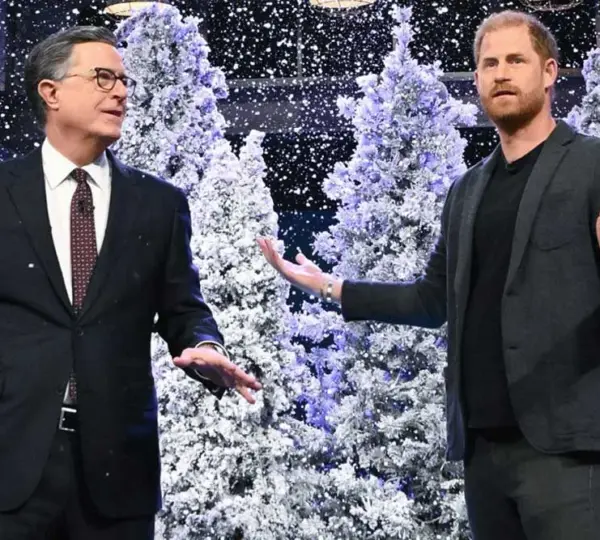
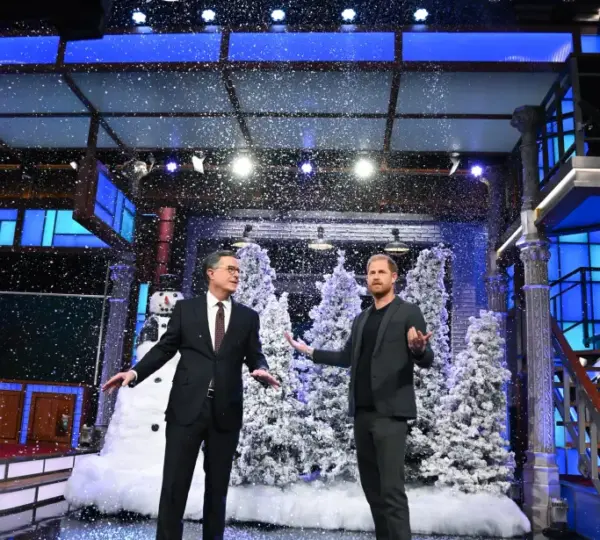
Harry’s entrance at the iconic Ed Sullivan Theater was part of a mock audition for a fictional Hallmark-style Christmas movie titled The Gingerbread Prince Saves Christmas in Nebraska.
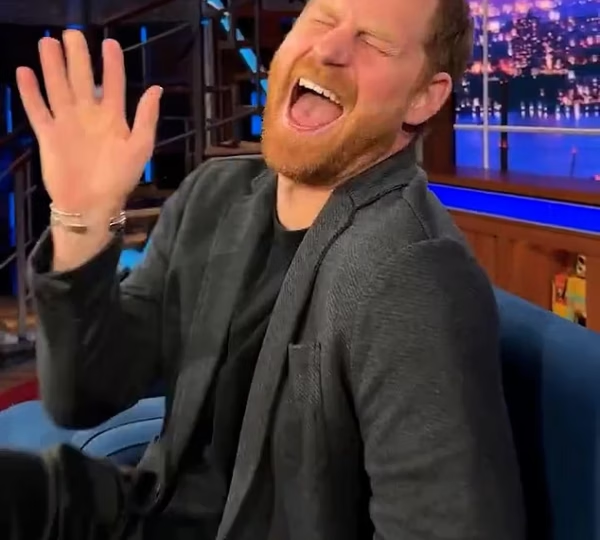
The sketch lampooned America’s fascination with Christmas movies, celebrity culture, and its enduring fascination with royalty.
Harry leaned into the absurdity with comedic timing honed from years in the public eye, crafting a playful scene that invited the audience to laugh while reflecting on cultural idiosyncrasies.
However, the humor took a sharper turn when Harry delivered a line that would dominate media coverage:“Really? I heard you elected a king.” (Yahoo)
Although Harry never named Donald Trump directly, the audience, media, and commentators immediately recognized the remark as a critique of the former president’s public persona and self-styled authority.
The line resonated with long-standing tensions between Trump and the Duke of Sussex, including threats Trump made regarding deportation and criticism of Harry and Meghan Markle following their royal exit.
Laughter from parts of the audience was mixed with scattered boos, signaling that the comment was both humorous and divisive.
Layering Humor With Historical Satire
The Duke did not stop at a single joke. Stephen Colbert, acting as moderator, offered gentle commentary to keep the sketch lighthearted, but Harry leaned further into historical satire.
He referenced his ancestor, King George III, whose reign famously triggered the American Revolution.
In a wryly self-aware comment, Harry suggested that after centuries of rebelling against monarchy, Americans seemed to have “circled back” to electing a modern king.
This layering of historical context and modern political critique gave the sketch additional depth, making the audience laugh while subtly prompting reflection on the intersections of governance, celebrity influence, and American political culture.
The sketch concluded with Harry poking fun at modern entertainment culture, joking about recording a self-tape audition, flying himself to Nebraska, and settling “a baseless lawsuit with the White House.”
These lines were interpreted as veiled nods to ongoing media conflicts and legal disputes involving Trump, blending comedy with pointed social commentary.
Colbert crowned Harry “The Late Show Prince of Christmas” amid falling fake snow, but the satire’s edge had already made its mark. (KTSA)
Context and Implications
1. A Rare Political Statement From a Royal
Since stepping back from active royal duties, Harry has largely avoided overt political commentary.
His decision to reference Trump on U.S. television marked one of his most explicit political jabs to date.
This moment underscores both the tension with Trump, who has previously made public threats regarding Harry’s U.S. residency, and the Duke’s willingness to voice opinions on American soil.
2. Celebrity Culture and Political Satire
By tying the holiday movie sketch to commentary on celebrity obsession and royalty, Harry highlighted a unique American cultural phenomenon: the merging of fame, media influence, and political perception.
The “modern king” quip effectively critiqued both the media’s fascination with authority figures and the public’s conflation of celebrity with political legitimacy.
3. Risk and Potential Backlash
The mixed audience reaction illustrates the stakes.
While many viewers praised Harry’s wit and insight, others considered the joke inappropriate or “reckless,” fearing it might further strain relations with the royal family and alienate portions of the American public.
Public commentary suggests this type of satire complicates the Duke’s careful navigation between his royal heritage and his American public persona.
4. Broader Social Commentary
Harry’s performance touched on deeper issues reflected in the “No Kings” movement, a 2025 public response to Trump’s self-styling rhetoric.
By referencing historical grievances, contemporary politics, and media attention, Harry sparked discussion about identity, democracy, and the ongoing tension between celebrity culture and governance.
Implications for Harry’s Public Image
Redefining Himself: Harry continues to transition from a “spare” royal to an outspoken media figure in the United States, unafraid to challenge political and cultural norms.
Polarization: His statements elicit admiration from some and criticism from others, highlighting the delicate balance he must maintain as a public figure in a foreign country.
Royal Estrangement: Such a public commentary may deepen divisions with the British royal family, complicating prospects for reconciliation.
Cultural Impact: The sketch provoked broader conversations on fame, political power, and the influence of celebrity culture in contemporary society.
Public and Media Reactions
The appearance generated a flurry of commentary across social media and traditional media outlets.
Fans praised Harry’s courage and comedic timing, noting the sophisticated blending of humor and political commentary.
Others criticized him for overstepping the “apolitical” role often associated with royalty.
Political analysts observed that the sketch symbolized the increasing overlap between celebrity culture and political discourse, while historians highlighted Harry’s clever use of historical satire to convey contemporary points.
Conclusion
Prince Harry’s appearance on The Late Show with Stephen Colbert demonstrates how humor can be a powerful medium for social and political commentary.
By blending self-deprecation, historical insight, and pointed satire, Harry transformed a lighthearted holiday sketch into a culturally resonant moment, reflecting the intersections of royalty, American politics, and media influence.
The line — “Really? I heard you elected a king” — extends far beyond comedy.
It prompts reflection on the nature of leadership, the influence of celebrity, and the enduring fascination with monarchy in modern society.
For Harry, it was both a performance and a statement: an assertion of his voice, his perspective, and his willingness to engage critically with contemporary political and cultural issues.
In the end, this appearance was a reminder that even holiday sketches can become moments of insight, discussion, and cultural reflection — particularly when delivered by a royal who has uniquely navigated the worlds of tradition, media, and political commentary.
When Prince Harry appeared unannounced on The Late Show with Stephen Colbert on December 3, 2025, audiences expected a lighthearted, festive sketch to mark the holiday season.
Instead, the Duke of Sussex delivered a performance that was as much social commentary as it was comedy.
What started as a playful, self-deprecating moment quickly morphed into a sharp, pointed critique of former President Donald Trump, highlighting Harry’s unusual position as a former royal navigating American media, politics, and public opinion.
The surprise appearance immediately captured headlines, with media outlets describing it as a rare intersection of royal culture, entertainment, and political satire.
The sketch underscored the way Harry has transitioned from a traditional “spare” royal to a highly visible public figure in the United States, unafraid to blend humor with cultural and political commentary.
The Comic Setup — With a Sharp, Memorable Punchline
Harry’s entrance at the iconic Ed Sullivan Theater was part of a mock audition for a fictional Hallmark-style Christmas movie titled The Gingerbread Prince Saves Christmas in Nebraska.
The sketch lampooned America’s fascination with Christmas movies, celebrity culture, and its enduring fascination with royalty.
Harry leaned into the absurdity with comedic timing honed from years in the public eye, crafting a playful scene that invited the audience to laugh while reflecting on cultural idiosyncrasies.
However, the humor took a sharper turn when Harry delivered a line that would dominate media coverage:“Really? I heard you elected a king.” (Yahoo)
Although Harry never named Donald Trump directly, the audience, media, and commentators immediately recognized the remark as a critique of the former president’s public persona and self-styled authority.
The line resonated with long-standing tensions between Trump and the Duke of Sussex, including threats Trump made regarding deportation and criticism of Harry and Meghan Markle following their royal exit.
Laughter from parts of the audience was mixed with scattered boos, signaling that the comment was both humorous and divisive.
Layering Humor With Historical Satire
The Duke did not stop at a single joke. Stephen Colbert, acting as moderator, offered gentle commentary to keep the sketch lighthearted, but Harry leaned further into historical satire.
He referenced his ancestor, King George III, whose reign famously triggered the American Revolution.
In a wryly self-aware comment, Harry suggested that after centuries of rebelling against monarchy, Americans seemed to have “circled back” to electing a modern king.
This layering of historical context and modern political critique gave the sketch additional depth, making the audience laugh while subtly prompting reflection on the intersections of governance, celebrity influence, and American political culture.
The sketch concluded with Harry poking fun at modern entertainment culture, joking about recording a self-tape audition, flying himself to Nebraska, and settling “a baseless lawsuit with the White House.”
These lines were interpreted as veiled nods to ongoing media conflicts and legal disputes involving Trump, blending comedy with pointed social commentary.
Colbert crowned Harry “The Late Show Prince of Christmas” amid falling fake snow, but the satire’s edge had already made its mark. (KTSA)
Context and Implications
1. A Rare Political Statement From a Royal
Since stepping back from active royal duties, Harry has largely avoided overt political commentary.
His decision to reference Trump on U.S. television marked one of his most explicit political jabs to date.
This moment underscores both the tension with Trump, who has previously made public threats regarding Harry’s U.S. residency, and the Duke’s willingness to voice opinions on American soil.
2. Celebrity Culture and Political Satire
By tying the holiday movie sketch to commentary on celebrity obsession and royalty, Harry highlighted a unique American cultural phenomenon: the merging of fame, media influence, and political perception.
The “modern king” quip effectively critiqued both the media’s fascination with authority figures and the public’s conflation of celebrity with political legitimacy.
3. Risk and Potential Backlash
The mixed audience reaction illustrates the stakes.
While many viewers praised Harry’s wit and insight, others considered the joke inappropriate or “reckless,” fearing it might further strain relations with the royal family and alienate portions of the American public.
Public commentary suggests this type of satire complicates the Duke’s careful navigation between his royal heritage and his American public persona.
4. Broader Social Commentary
Harry’s performance touched on deeper issues reflected in the “No Kings” movement, a 2025 public response to Trump’s self-styling rhetoric.
By referencing historical grievances, contemporary politics, and media attention, Harry sparked discussion about identity, democracy, and the ongoing tension between celebrity culture and governance.
Implications for Harry’s Public Image
Redefining Himself: Harry continues to transition from a “spare” royal to an outspoken media figure in the United States, unafraid to challenge political and cultural norms.
Polarization: His statements elicit admiration from some and criticism from others, highlighting the delicate balance he must maintain as a public figure in a foreign country.
Royal Estrangement: Such a public commentary may deepen divisions with the British royal family, complicating prospects for reconciliation.
Cultural Impact: The sketch provoked broader conversations on fame, political power, and the influence of celebrity culture in contemporary society.
Public and Media Reactions
The appearance generated a flurry of commentary across social media and traditional media outlets.
Fans praised Harry’s courage and comedic timing, noting the sophisticated blending of humor and political commentary.
Others criticized him for overstepping the “apolitical” role often associated with royalty.
Political analysts observed that the sketch symbolized the increasing overlap between celebrity culture and political discourse, while historians highlighted Harry’s clever use of historical satire to convey contemporary points.
Conclusion
Prince Harry’s appearance on The Late Show with Stephen Colbert demonstrates how humor can be a powerful medium for social and political commentary.
By blending self-deprecation, historical insight, and pointed satire, Harry transformed a lighthearted holiday sketch into a culturally resonant moment, reflecting the intersections of royalty, American politics, and media influence.
The line — “Really? I heard you elected a king” — extends far beyond comedy.
It prompts reflection on the nature of leadership, the influence of celebrity, and the enduring fascination with monarchy in modern society.
For Harry, it was both a performance and a statement: an assertion of his voice, his perspective, and his willingness to engage critically with contemporary political and cultural issues.
In the end, this appearance was a reminder that even holiday sketches can become moments of insight, discussion, and cultural reflection — particularly when delivered by a royal who has uniquely navigated the worlds of tradition, media, and political commentary.



:max_bytes(150000):strip_icc():focal(748x163:750x165)/CARLY-SIMON-.SALLY-AND-BEN-TAYLOR-James-Taylor-081426-23b299f6af984ac38cb7defb39a61af0.jpg?fit=1500,1000&ssl=1 "Carly Simon details how James Taylor divorce affected family, says kids had to ‘drown out all the noise’")
:max_bytes(150000):strip_icc():focal(749x0:751x2)/selena-gomez-benny-blanco-wedding-092725-14-056232ee85cf4228afe33a234c624d52.jpg?fit=1500,1000&ssl=1 "Selena Gomez Marries Benny Blanco")




:max_bytes(150000):strip_icc():focal(753x271:755x273):format(webp)/cole-the-deaf-dog-112125-1a-ad248101bd174108a795d88d6afd93d8.jpg?fit=750,500&ssl=1 "Elementary School Throws Deaf Therapy Dog a Surprise Birthday Party as Students Learn Sign Language to Sing ‘Happy Birthday’")




:max_bytes(150000):strip_icc():focal(749x0:751x2)/Shannen_Doherty_4-tout-3098ca831ddf4164b3b65617640e1a20.jpg?fit=1500,1000&ssl=1 "Shannen Doherty Opens Up About Her Departure From “Beverly Hills, 90210”")