In today’s article, we dive into the burning topics that are capturing public attention: “Americans’ anger about the economy hits Trump and Republicans’ midterm prospects.” The latest election news doesn’t seem to be in Mr. Trump’s favor, with a continuous streak of unfavorable headlines and setbacks for his camp.
Next, we explore a bold proposal: Mr. Trump’s idea of turning Venezuela into the 51st state. A fascinating concept, isn’t it? Following that, we look back at a historic milestone—his major state visit to China. We will analyze key international cooperation issues, from technology and agriculture to AI and the oil industry.
We invite you to read through today’s comprehensive summary for all the details.

It’s President Donald Trump’s economy – and most Americans aren’t happy with it.
A new CNN poll conducted by SSRS finds that 77% – including a majority of Republicans – say that Trump’s policies have increased the cost of living in their own community. Roughly two-thirds of Americans say that Trump’s policies have worsened economic conditions in the country. And Trump’s approval rating stands at 30% on the economy, a career low.
Economic unhappiness has become a fixture of the political landscape. Views of the US economy have remained underwater since the start of the pandemic, with the only exception a brief spike of optimism at the beginning of Joe Biden’s presidency.
That dissatisfaction gave the Republican Party a yearslong advantage on trust to handle economic issues. Now, it’s left the GOP with the brunt of the blame for Trump’s second-term policies.
Most Americans say that the Iran war and tariffs have hurt their finances
Q: “Generally speaking, do you think each of the following have a positive effect, a negative effect or not much effect on your financial situation?”
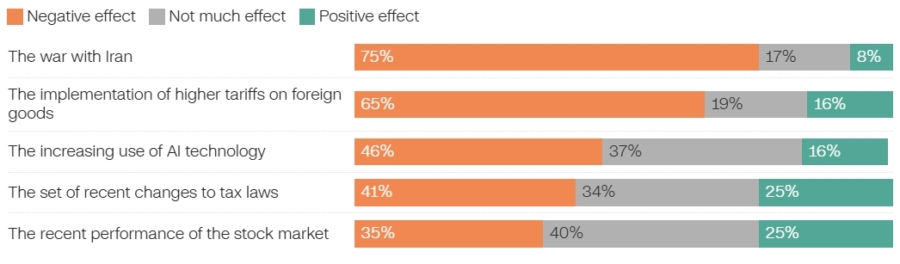
Note: The CNN poll was conducted by SSRS from April 30-May 4 among a random national sample of 1,499 US adults drawn from a probability-based panel. Surveys were either conducted online or by telephone with a live interviewer. Results have a margin of sampling error of ±2.8 percentage points.
In the latest poll, Democrats are more trusted than the GOP to handle central economic issues, including the cost of living, helping the middle class and inflation. Significant shares of the public, however, say they trust neither party on many of those same issues.
One-third of the public approves of the way Trump is handling helping the middle class. Just 26% of Americans approve of his performance on inflation and 21% on gas prices, with significant pockets of dissatisfaction even among those who overall support his presidency.
A majority of Republicans disapprove of his handling of gas prices. The share saying Trump’s policies have made cost of living rise is up 17 points overall since last year, and up 25 points among Republicans.
Distrust of both parties
The public is close to evenly split on which political party would do a better job of dealing with the economy. That contrasts with the GOP’s typical advantage on the issue during the Biden era: In one 2022 CNN survey, Americans said by a 15-point margin that the Republican Party’s economic views were closer to their own.
When it comes to cost of living, Democrats hold a 9-point advantage. That’s due in part to Republicans’ doubts about their own party: Democratic-aligned adults are 15 points likelier than GOP-aligned adults to say their party could better address the cost of living.
Americans give Democrats the advantage to handle cost of living issues, but more than one-third trust neither party
Q: “Which political party do you think would do a better job of dealing with each of the following issues?”
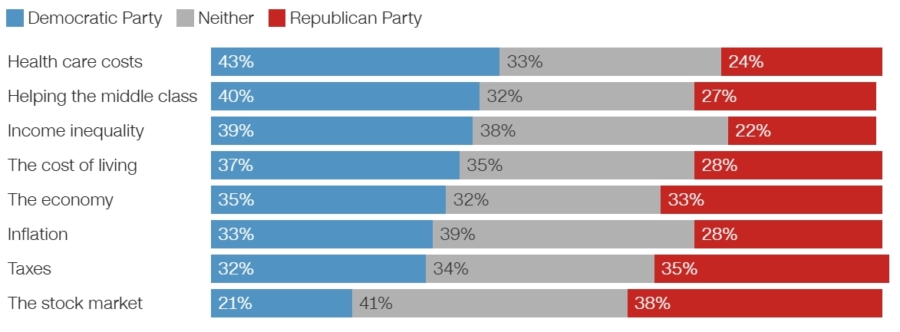
Note: The CNN poll was conducted by SSRS from April 30-May 4 among a random national sample of 1,499 US adults drawn from a probability-based panel. Surveys were either conducted online or by telephone with a live interviewer. Results have a margin of sampling error of ±2.8 percentage points.
Democrats also lead by double digits on trust to handle income inequality, healthcare costs and helping the middle class, with a smaller edge on handling inflation. Republicans are ahead in trust to handle the stock market, with relatively close divides on which party would do a better job of dealing with taxes.
The divide on economic issues arguably leaves Democrats well-positioned on a set of issues with more populist appeal. The vast majority of Americans, 85%, describe themselves as working-class, middle-class or upper-middle class, and three-quarters say that the country’s economic system is unfairly geared toward powerful interests. By contrast, just over half of the public reports holding any investments in the stock market, including retirement funds.

But one possible warning sign for Democrats emerges here. On each of the issues tested, more than 30% of Americans – including half or more of political independents – say they trust neither party. And by an 8-point margin, the public says that there’s a bigger problem with the government giving help to too many people who “don’t deserve it” rather than failing to help enough people, suggesting some limits to the appetite for a more robust social safety net.
The poll finds registered voters closely split in their partisan preference ahead of the midterms, with 45% saying they’d support a Democratic candidate for Congress, 42% a Republican candidate, and 14% neither. Polling on congressional preference this year, including previous CNN surveys, has largely given Democrats the advantage.
Voters who aren’t sold on either party’s economic message tend to prefer the Democrats on the generic ballot, the CNN survey finds.

How important are economic issues to the midterms?
There’s no doubt that economic issues are at the top of many Americans’ minds heading into this year’s election season. But caring about an issue isn’t the same thing as deciding to vote on that basis.
Asked to pick which of six issues is the most important facing the country, 55% choose the economy and the cost of living, more than doubling the share who pick any single other issue.
In a separate question, however, 57% say that there are other political issues that matter at least as much as the economy when it comes to this year’s midterms.
Notably, the bloc of Americans that cares most about the economy appears to include some of the most politically persuadable. Sixty percent of “true” independents – those who don’t lean toward either party – say the economy matters more than any other midterm issues, as do 52% of those who report paying relatively little attention to political news. Partisans, and those who are more attuned to politics, are more likely to place weight on other issues.
Overall, Americans are about evenly split on whether or not they think that the midterm outcome is likely to have a major effect on their own finances – a shift from 2024, when amid Trump’s campaign promises to “end inflation,” most believed the presidential election could have a big impact.

Trump Hints at Making Venezuela the 51st State; Caracas Responds Sharply

President Donald Trump posted a map depicting Venezuela as the “51st state” of the U.S., while Venezuela’s interim president rejected the notion.
On May 12, U.S. President Donald Trump posted a map on the social media platform Truth Social, which integrated Venezuela with the American flag and the caption “the 51st state.”

Previously, on May 11, President Trump told Fox News that he was “seriously considering making Venezuela the 51st state of the U.S.”
Responding to President Trump’s statement, Venezuelan Interim President Delcy Rodríguez asserted that Venezuela has no plans to become the 51st U.S. state.
“That possibility will never be considered. If there is one thing that Venezuelans have always preserved, it is the love for our independence process and the reverence for the heroes of that independence,” the interim president emphasized.
“We will continue to defend our territorial integrity, sovereignty, independence, and history,” Ms. Rodríguez said. She added that Venezuela is “not a colony, but a free nation.”
Ms. Rodríguez confirmed that Venezuelan and U.S. officials have been in contact and are working toward “cooperation and maintaining mutual understanding.”
When asked about the prospect of Venezuela becoming a U.S. state, Interim President Rodríguez affirmed that her government is working on a “diplomatic cooperation program” with the United States.
Ms. Rodríguez has served as vice president since 2018 and was sworn in as interim president on January 5, temporarily governing Venezuela after the U.S. captured President Nicolás Maduro and his wife in Caracas during a surprise raid.

Ms. Rodríguez has overseen a thaw in Washington-Caracas relations since taking office, implementing reforms to reopen Venezuela’s mining and oil industries to foreign companies, particularly those from the U.S.
The Venezuelan opposition has demanded that elections be held, while Ms. Rodríguez stated that the process would take place “at some point.”
Since the U.S. captured President Maduro on January 3, Mr. Trump has repeatedly made statements regarding control of the oil-rich nation.

In a social media post in March, the American leader wrote: “Good things are happening with Venezuela lately! I wonder what this miracle is? Becoming the 51st state, does anyone want that?”
Following the raid to capture President Maduro, the White House restarted relations with Venezuela.
A series of high-ranking officials in the Trump administration have traveled to Venezuela, including CIA Director John Ratcliffe. A U.S. commercial flight landed in the South American nation for the first time in over seven years. The U.S. Embassy in Venezuela also recently reopened its doors.
The business community has stated that this marks the beginning of a new era of commercial cooperation between the U.S. and Venezuela, the country that possesses the world’s largest proven oil reserves.
Trump Visits China to Tackle Hot-Button Issues
U.S. President Donald Trump is embarking on a state visit to China from May 13 to 15, where he is expected to discuss a wide range of international and bilateral issues.
At the invitation of Chinese President Xi Jinping, U.S. President Donald Trump is conducting a state visit to China this week. Mr. Trump arrived in Beijing on May 13, with high-level talks scheduled for May 14 and 15.
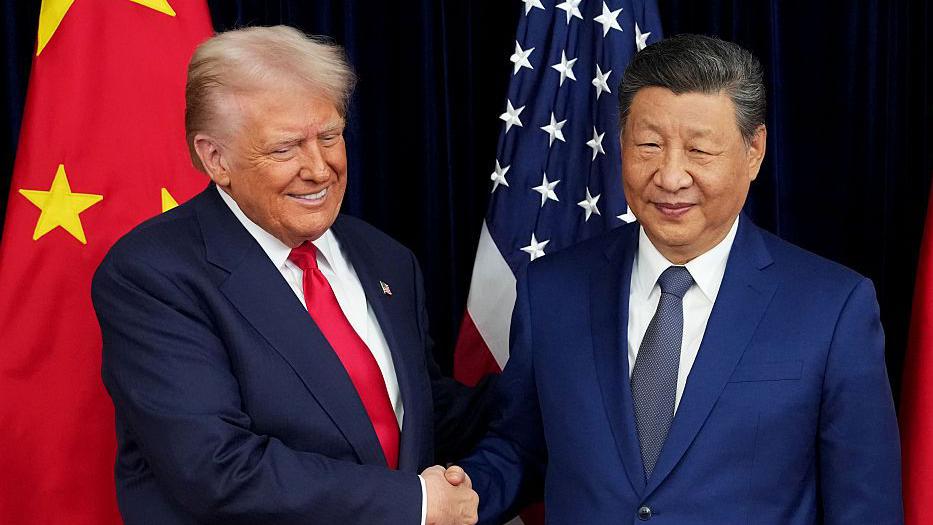
Discussing a Range of Bilateral and International Issues
On May 11, Chinese Foreign Ministry spokesperson Guo Jiakun stated that this will be the next face-to-face meeting between the two leaders since their encounter in South Korea last October. This also marks the first visit to China by a U.S. president in nearly nine years.
President Xi is expected to engage in extensive exchanges with Mr. Trump regarding major issues concerning U.S.-China relations, as well as global peace and development, according to the Xinhua News Agency.
The focus of the visit is likely to center on trade issues, urging China to purchase more American goods and preventing tensions from escalating. Observers are closely watching for the potential announcement of deals involving Boeing aircraft, agricultural products, energy, the stabilization of rare earth supply chains, and cooperation in the fight against fentanyl, according to the South China Morning Post.
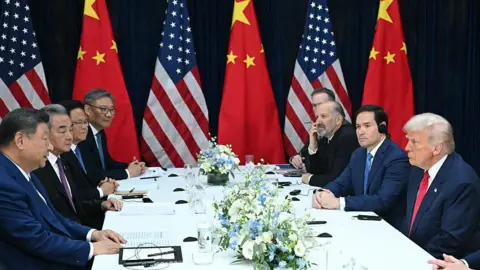
The leaders of the world’s two largest economies will hold their first in-person meeting in over six months, as both sides seek to stabilize a relationship strained by trade, the conflict involving the U.S., Israel, and Iran, and various other disagreements.
On the American side, White House Principal Deputy Press Secretary Anna Kelly stated on May 10 that President Trump would arrive in Beijing on the evening of May 13 (U.S. time) for a visit she described as “carrying immense symbolic significance.”
According to Kelly, the American leader will attend an official welcoming ceremony and hold a bilateral meeting with President Xi Jinping on May 14, followed by a visit to the Temple of Heaven in Beijing and a state dinner.
Kelly noted that the two leaders will meet again on May 15 for a tea chat and a bilateral working lunch, adding that the U.S. expects to host the Chinese leader for a reciprocal visit later this year.
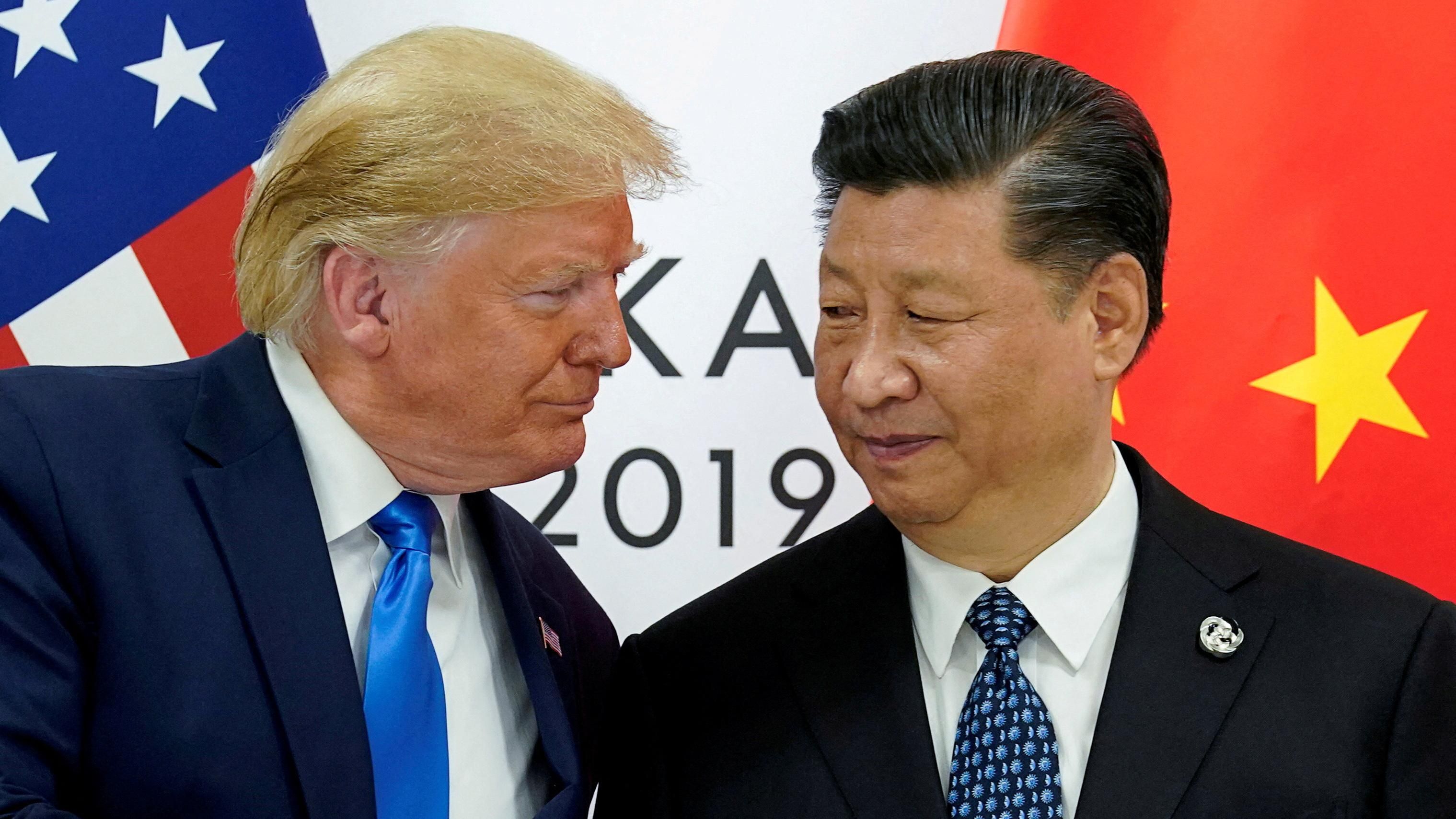
High Expectations for the Visit
On May 11, CBS News cited a list released by a White House official showing a delegation of numerous American business leaders, including Tesla CEO and billionaire Elon Musk and Apple CEO Tim Cook, who will accompany Trump on his trip to China this week.
The list also includes Blackstone Chairman and CEO Stephen Schwarzman, Cargill CEO Brian Sikes, Citi CEO Jane Fraser, Coherent CEO Jim Anderson, GE Aerospace CEO Larry Culp, Goldman Sachs CEO David Solomon, Illumina CEO Jacob Thaysen, Mastercard CEO Michael Miebach, Micron CEO Sanjay Mehrotra, and Qualcomm CEO Cristiano Amon.
Additionally, Cisco CEO Chuck Robbins was invited but is unable to attend as the company prepares to announce its earnings report this week.
The delegation members span several key sectors, including aviation, technology, banking, and social media.
Proposals to establish a U.S.-China Trade Council and a U.S.-China Investment Council—initiatives pushed by the Trump administration—are expected to surface during this week’s negotiations.
U.S. Trade Representative Jamieson Greer stated that he emphasized the role a Trade Council “could play in optimizing bilateral trade for non-sensitive items” during a phone call with Chinese Vice Premier He Lifeng last month.
Furthermore, Reuters cited U.S. officials saying the two leaders are also expected to discuss Iran, Taiwan, artificial intelligence (AI), and nuclear weapons.
Regarding expectations for the trip, the Chinese Foreign Ministry spokesperson emphasized that head-of-state diplomacy plays an irreplaceable role in providing strategic guidance for U.S.-China relations.
“China is ready to work with the U.S. to expand cooperation and manage differences in the spirit of equality, respect, and mutual benefit, thereby bringing more stability and certainty to a world undergoing profound volatility and change,” Mr. Guo emphasized.
Meanwhile, the White House Deputy Press Secretary told Fox News on May 11 that many CEOs are participating because Mr. Trump “never travels for purely symbolic reasons.”
According to her, the American people can expect more deals beneficial to the country, continued advancement of the U.S.-China Trade Council, and agreements spanning aerospace, energy, and agriculture.
“These deals will ultimately end the offshoring of jobs and the abandonment of American workers in exchange for ‘America First’ policies and agreements, while revitalizing the domestic economy,” Kelly said.
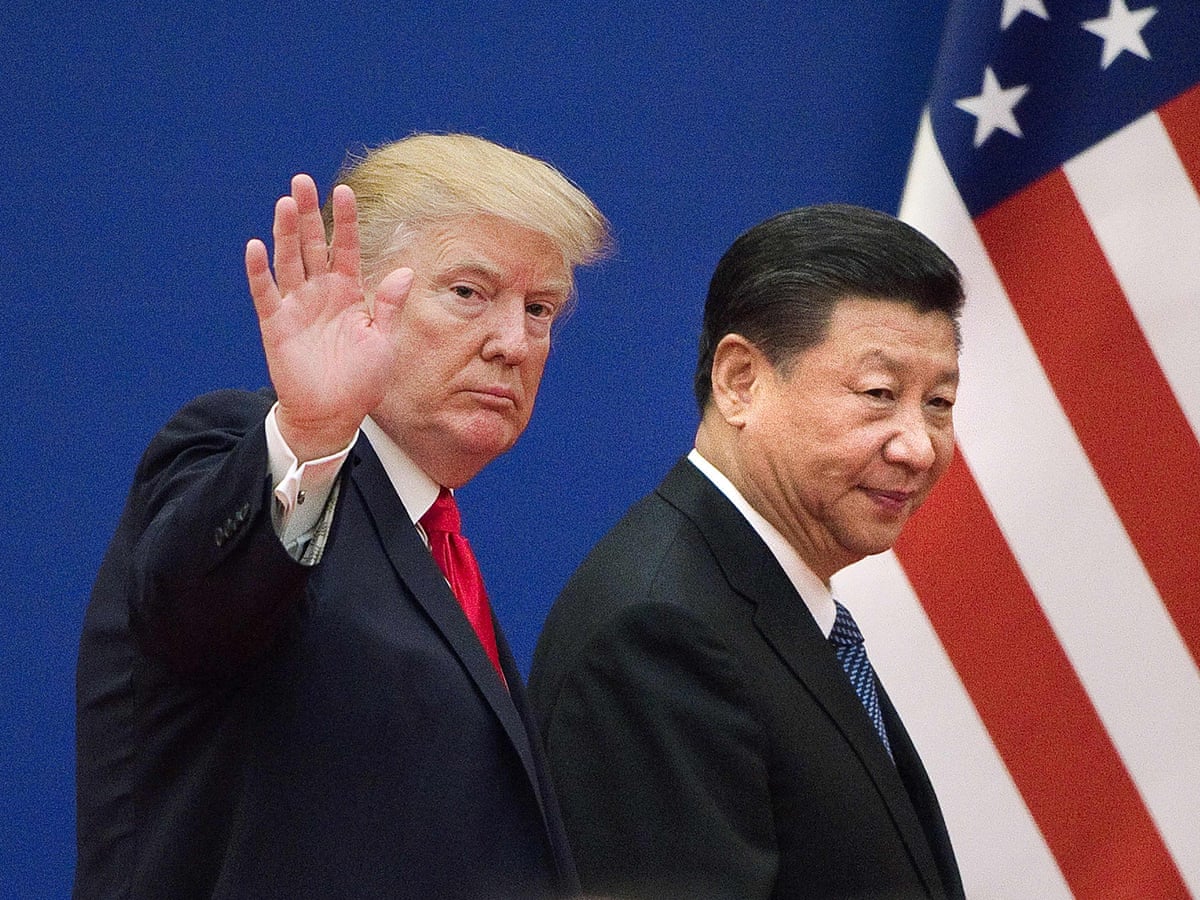
China Vows to Continue Promoting Peace Dialogue on Iran
On May 11, the Chinese Foreign Ministry affirmed that Beijing will continue to play an active role in promoting peace dialogue and ending the war in Iran, according to the ministry’s website.
Speaking at a regular press conference, spokesperson Guo Jiakun made the statement when asked about reports that President Donald Trump is expected to pressure China regarding Beijing’s approach toward Iran.
“China’s position on the situation in Iran is consistent. We will continue to play an active role in promoting peace dialogue and an early end to the conflict,” Mr. Guo said.
Trump’s China Visit Draws Scrutiny with $870 Billion Billionaire Delegation
The summit between the two superpowers, accompanied by a formidable lineup of billionaires, carries expectations of reshaping the tech supply chain and resolving the inflation puzzle currently weighing on the global economy.

The first Asian tour of President Donald Trump’s second term is putting global financial markets on high alert. Far from being a mere diplomatic event, the master of the White House is bringing with him one of the most powerful delegations in commercial history.
These are the business minds shaping the American economy, controlling total assets amounting to $870 billion. The meeting between President Trump and Chinese President Xi Jinping this week is expected to determine the future of capital flows and tech supply chains, and specifically, to untangle the energy crisis currently strangling the globe.
A Billionaire Delegation and a Calculated Absence
The guest list boarding the flight to Beijing brings together 16 of America’s top business leaders. According to Bloomberg, the centerpiece of the delegation consists of five billionaires possessing massive fortunes.
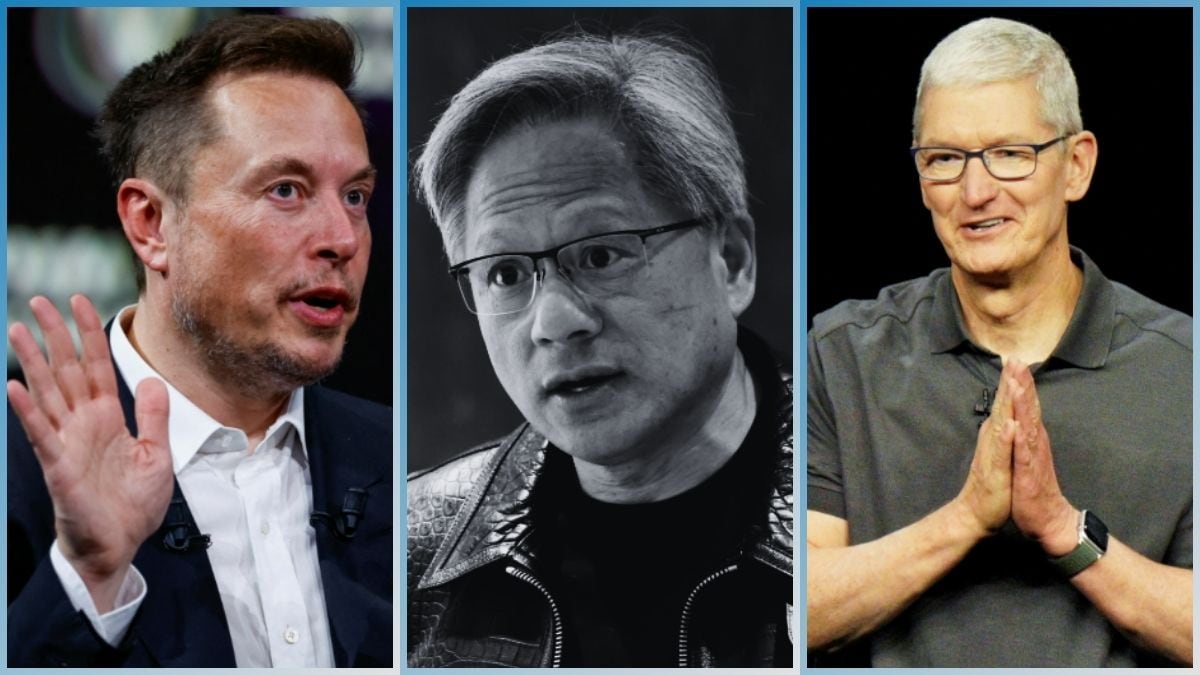
Leading the pack is Tesla’s Elon Musk, with a net worth of approximately $823.3 billion. Following him are the names that define Wall Street and Silicon Valley: Stephen Schwarzman of Blackstone, Tim Cook of Apple, Larry Culp of General Electric, and Larry Fink of BlackRock.
The presence of these figures sends a clear signal regarding Washington’s priorities. The focus of the trip does not lie in political controversy, but targets pragmatic economic deals. Investment capital is beginning to find its way back to the market of over a billion people, and American corporations do not want to miss this window.

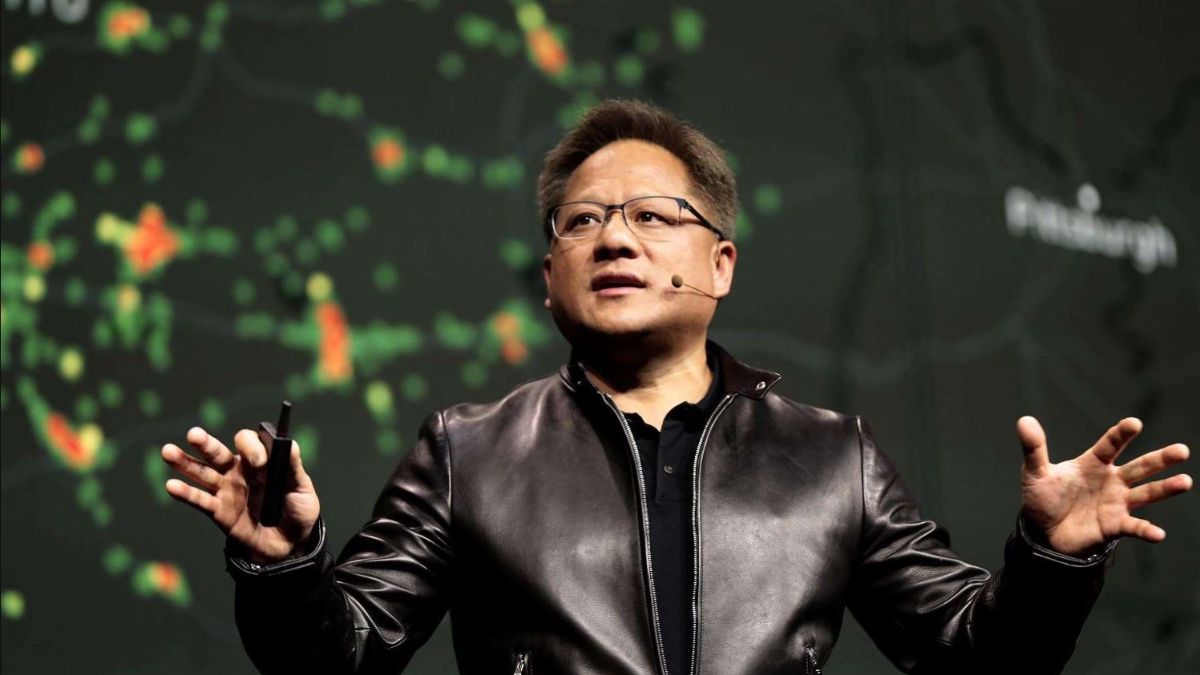
However, the market noted one particularly conspicuous absence. Nvidia CEO Jensen Huang, with a net worth of $190.5 billion, was not present on the trip despite being considered a close advisor to Mr. Trump on artificial intelligence.
According to Reuters, the underlying reason stems from the White House’s negotiating strategy. The U.S. administration is currently prioritizing urgent problems regarding commercial aviation and agricultural products rather than immediately focusing on the semiconductor sector, which remains entangled in export barrier bottlenecks.
Expectations for the Largest Aviation Deal in History
Ahead of news regarding President Trump’s visit to China, investors turned their attention to the stocks of heavy industrial corporations. The focal point of these trade negotiations is a massive contract that could alter the landscape of the global aviation industry.
According to sources from Reuters, Boeing is very close to finalizing an order for 500 737 MAX aircraft along with dozens of wide-body planes utilizing GE engines. If a nod of approval is given by Beijing, this would be Boeing’s first major order in China since 2017.
This deal would not only serve to rescue the American aviation giant after a series of crises but also has the potential to become the largest single order in the history of global aviation. Boeing CEO Kelly Ortberg has made no secret of his expectation that the Trump administration will be the key to swinging open the doors to a Chinese market that has long been frozen.
In addition to aviation, the world’s two largest economies are seeking to maintain stability for global supply chains. One of the key agreements being discussed is the extension of a trade truce, thereby ensuring that the flow of rare earths from China to American factories remains uninterrupted.

The Energy Bottleneck and the Oil Price Puzzle
While billion-dollar deals attract media attention, the financial world understands that the true “common thread” of this summit lies in the energy market. The world is facing the most severe oil supply shock in modern history as the Strait of Hormuz remains nearly blockaded.
According to the International Energy Agency, approximately 13 million barrels of oil per day are being kept off the market due to conflict in the Middle East. Brent crude prices have surged by 65% and are currently trading around $107 per barrel. Inflationary pressure is weighing on every economy, and this bottleneck can only be cleared if the U.S. and China find a common voice.
China is currently the largest buyer of Iranian oil and is directly affected, as one-third of its imported oil must pass through Hormuz. However, Beijing holds a major negotiating advantage thanks to its proactive stockpiling of 360 million barrels in strategic reserves.
The Wall Street Journal suggests that President Trump will use economic leverage to apply pressure, forcing Beijing to intervene to help reopen this vital maritime artery. In return, China may agree to resume purchasing U.S. liquefied natural gas and crude oil to diversify its supply amid the collapse of Middle Eastern supply chains.
Global markets are holding their breath for official announcements from Beijing. Matt Gertken, Chief Strategist at BCA Research, argues that the biggest question right now is not how many billions of dollars will be signed. What investors truly care about is whether the handshake between the two leaders is powerful enough to cool down the global energy tinderbox.






:max_bytes(150000):strip_icc():focal(753x271:755x273):format(webp)/cole-the-deaf-dog-112125-1a-ad248101bd174108a795d88d6afd93d8.jpg?fit=750,500&ssl=1 "Elementary School Throws Deaf Therapy Dog a Surprise Birthday Party as Students Learn Sign Language to Sing ‘Happy Birthday’")



:max_bytes(150000):strip_icc():focal(728x320:730x322):format(webp)/Dougherty-Dozen-121925-8cb8e5c784f24afa8d04fbffee3fef7d.jpg?fit=750,500&ssl=1 "Parents of 11 Kids Reveal How They Tackle Holiday Shopping and Christmas Dinner for Entire Family (Exclusive)")