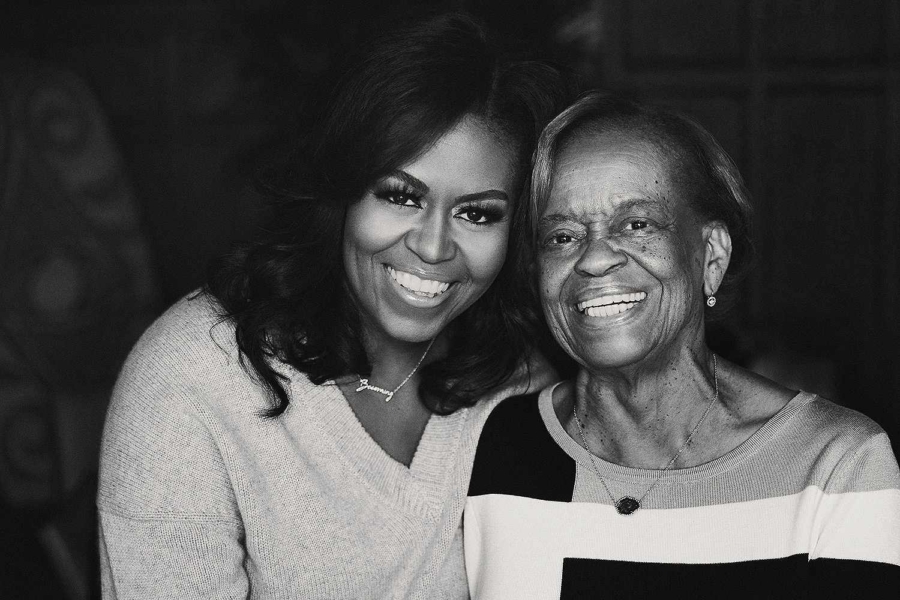
Robinson became a fixture of the White House when she moved from her hometown of Chicago to help take care of her granddaughters during the Obama administration.
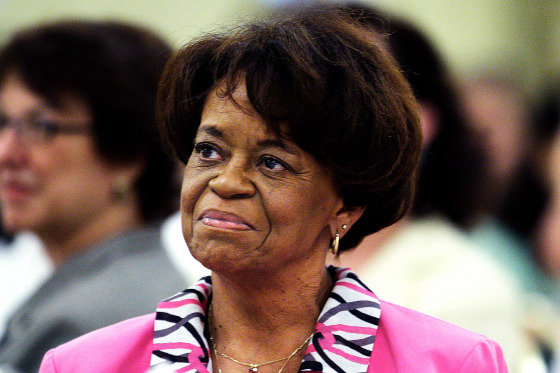
WASHINGTON — Former First Lady Michelle Obama’s mother, Marian Robinson, has died, according to a family statement shared with NBC News. Robinson was 86 years old.
“She passed peacefully this morning, and right now, none of us are quite sure how exactly we’ll move on without her,” the family statement said.
Jimmy Kimmel Slams Donald Trump’s ‘Loathsome’ Comments About Rob Reiner
Michelle Obama Says America Needs to ‘Grow Up’ Before a Woman Can Be President
The family statement is from Michelle and Barack Obama; Craig Robinson and his wife, Kelly; and Marian Robinson’s grandchildren, Avery, Leslie, Malia, Sasha, Austin and Aaron.
Robinson became known to Americans as the country’s first grandmother after her son-in-law, Barack Obama, won the 2008 presidential election. She was a fixture in the White House during his eight years in office, though she kept a low profile. She attended holiday events, the occasional overseas trip and concerts in the East Room. But most often she was with her granddaughters, Sasha and Malia.

Having lived in Chicago her entire life, Robinson agreed to move to Washington, D.C., in 2009 to live in the White House residence and help take care of her granddaughters, who were seven and 10 years old at the time.
“I felt like this was going to be a very hard life for both of them,” she later said in a CBS interview, referring to her daughter and son-in-law. “And I was worried about their safety, and I was worried about my grandkids. That’s what got me to move to D.C.”
Michelle Obama Embraces Moody Glam in a Sheer LBD With a Zipper Running All the Way Down Her Chest
In their statement Friday, Robinson’s family members said she agreed to leave Chicago with “a healthy nudge.”
“We needed her. The girls needed her. And she ended up being our rock through it all,” they said.
“She relished her role as a grandmother. … And although she enforced whatever household rules we’d set for bedtime, watching TV, or eating candy, she made clear that she sided with her ‘grandbabies’ in thinking that their parents were too darn strict,” they added.

In a statement released Saturday, President Joe Biden and first lady Jill Biden said, “We knew Mrs. Marian Robinson as a devoted mother and grandmother with a fierce and unconditional love of her family. With the blessing of friendship, we felt that love ourselves — with every quiet smile or warm embrace she shared with us.”
“The entire Biden family sends its deepest love to Michelle, Craig, Barack, Kelly, and the six irrepressible grandchildren whom she helped to raise and so loved, and in whom her kind and gentle spirit lives on,” the statement added.
Robinson was born in Chicago in 1937 and grew up in the city’s South Side, where she raised her daughter and son, Craig Robinson. She was married to Fraser Robinson, who died in 1991 from multiple sclerosis.
The former president once called his mother-in-law “the least pretentious person I know.” Indeed, Robinson said in the CBS interview that it was a “huge adjustment” being waited on by White House residence staff, whom she said she convinced to let her do her own laundry.
Inside Barack Obama’s stepped-up plans to fight back against Donald Trump
“Rather than hobnobbing with Oscar winners or Nobel laureates, she preferred spending her time upstairs with a TV tray, in the room outside her bedroom with big windows that looked out at the Washington Monument,” the family said in its statement Friday. “The only guest she made a point of asking to meet was the Pope.”
The former president credited Robinson with keeping his daughters grounded while they grew up in the White House.
“She’s down to Earth and she doesn’t understand all the fuss,” he said in an interview on “The Late Show with Stephen Colbert.”

Michelle Obama was deeply close to her mother. It was Robinson who narrated the biographical video introducing her daughter at the Democratic National Convention in 2008. And after leaving the White House, Robinson said, “My saying is when I grow up, I would like to be like Michelle Obama.”
Just a few weeks ago, Michelle Obama paid tribute to her mother on Mother’s Day by announcing that an exhibit at the Obama Presidential Center Museum in Chicago will be named after her.
“In so many ways she fostered in me a deep sense of confidence in who I was and who I could be by teaching me how to think for myself, how to use my own voice, and how to understand my own worth,” the former first lady said in a video announcement. “I simply wouldn’t be who I am today without my mom.”
The family statement released Friday said “there was and will be only one Marian Robinson,” adding, “In our sadness, we are lifted up by the extraordinary gift of her life. And we will spend the rest of ours trying to live up to her example.”
Michelle Obama Claims She Was Under a ‘Particularly White Hot Glare’ as First Black FLOTUS
Robinson died ‘peacefully’ on Friday, her family announced
:max_bytes(150000):strip_icc():focal(983x617:985x619):format(webp)/Michelle-Obama-and-mother-Marian-Robinson-053124-386d737d75ec4af19b1d01d9b48ec7c2.jpg)
Michelle Obama’s mother, Marian Robinson, has died.
Robinson, the mother of the former first lady, died on Friday, May 31, her family told NBC News in a statement. She was 86 years old.
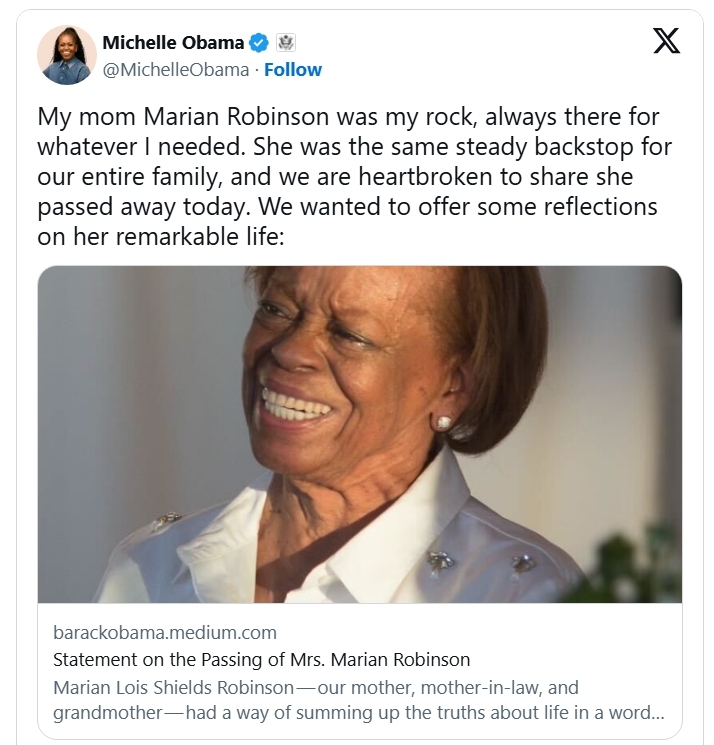
Following the news, Michelle shared a message on X, formerly Twitter, remembering her mother.
“My mom Marian Robinson was my rock, always there for whatever I needed,” she wrote. “She was the same steady backstop for our entire family, and we are heartbroken to share she passed away today.”
As Barack Obama stumps for other Democrats, the party gets to see what it lost
“She passed peacefully this morning, and right now, none of us are quite sure how exactly we’ll move on without her,” NBC’s statement read.
:max_bytes(150000):strip_icc():focal(749x0:751x2):format(webp)/michelle-obama-mother-marian-db78aa4a28e4471792d9411129a809b8.jpg)
It added that the lifelong Chicago resident left her hometown with “a healthy nudge” when her daughter moved into the White House with former President Barack Obama after he won the 2008 election.
“We needed her. The girls needed her. And she ended up being our rock through it all,” the family said.
“She relished her role as a grandmother. … And although she enforced whatever household rules we’d set for bedtime, watching TV, or eating candy, she made clear that she sided with her ‘grandbabies’ in thinking that their parents were too darn strict.”
The statement, which was shared by Michelle and Barack; Michelle’s brother Craig Robinson and his wife, Kelly; and Marian Robinson’s grandchildren, Avery, Leslie, Malia, Sasha, Austin and Aaron, continued, “There was and will be only one Marian Robinson.”
:max_bytes(150000):strip_icc():focal(999x0:1001x2):format(webp)/michelle-obama-parents-fraser-marian-5-def57536021048dea90738bc3eac0a31.jpg)
“In our sadness, we are lifted up by the extraordinary gift of her life. And we will spend the rest of ours trying to live up to her example.”
Barack, 62, also expressed his condolences on her passing in a separate statement.
“There was and will be only one Marian Robinson. In our sadness, we are lifted up by the extraordinary gift of her life. And we will spend the rest of ours trying to live up to her example,” the former president wrote in a tweet.
As Trump’s abuses worsen, it seems Obama is increasingly fired up and ready to go
Michelle’s father, Fraser Robinson, died in 1991. The author has often talked about her childhood and the lessons that both parents taught her.
Speaking to Chicago’s ABC 7 in 2022, the Princeton University and Harvard Law School graduate said she came from humble beginnings but that didn’t stop her from knowing her worth.
“We were poor. We lived in a small house, but what they gave us was a feeling of importance, a belief that our voices mattered at a very young age, a sense of understanding, of pushing through, resilience,” she said.
That same year, Michelle told NPR that even as a young child, her parents taught her responsibility — buying her and her brother alarm clocks at 5 years old and allowing them to walk to school on their own.
“And what that does for a kid – when your parent trust you, it encourages you. It tells you that if my mom thinks I can do this, that I must be capable,” Michelle said.
Trump’s longtime rage at Obama roars back amid Epstein furor
House GOP passes narrow health care package, with key Obamacare subsidies set to expire

House Republicans on Wednesday approved a narrow package designed to lower health care costs for some Americans in the coming years – marking a win for leadership even as some of their own members complain it falls woefully short of tackling rising prices in 2026.
Speaker Mike Johnson and his team were aggressive in pushing their health care plan to the floor this week, vowing it will be the first step of a major GOP agenda on lowering costs next year.
They are specifically ignoring, however, the issue of the expiring enhanced Obamacare subsidies that were passed during the pandemic to help people afford premium costs. Those tax credits will expire at the end of the month, spiking premiums for tens of millions of Americans next year.
The House GOP package, instead, would allow small businesses — as well as self-employed people — to band together across industries to buy coverage through association health plans in an effort to lower premiums. It would also, once again, provide federal funding for the cost-sharing subsidies that lower-income Obamacare enrollees receive to reduce their deductibles and out-of-pocket costs for care.
House Republicans would also require pharmacy benefit managers, which act as middlemen between drugmakers and insurers or employers, to provide employers with data on the price of drugs, the rebates they receive from manufacturers and other operations.
The House voted 216-211 to send the measure to the Senate, which is not expected to vote on it before lawmakers leave town for the holiday recess.
The last-minute health care push from GOP leaders comes at a fraught moment for the party: President Donald Trump is striving to show he is making progress to lower costs for everyday Americans. But his own members are attacking Johnson and other GOP leaders for ignoring the looming Obamacare subsidies cliff, which would raise costs for tens of millions of Americans starting in January.

If the enhanced subsidies lapse, enrollees will see their annual premium payments increase by 114% — or about $1,000 — on average in 2026, according to KFF, a nonpartisan health policy research group. Roughly 2 million more people are also expected to be uninsured next year if the subsidies end, according to the Congressional Budget Office. The more generous assistance was enacted in 2021 as part of a Biden administration Covid-19 relief package.
A group of GOP centrists have been pressuring Johnson for months to reverse course on the subsidies — pushing bipartisan efforts to extend the subsidies while adding “guardrails” to ensure the dollars are not misused.
But Johnson has only dug in. Those centrists then decided Wednesday to openly defy Johnson and potentially issue him a humiliating defeat in January by signing onto a Democratic effort to extend the subsidies for three years. That plan from House Minority Leader Hakeem Jeffries is detested by most Republicans because it includes no reforms.
But centrists insist they had no other options to keep the money flowing in January – and prevent millions from losing coverage altogether – after party leaders repeatedly blocked their attempts to get a floor vote on the compromise proposals.

Trump’s Obamacare fix: Send consumers money, not insurance companies
President Donald Trump and Republicans have floated an alternative to the Affordable Care Act: Send money directly to consumers instead of health insurance companies.
Proposals vary and details are few, but Republicans are championing these options as Congress has yet to vote on the fate of cheaper health insurance for millions of Americans.
Democrats want to bolster the Affordable Care Act, often called “Obamacare,” by extending COVID-19 pandemic-era tax credits that expire at the end of 2025. Without these enhanced tax credits, average costs for 22 million Americans who get subsidized ACA insurance will more than double on Jan. 1, 2026, according to KFF, a health policy nonprofit.
Senate Majority Leader John Thune, R-South Dakota, promised a vote on the enhanced tax credits by mid-December but would not guarantee Republicans’ support to extend the subsidies. House Speaker Mike Johnson, R-Louisiana, hasn’t committed to a vote and called the enhanced tax credits a “boondoggle.”
When signing legislation to end a record 43-day government shutdown without extending the subsidies, Trump said he wanted “money to go directly to you, the people.”
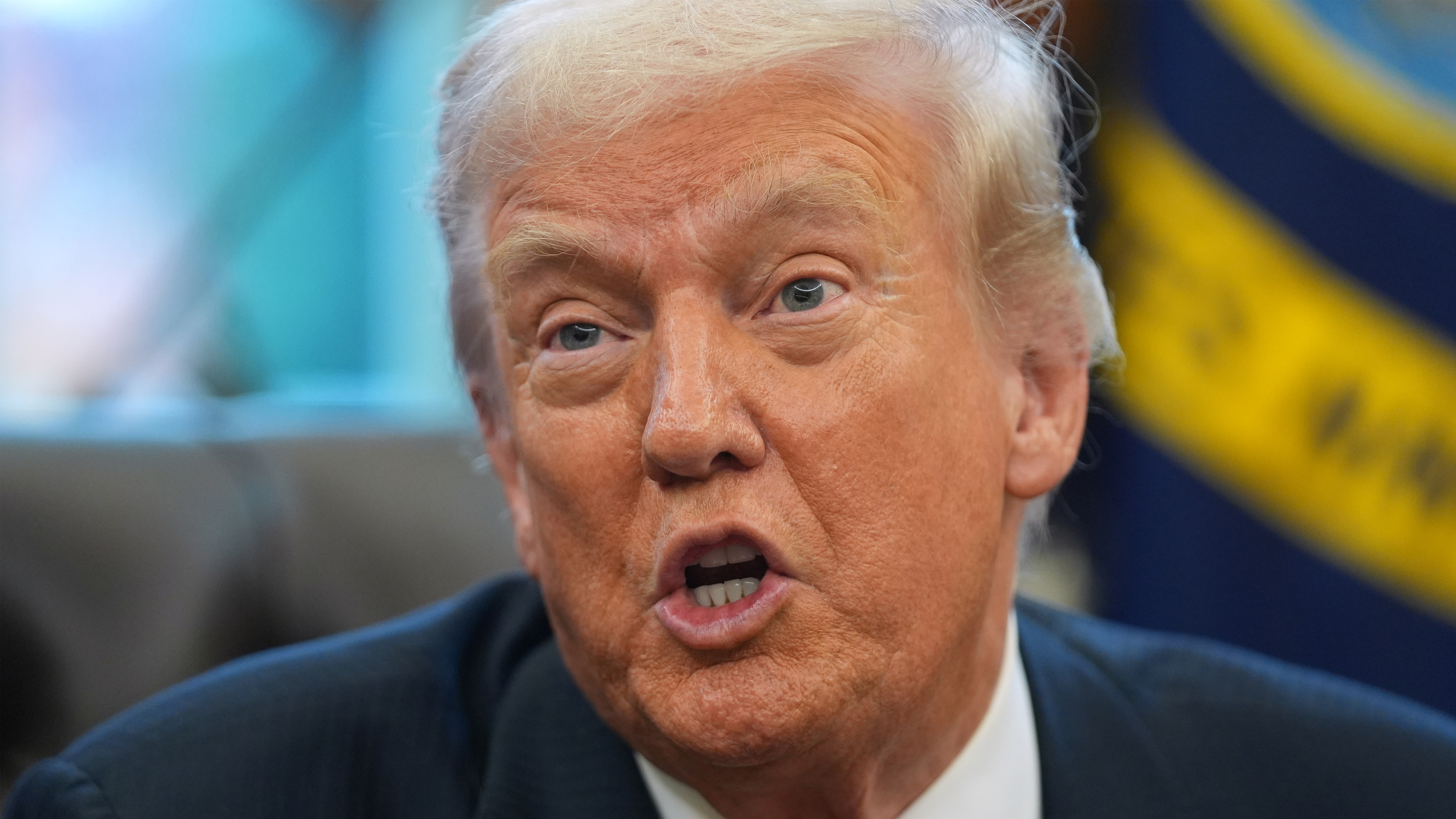
Though the tax credits would make Obamacare insurance more affordable for millions or enrollees, it would do little to slow rising health care costs most Americans face. Americans spend more on medical care than any other nation, and rising medical costs trigger higher insurance rates that all Americans pay, whether people get coverage through the workplace, Medicare or the Affordable Care Act.
More than 150 million Americans who get coverage through their employer will see average costs in 2026 rise at their highest level in a decade in a half. And older Americans on Medicare were notified their Part B premiums − the medical insurance that covers outpatient and preventive care, doctors’ visits and medical equipment − will jump 9.7% in 2026, straining affordability for seniors who rely on Social Security to make ends meet.
How would sending money directly to consumers work?
Trump hasn’t provided details on his proposal. In a Nov. 18 post on Truth Social, Trump said, “THE ONLY HEALTHCARE I WILL SUPPORT OR APPROVE IS SENDING THE MONEY DIRECTLY BACK TO THE PEOPLE” instead of insurance companies.
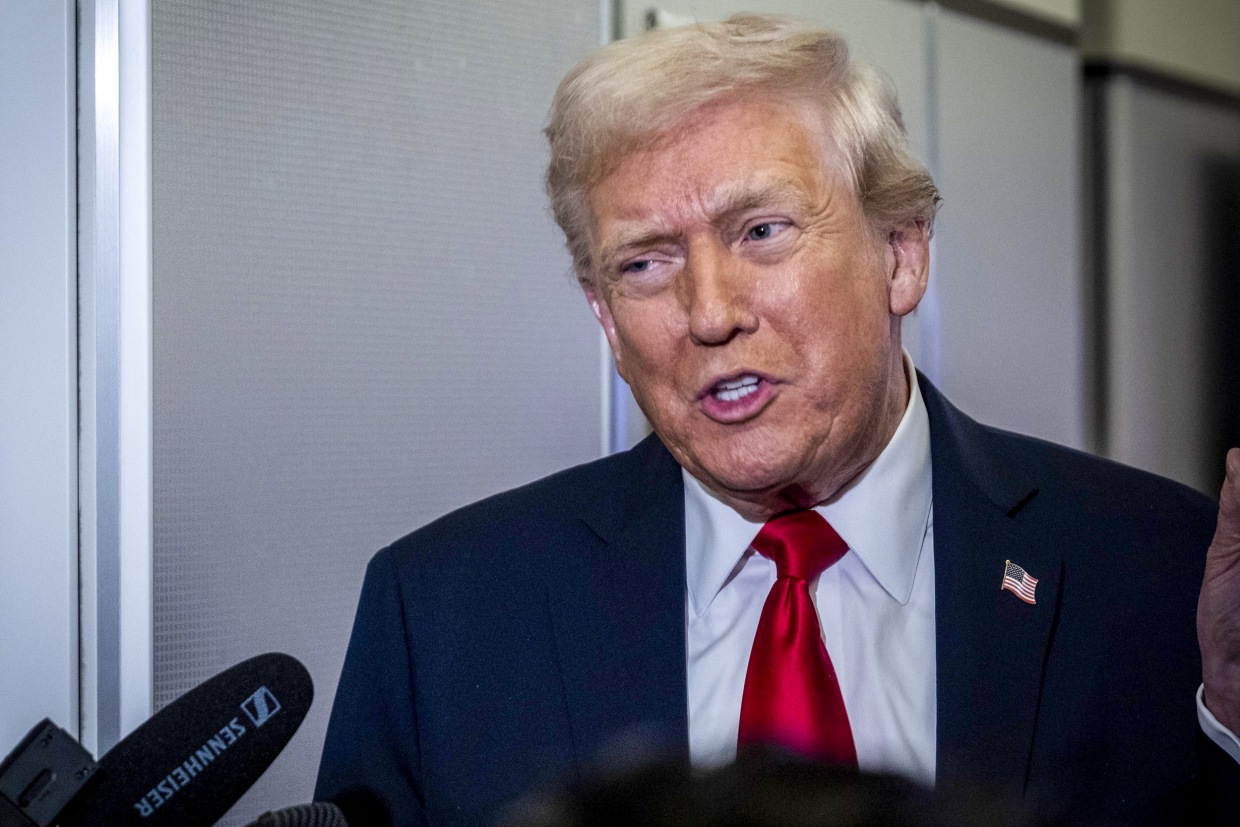
Members of Congress, former Trump administration officials and some academic researchers have proposed using health savings accounts to fund health care.
Health savings accounts are commonly used by working-age Americans who get health insurance through an employer. These accounts, paired with high-deductible health insurance plans, allow consumers to sock away part of their paycheck before taxes. The money can be spent on eligible expenses such as a doctor or hospital bill or prescription drugs.
Sen. Bill Cassidy, R-Louisiana, wants health savings accounts to be paired with “bronze” level Affordable Care Act plans. Families would get federal money deposited into a health savings account to shop for health care. “It empowers the patient to lower the cost,” Cassidy said in a Senate hearing Nov. 19.
Brian Blase, a White House adviser during the first Trump administration, has proposed shifting a portion of Obamacare funding to health savings accounts for low-income enrollees.
The Affordable Care Act now gives lower-income enrollees “cost-sharing reduction” payments to offset costs such as deductible and copays. Under Blase’s proposal, lower-income consumers would have to option of directing these subsidies to a health savings account instead of sending payments directly to insurance companies.
Similar to Blase’s proposal, Sen. Rick Scott, R-Florida, announced a bill Nov. 20 that would convert the ACA’s cost-sharing reduction payments to HSA-style “Trump Health Freedom Accounts.” States would need to submit a waiver to the federal government to establish “freedom accounts.”
Scott’s proposal would allow consumers to use the accounts to pay for health insurance premiums. With limited exceptions, HSA accounts now can’t be used to pay for health insurance premiums.
“Americans will alwaysmake a better choice for their families than the government will,” Scott said in a statement. “We should give them that opportunity and take a huge step forward in fixing Obamacare.”
Democrats warn of health insurance ‘cliff’ for millions of Americans
Democrats are skeptical about the timing of the Republican proposals. They say there isn’t enough time to change Affordable Care Act tax credits without risking insurance coverage for millions of Americans.
“Individuals are going to lose health care. This is a cliff,” said Sen. Catherine Cortez Masto.
The Nevada Democrat said Congress should extend the enhanced premium tax credits for one year to give both parties time to study longer-term options. “It should be a thoughtful process and not putting people over a cliff,” Cortez Masto said.

Sen. Ron Wyden, D-Oregon, agreed there’s not enough time to craft health care legislation before insurance rates reset for millions of ACA enrollees in January. Congress should extend the enhanced premium tax credits first, he said.
“There is no way for Congress to put together a proposal in the next couple of weeks that’s going to help people in January,” Wyden said in a Senate committee hearing Nov. 19.
Health policy experts also are skeptical of proposals that would divert existing Obamacare subsidies to health savings accounts. Such a move could risk upending the ACA marketplaces and compel healthier people to drop coverage, leaving insurance pools with sicker people and pricier monthly insurance premiums, they say.
“The original tax credits that have existed since the ACA was first passed, that’s what keeps that market working,” said Cynthia Cox, KFF’s vice president and director of the Program on the ACA. “Without those tax credits, the market collapses, and then there’s no option for people who have preexisting conditions to get health insurance.”
The concept of sending money directly to consumers instead of health insurers is “an old, old idea,” said Robert Kaestner, an economist and research professor at the University of Chicago, Harris School of Public Policy. “This has been the conservative health reform plan for 40 years.”
Kaestner said health savings accounts might work for middle- and higher-income people who can afford to fund the accounts while paying for everyday living expenses. But he said lower-income families don’t have the same financial cushion, especially when they face a costly health expense such as cancer treatment.
“The HSA can’t cover your cancer care,” Kaestner said.








:max_bytes(150000):strip_icc():focal(753x271:755x273):format(webp)/cole-the-deaf-dog-112125-1a-ad248101bd174108a795d88d6afd93d8.jpg?fit=750,500&ssl=1 "Elementary School Throws Deaf Therapy Dog a Surprise Birthday Party as Students Learn Sign Language to Sing ‘Happy Birthday’")






:max_bytes(150000):strip_icc():focal(749x0:751x2)/jennifer-aniston-111225-c037a077dd3043178ee27f4038312cd6.jpg?fit=1500,1000&ssl=1 "Jennifer Aniston Overcomes the Pain of Infertility")


