Key Points
- The Supreme Court rejected a request by the Trump administration to lift a judicial block on a controversial rule that critics feared would make it more difficult to vote by mail in the upcoming midterm elections, which will determine which political party controls the two chambers of Congress.
- The Supreme Court said the administration “is unlikely to succeed on the merits of its challenge to the” preliminary injunction issued by a federal District Court judge blocking the rule.
- Justice Brett Kavanaugh, an appointee of President Donald Trump, concurred with the ruling.
- Two other conservatives, Justices Samuel Alito and Clarence Thomas, dissented.
The Supreme Court on Monday night rejected a request by the Trump administration to lift a judicial block on a controversial U.S. Postal Service rule that critics feared would make it more difficult to vote by mail in the upcoming midterm elections.
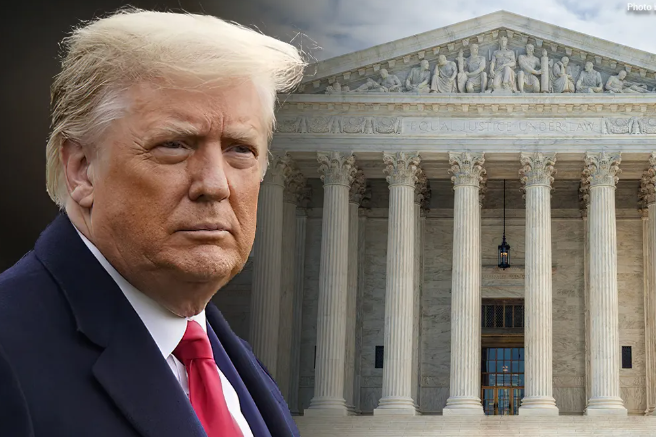
In an unsigned order, the Supreme Court said the administration “is unlikely to succeed on the merits of its challenge to the” preliminary injunction issued by a federal court judge in Boston preventing the USPS rule from being used in November’s elections nationwide.
The decision comes less than two months before Election Day for contests that will determine which political party controls each chamber of Congress. President Donald Trump’s fellow Republicans hold slim majorities in both the House of Representatives and the Senate.

Justice Brett Kavanaugh, a Trump appointee, concurred with the ruling in a statement that said, “there is at least a fair prospect that the final rule falls within the Postal Service’s statutory authority.”
“But applying the rule in the 2026 elections would be arbitrary and capricious in violation of the Administrative Procedure Act because state and local election officials do not have sufficient time to reasonably implement the rule before the elections,” Kavanaugh added. “For that reason, I concur in the denial of the application for stay.”
Two of Kavanaugh’s fellow conservatives on the nine-justice court, Justices Samuel Alito and Clarence Thomas, dissented from the decision to reject a stay of the injunction against the Postal Service rule, which was issued in late August.
That rule, which implemented an executive order issued by Trump in March, established new standards for ballot envelopes and required states to create lists of voters who were eligible to obtain mail ballots.
Monday’s decision by the Supreme Court only prevents the Postal Service’s rule from being used in November’s elections. It is possible that the court will allow the rule to be used in future elections.
Alito, in his written dissent, said that some of the plaintiffs who had sued to challenge the Postal Service’s rule lacked legal standing to do so, “while the remainder are pursuing a claim that this Court has recently called a ‘Hail Mary pass’ that ‘rarely succeeds.’”

“The Government has a strong interest in enforcing the rule, and implementing it will also ‘enhance the visibility of Federal Ballot Mail’ in order to better detect election fraud,” Alito wrote.
“On the other side of the balance, the plaintiff States invoke the practical effects of implementing the rule close to the midterm elections. I take that problem very seriously, but it is not enough to convince me to deny the application.”
Celina Stewart, CEO of the League of Women Voters, one of the plaintiffs in the case, said in a statement, “Today, the Supreme Court refused to allow the federal government to throw our elections into chaos just weeks before Election Day.”
“The Postal Service exists to deliver Americans’ mail — not to rewrite election rules, demand voters’ personal information, or decide which ballots make it through the system,” Stewart said. “This was an extraordinary attempt to interfere with voting in all 50 states, and voters should never have been put in this position. Voters should never be caught in the middle of a political power warfare.”
New York Attorney General Letitia James, who was part of the coalition suing to block the rule, said in a statement, “I am truly relieved the Court granted this reprieve.”
“Voters should never have to wonder whether a ballot they legally cast will be counted because the federal government suddenly changed the rules,” James said. “We will keep fighting to make sure every eligible ballot is counted come November. Now, I encourage all eligible Americans to get out and vote – and vote early.”

Trump’s Promise to Hand Out Cash to Americans Sparks Controversy
Despite mixed reactions, U.S. President Donald Trump continues to reassure Americans that they will receive cash payouts if the Republican Party maintains its majority in Congress after the November 3 election day. In a recent statement, the White House host affirmed yesterday (Vietnam time) that he is fully capable of fulfilling his promise to give $5,000 to every American citizen if the GOP secures a favorable outcome in the midterm elections.
Trump’s Promise At the Republican National Convention in Dallas, Texas, on September 9, President Trump declared he would distribute cash to American voters under the aforementioned condition. As of yesterday (September 14), he reaffirmed: “The $5,000 amount will be handed out, 100% guaranteed. And the reason is that America is pulling in trillions of dollars.”
Trump also explained why he does not want to implement the payout at the moment. “I don’t want to do it now, because if the Democrats get control of Congress, the country will descend into chaos and they won’t be able to pay that money,” the leader emphasized.
The U.S. President further predicted that if the Republican Party keeps its majority in both chambers, the administration in Washington will bring in massive sums of money. “We are attracting more than $20 trillion in investment. And under the Democrats, all of that money would be thrown away,” Trump said.
Regarding the funding source for this pledge, Commerce Secretary Howard Lutnick declared it would not come from taxpayer money, stating that the federal government could generate the funds Trump intends to disburse. However, Kevin Hassett, Director of the White House National Economic Council, suggested that this payment could be rolled out through a budget reconciliation package with Congress, which holds the power of the purse. The U.S. Constitution mandates that the administration cannot spend public money unless authorized by Capitol Hill.
Meanwhile, Professor Paul Berman of the George Washington University Law School cited figures showing that tariff revenues fall far short of covering the estimated total of up to $1.3 trillion needed for Trump’s plan. “Even if there were enough money, these funds go into the national treasury, and at that point, only Congress has the authority to appropriate them into expenditures,” Professor Berman said.
House Speaker Mike Johnson, a key political ally of President Trump, also confirmed that for the White House to spend money, it must go through Congress. Republican lawmakers will attempt to make this promise a reality, according to a report by USA TODAY on September 13. Representative Bernie Moreno, an Ohio Republican, also stated he would introduce a bill in Congress to ensure Trump can deliver on his promise.

Numerous Promises Forgotten Counting this latest promise, President Trump has promised cash payouts to Americans at least four times since the start of his second term, yet none have materialized. According to Axios, in early 2025, after billionaire Elon Musk—who was then leading the Department of Government Efficiency (DOGE)—promised to bring in trillions of dollars by dismantling and merging government agencies, Trump declared he would give $5,000 to every American. In the end, Musk left his post after a few months, and the promise went unfulfilled.
By November 2025, Trump pledged to distribute $2,000 to every citizen, funded by tariff revenues that he claimed reached trillions of dollars. In reality, the Bipartisan Policy Center (headquartered in Washington, D.C.), citing Treasury Department data, pointed to a figure of roughly $341 billion collected from tariffs under Trump. After the Supreme Court issued a ruling striking down Trump’s tariff system, Washington was forced to refund $166 billion to importers. Ultimately, Americans have yet to see any $2,000 checks.
In early 2026, Trump made a third payout promise, proposing that funds earmarked for healthcare programs be sent directly to citizens instead of insurance providers. This proposal was part of the “Great Healthcare Plan” pushed by Trump. Once again, no specific details have been announced to date, and the money remains nowhere to be seen.
Pushback From Within the GOP
Several Republicans disagree with Trump’s giveaway plan. For instance, Politico cited a warning from Florida Governor Ron DeSantis that handing out cash in this manner would only drive up inflation at a time when the U.S. is drowning in national debt. Maine Republican Senator Susan Collins pointed out another issue: Trump’s proposed payout lacks income eligibility limits, which would make the final price tag astronomically high.

Trump Dismisses AI Safety Warnings
The White House leader expressed skepticism over leading AI companies collectively calling to slow down AI development…
U.S. President Donald Trump, through posts on his Truth Social network, dismissed AI safety warnings and stated that the country already possesses the necessary mechanisms to manage and discipline non-compliant AI companies.

According to Reuters, public concern regarding potential AI risks is escalating after Anthropic researcher Jacob Coxon announced his resignation last week, driven in part by fears that “this technology could kill us all by the end of the decade.”
Shares of AI-related enterprises worldwide plummeted on Monday following calls from leaders of some of the industry’s largest firms to decelerate the pace of technological development.
Other administration officials, including Vice President JD Vance, expressed skepticism regarding the motives behind tech executives urging increased government oversight.
“I find it a bit strange that so many companies developing advanced AI models are coming to the government and asking to be regulated,” Vance said.
However, Vance acknowledged that new technology always carries risks and expressed hope that the White House and Congress can collaborate to establish appropriate safety safeguards.

Still, he affirmed: “I don’t think Americans should be afraid of anything. I think we need to be clear-eyed that everything has risks, everything has a downside, and that’s certainly true with AI.”
Trump also alleged a “conspiracy” aimed at undermining the AI industry, while insisting that his oversight alone would be sufficient to prevent AI models from “going off the rails.” On social media, he further characterized industry calls for tighter AI regulation as a “hoax.”
Meanwhile, according to Reuters sources, three U.S. senators are drafting legislation that would require AI companies to prove they are taking measures to prevent their technology from causing harm. However, the specific provisions of the bill remain under negotiation.
“The Trump Administration has prevented people in the AI industry from doing bad, or potentially harmful, things—like Dario (Anthropic), who is pretending to be a ‘perfect little angel’—and we will continue to do so,” Trump wrote on social media.
He added: “The only barrier or ‘guardrail’ AI needs is a Strong and Smart President, and America has that.”
Prior to this, the Trump administration had been embroiled in a dispute with Anthropic over AI safety issues and military applications of the technology.
Consequently, U.S. Secretary of Defense Pete Hegseth barred Anthropic from participating in certain military contracts after the company refused to allow the U.S. government to use its Claude AI models for domestic surveillance or autonomous weapons systems.
Anthropic subsequently filed a lawsuit in a California court. On August 27, a U.S. judge ruled in favor of the company.
According to analysis by CNN, Trump’s series of social media posts throughout Monday demonstrated that outpacing China in the AI race and preserving the economic benefits generated by the technology take priority over addressing growing public anxieties.
In reality, the rapid expansion of AI has generated massive stock market returns and spurred extensive production activities, including a surge in data center construction. Trump views these factors as evidence that the U.S. economy is thriving under his leadership.
However, fears that AI could replace jobs, alongside the negative localized impacts of data centers on residents’ daily lives, are driving increasing public skepticism toward the technology across the United States.





:max_bytes(150000):strip_icc():focal(753x271:755x273):format(webp)/cole-the-deaf-dog-112125-1a-ad248101bd174108a795d88d6afd93d8.jpg?fit=750,500&ssl=1 "Elementary School Throws Deaf Therapy Dog a Surprise Birthday Party as Students Learn Sign Language to Sing ‘Happy Birthday’")