Summary
More than 1,600 foreign rescuers have arrived and additional teams are on the way
Authorities restricted access to La Guaira
US official said aid worth hundreds of millions of dollars could be announced within a day or so
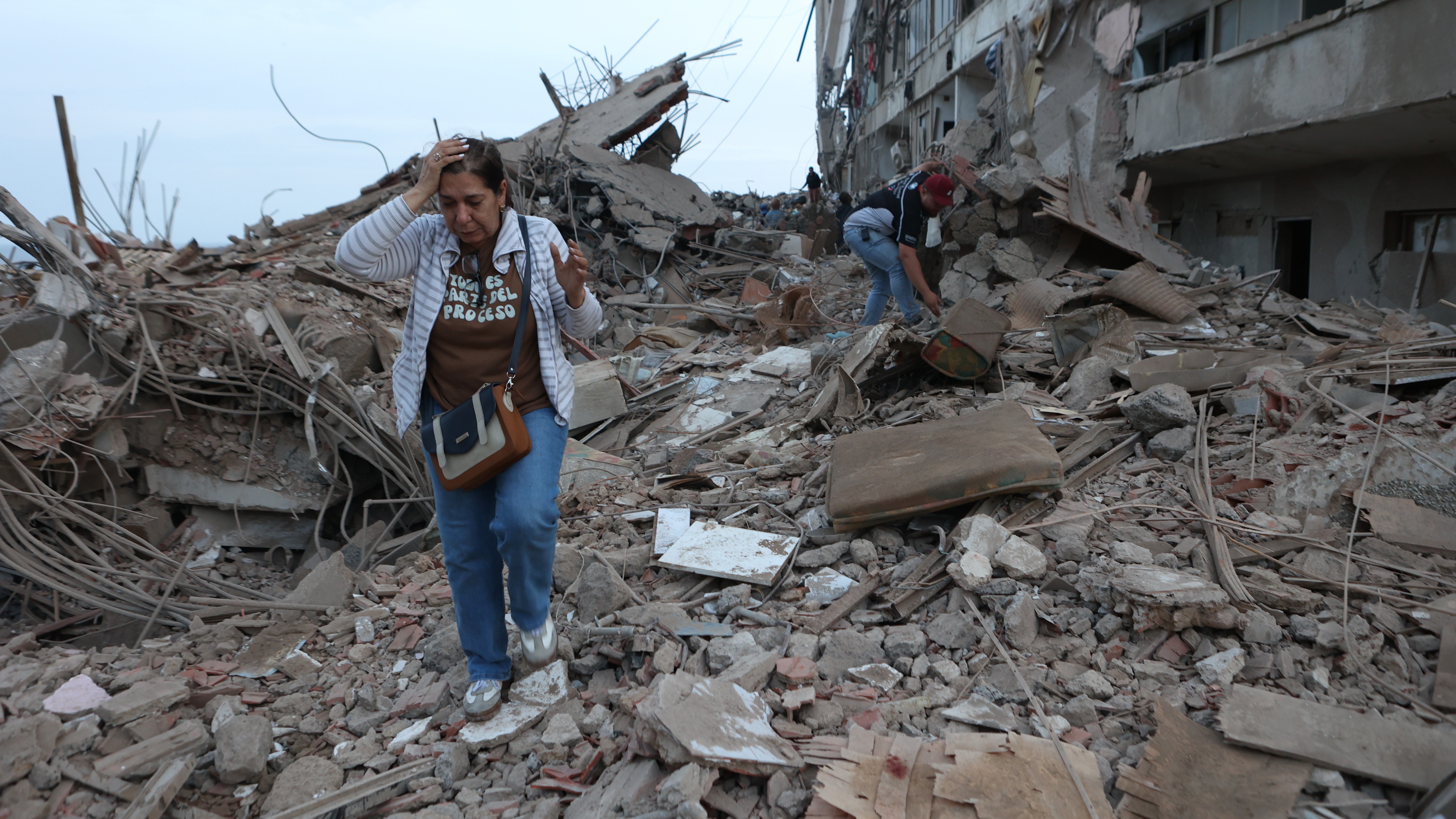
LAGUAIRA/CARACAS, June 27 (Reuters) – The death toll from Venezuela’s devastating twin earthquakes rose above 1,400 on Saturday as foreign rescue teams poured into the country and authorities pressed on with the search for survivors in the hardest-hit coastal areas.
The updated toll came as rescuers fanned out across La Guaira and parts of Caracas, where families and volunteers have spent days pulling survivors and bodies from the rubble, often complaining of scant heavy equipment and a limited official presence.

Officials said more than 1,600 foreign rescuers had arrived and that additional teams were on the way, adding to a growing international response to the twin quakes that struck on Wednesday and unleashed hundreds of aftershocks.
In Caraballeda, one of the worst-hit areas of La Guaira, U.S. helicopters ferried rescue teams into a dusty landing zone, according to Reuters witnesses, dropping off crews before taking off again.
Among the crowds of volunteers was Alejandro Serrano, a 33-year-old industrial engineer who had traveled from San Cristobal in western Venezuela searching for his 24-year-old sister, Ana Serrano, who lived in the Bahía Mar building in Caraballeda, which was destroyed in the quakes.

Serrano said he searched Thursday night at Caracas’ Perez Carreno Hospital, but did not find her. He said he had given his sister’s details and the address to rescue teams from Argentina and El Salvador.
“I hope they don’t find her” in the rubble, he said, meaning he hoped she was still alive. “But I need to find her.”
SLEEPING IN THE STREET
Residents said the response in some areas had been uneven, though heavy machinery was working in parts of Caraballeda and Los Corales by Saturday.
In the small Los Corales area known as Valle del Pino, Beisy Rivas, 60, said five or six homes in her neighborhood were still standing but had been damaged.
“Since the night of the earthquakes, almost all the neighbors have been sleeping in the street because of the aftershocks,” she said. “My nerves are on edge, thinking about the dead and about the people who lost relatives.”

Nearby, Yendri Santana said some homes in her 30-house development had cracks in the walls, though no one there had died. Sitting on a curb with Rivas after collecting food donations from a truck, Santana said her sister had lost her small home but survived.
“It hurts to see people struggle so much only to lose everything,” she said.
Authorities continued to restrict access to La Guaira and maintained controls on the main road from Caracas, saying traffic was slowing emergency vehicles. Civilians not attached to official rescue teams needed credentials to pass checkpoints.
Power throughout the region was gradually returning. Venezuela’s power grid, crippled by years of underinvestment and economic sanctions, regularly experiences problems, leading to daily, hours-long blackouts in some regions.

55,000 MISSING
Although the government has said hundreds are missing or trapped, more than 55,000 people are listed as unaccounted for on a website promoted by the country’s opposition.
The U.S. Geological Survey estimated more than 10,000 deaths were possible from the magnitude 7.2 and 7.5 quakes, which would place them among Latin America’s deadliest of the last century.
The disaster could have political consequences for interim President Delcy Rodriguez, who has portrayed herself as an agent of change even though she served as vice president to Nicolas Maduro, who was ousted and arrested by the U.S. in January.
Pope Leo, speaking in Rome on Saturday, offered prayers for the victims, their families and those involved in relief operations, and said he hoped global solidarity with Venezuela would endure.
The U.S. has sent aid to Venezuela in the aftermath of the quakes. A senior U.S. administration official said on Saturday that a funding package worth hundreds of millions of dollars is expected to be announced within the next day or so, in addition to $150 million that the Trump administration has already committed.
A White House official also told Reuters that a renewed push by Venezuelan opposition leader Maria Corina Machado, who left Venezuela late last year, for U.S. help to return home is frustrating senior officials in Washington, who said it was too soon after the disaster.
Reporting by Vivian Sequera in La Guaira, additional reporting by Mayela Armas and Deisy Buitrago in Caracas, Julia Symmes Cobb in Bogota, Eliana Raszewski in Buenos Aires and Karen J. Brettell in Washington, writing by Julia Symmes Cobb, editing by Alexander Smith, Alistair Bell, Chizu Nomiyama, Rod Nickel

Venezuela earthquake rescue teams listen for signs of life as death toll mounts
CNN teams are on the ground in Caracas and La Guaira. Rescues have provided moments of hope amid an agonizing wait for word on the missing.
Here’s the latest
• Death toll: At least 1,450 people have died since last week’s devastating earthquakes in Venezuela. CNN is on the ground in La Guaira and Caracas, where teams are digging through the rubble as part of frantic rescue efforts.
• Glimmers of hope: Search efforts have provided some moments of jubilation, including the rescue of an infant and a woman trapped for over three days. Officials are hoping a surge of foreign aid and responders will bolster emergency workers and help address humanitarian needs.
• Struggling institutions: The disaster has compounded issues from years of economic and political strife, particularly for the overwhelmed healthcare system.
Venezuela earthquake: father and son found alive in rubble after four days as death toll nears 1,500
President says ‘we always hold onto hope’ as discovery of earthquake survivors spurs fresh search efforts despite dwindling chances of survival
A man and his teenage son were found alive under the rubble in Venezuela on Sunday, in a town about 40km north of the capital Caracas, AFP journalists reported, as the death toll from last week’s twin earthquakes passed 1,450.
The discovery of survivors in Caraballeda was made by French and American rescue teams nearly four days after back-to-back quakes of magnitude 7.2 and 7.5 struck, completely destroying nearly 200 buildings in the area.
Interim president Delcy Rodríguez on Sunday praised rescuers for still pulling survivors from the ruins. “Today we have rescued people who are still alive, and therefore these efforts will not be suspended,” she said. “We always hold on to hope.”
The rescue offered a glimmer of hope in an ongoing tragedy that has shaken a country already mired in an economic crisis, but tens of thousands of people were still reported missing and the critical 72-hour window for rescuing trapped victims following a natural disaster has now passed.
Millions more people were reported to lack sanitation and other basic needs after one of Latin America’s most devastating earthquake disasters.
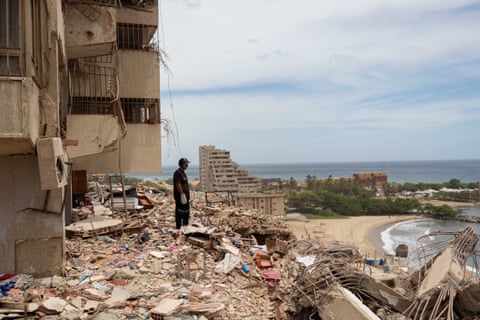
Rescue teams from the US, Mexico and elsewhere scrambled to save people as desperate residents dug by hand for relatives trapped in the pancaked layers and rubble of collapsed apartments.
About 774 buildings were badly damaged by the twin quakes that struck on Wednesday evening, National Assembly president Jorge Rodriguez said on Sunday. On Sunday, Rodriguez reported 1,450 dead – a toll expected to rise – with 3,150 people injured.
Even as rescue efforts continued apace, outbreaks of looting hit La Guaira, a port city near the country’s main international airport. Much of the city now lies in rubble after Wednesday’s disaster. Pharmacies, supermarkets and other businesses were ransacked, said residents, some of whom complained of the slow and meagre post-quake aid coming from authorities.
US helicopters ferried in aid, and 230 more US military personnel were arriving to help expand airport capacity and reopen a key seaport to boost relief efforts, the US Southern Command said on Sunday.
The US – which seized Venezuela’s former president Nicolás Maduro in a military raid on Caracas in January – had already sent a 250-strong disaster response team.
But the prospect for rescuing more survivors has dwindled.
A Salvadoran rescue worker who declined to give his name, said: “At this point, they are probably dead bodies. Thanks to God maybe we can find people still alive.”
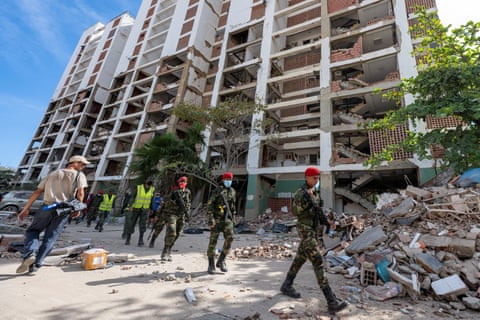
Exasperation has boiled over in some locales where residents claim that authorities have not done enough to rescue earthquake victims. “The country needs you. Put down your weapon,” one man shouted to soldiers in the Tanaguarena area of hard-hit La Guaira state, urging them to pick up picks and shovels instead.
Facing public outrage at the response by local officials, President Rodriguez thanked other countries for the outpouring of aid.
Twenty-four nations have sent 521 tons of supplies, 86 units with dogs trained to locate people trapped beneath the rubble and more than 2,700 search-and-rescue personnel, she said.
The UN migration agency said that up to 6.76 million people could be affected by the disasters, and would require shelter, water, sanitation, healthcare and essential relief items.
Venezuela’s worst earthquakes in more than a century have come after the oil-rich country endured more than a decade of economic collapse. The crisis has hollowed out hospitals and public services, driving millions to leave the country.
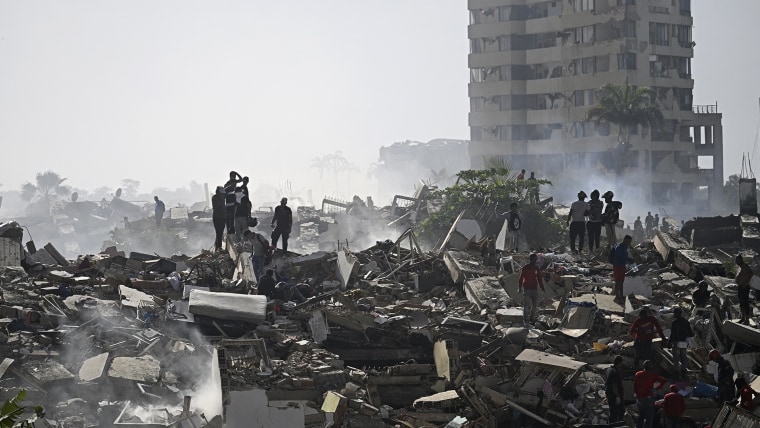
The UN has put the bill for physical repairs at $6.7bn – equivalent to six% of Venezuela’s GDP.
On Sunday Venezuelan opposition figure Maria Corina Machado, who is in exile, announced she would return “very soon” to her homeland.
“The time has come,” she told US broadcaster Fox News. “We need to be together, to embrace, to grieve and mourn together, but also to give each other strength at this difficult time.”



:max_bytes(150000):strip_icc():focal(749x0:751x2):format(webp)/Katie-Bates-Pregnancy-Loss-011726-d6421e92f38a431b92ff1cd350c5226c.jpg?fit=750,500&ssl=1 "Bringing Up Bates’ Katie Bates Announces Pregnancy Loss: ‘I Will Spend the Rest of My Life Missing You’")



:max_bytes(150000):strip_icc():focal(753x271:755x273):format(webp)/cole-the-deaf-dog-112125-1a-ad248101bd174108a795d88d6afd93d8.jpg?fit=750,500&ssl=1 "Elementary School Throws Deaf Therapy Dog a Surprise Birthday Party as Students Learn Sign Language to Sing ‘Happy Birthday’")


:max_bytes(150000):strip_icc()/ap_4346621549-2000-a4f5b5004ec84decb7c1ed85a0050271.jpg?fit=1500,1000&ssl=1 "Kathy Bates: A Brave Warrior Fighting Against Cancer")