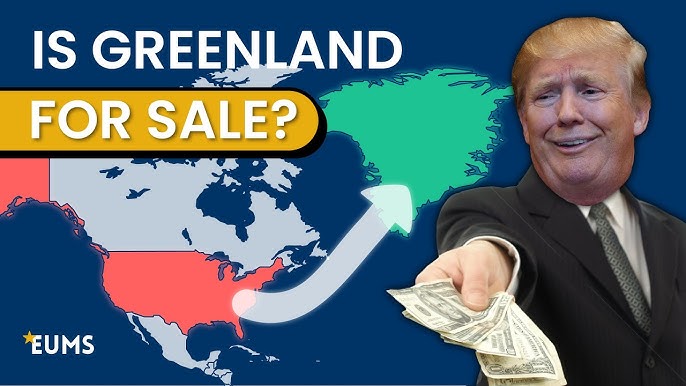
In the late summer of 2019, a tweet from the 45th President of the United States sent shockwaves from Washington to Copenhagen. Donald Trump’s public interest in purchasing Greenland—the world’s largest island—was initially greeted with a mixture of laughter, derision, and diplomatic outrage. The Danish Prime Minister, Mette Frederiksen, dismissed the idea as “absurd.” Yet, for students of American history and geopolitical strategy, the proposal was anything but a joke. It was the latest chapter in a century-long American obsession with a frozen frontier.
From Harry Truman’s $100 million offer in 1946 to the modern-day “Ice Curtain” tensions with Russia and China, the desire to acquire Greenland is a calculated move driven by three pillars of American power: military dominance, resource security, and the unavoidable reality of a melting planet.

I. The “Unsinkable Aircraft Carrier”
To understand why the White House keeps looking North, one must look at a polar map rather than a standard Mercator projection. From the top of the world, Greenland is the ultimate high ground.
During World War II, after Nazi Germany occupied Denmark, the United States stepped in to protect Greenland, recognizing that whoever controlled the island controlled the North Atlantic shipping lanes. This strategic necessity solidified during the Cold War. In 1951, the U.S. and Denmark signed a defense treaty that led to the construction of Thule Air Base (now Pituffik Space Base).
Located 750 miles north of the Arctic Circle, Thule became the cornerstone of the Ballistic Missile Early Warning System (BMEWS). In an era where a Soviet nuclear strike would likely travel over the North Pole, Thule provided the precious minutes of warning needed for a retaliatory strike.
Today, the military calculus has evolved but remained just as urgent. As Russia revitalizes its Northern Fleet and builds new bases along its Arctic coastline, Greenland serves as a gateway to the GIUK gap (Greenland, Iceland, and the United Kingdom). This maritime chokepoint is the only way for Russian submarines to enter the Atlantic undetected. For the Pentagon, owning Greenland wouldn’t just be about a base; it would be about turning the entire island into a permanent, “unsinkable aircraft carrier” for the 21st century.

II. The Rare Earth Treasure Trove
Beyond its strategic location, Greenland is a geological goldmine that remains largely untapped due to its massive ice sheet. However, as the ice recedes, it is revealing a prize that is central to the future of the global economy: Rare Earth Elements (REEs).
In the modern world, REEs are the “new oil.” They are essential components in everything from F-35 fighter jets and Tomahawk missiles to smartphones and electric vehicle batteries. Currently, China controls over 80% of the world’s REE processing capacity, a monopoly that gives Beijing immense leverage in any trade war.
Greenland is home to the Kvanefjeld and Tanbreez deposits, which are among the largest undeveloped rare earth sites on Earth. For the United States, acquiring or securing exclusive rights to Greenlandic minerals is a matter of national security. It is the only way to “de-risk” the American supply chain from Chinese interference. To Washington, the price tag of a few billion dollars for the island seems like a bargain compared to the cost of losing the technological arms race.

III. The “Near-Arctic State” Problem
The third driver of American interest is the sudden arrival of China in the Far North. In 2018, Beijing declared itself a “Near-Arctic State,” a term that raised eyebrows in Washington. China has since invested heavily in Arctic infrastructure, proposing to build airports in Greenland and partnering with Russia on the “Polar Silk Road.”
The U.S. views these moves through a Monroe Doctrine lens. The idea of a Chinese-funded deep-water port or a dual-use scientific station in Greenland is a nightmare scenario for American defense planners. By expressing an interest in “buying” the island, American presidents are signaling to both Copenhagen and Beijing that the U.S. considers Greenland to be within its exclusive sphere of influence.
IV. The Climate Irony: Profit from Peril
There is a profound and tragic irony at the heart of the Greenland debate. The very phenomenon that threatens the island’s traditional way of life—global warming—is what makes it so attractive to the U.S. government.
The melting of the Greenland Ice Sheet is opening up new navigable waters. The Northwest Passage and the Northern Sea Route could eventually rival the Suez Canal for global trade, cutting shipping times between Asia and Europe by weeks. Controlling Greenland means controlling the ports, the rescue stations, and the tolls of the future’s most important maritime highways.
Furthermore, as the world warms, Greenland’s vast freshwater reserves and its potential for “green” hydropower become increasingly valuable. In a future defined by resource scarcity, a massive, sparsely populated territory with unlimited water and minerals is the ultimate hedge.

V. The Human Factor: A People, Not a Property
While Washington strategists move pins across a map, the 56,000 residents of Greenland—mostly indigenous Inuit—have their own vision for the future. For them, the talk of “buying” their land is a relic of colonial thinking.
Greenland has been moving steadily toward independence from Denmark since 1979. The 2009 Self-Rule Act gave Greenlanders the right to self-determination. If Greenland ever leaves the Danish Kingdom, it will do so as a sovereign nation, not as a real estate asset to be traded between empires.
However, the economic reality is harsh. Greenland currently relies on a massive annual subsidy from Denmark (the bloktilskud) to fund its social services. To achieve true independence, Nuuk needs an economic engine. This is where the American “interest” becomes a complex temptation. While they don’t want to be “sold,” many Greenlandic politicians welcome American investment as a way to diversify their economy away from fishing and Danish aid.
VI. Conclusion: The New Great Game
The pursuit of Greenland is not a historical quirk of the Trump or Truman eras. It is a reflection of a permanent American geopolitical truth: the Arctic is the next great frontier of global power.
Whether through a literal purchase (which remains highly unlikely in the modern legal framework) or through a massive “soft power” surge of investment and military cooperation, the United States will continue to tighten its grip on Greenland. As the ice continues to melt and the “Great Game” for the North heats up, the world’s largest island will remain at the very center of the map of American ambition.
Washington isn’t just looking for more land; it is looking for the keys to the 21st century. And those keys are currently buried under the ice of Greenland.
Expanded Analysis: The Legal and Moral Obstacles
While the article focuses on the why, it is essential to understand the why not. Modern international law, governed by the UN Charter, emphasizes the right to self-determination. The era of the “Louisiana Purchase” or the “Alaska Purchase” ended with the 19th century. Today, a territory cannot be transferred without the explicit consent of its population.
Furthermore, Denmark’s refusal is tied to its own identity as an Arctic power. Without Greenland, Denmark’s influence in global affairs would shrink significantly. For the Danes, Greenland is not a burden to be sold, but a vital link to the future of the Atlantic alliance.







:max_bytes(150000):strip_icc():focal(753x271:755x273):format(webp)/cole-the-deaf-dog-112125-1a-ad248101bd174108a795d88d6afd93d8.jpg?fit=750,500&ssl=1 "Elementary School Throws Deaf Therapy Dog a Surprise Birthday Party as Students Learn Sign Language to Sing ‘Happy Birthday’")